
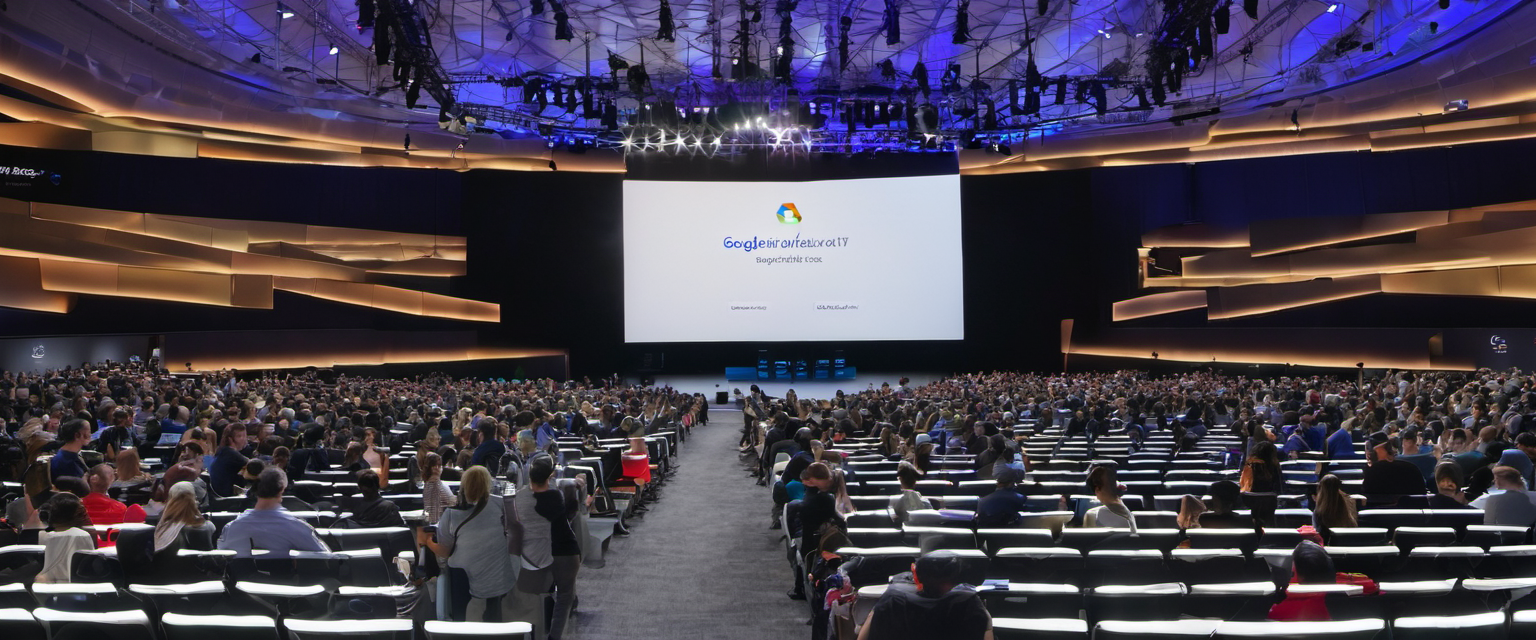
On Friday April 24, Sundar Pichai walked onto the Cloud Next 2026 keynote stage in Las Vegas and said the most casually destabilizing sentence a CEO has said in this cycle so far:
“Today, more than 75% of new code at Google is now AI-generated and approved by engineers.”
That number was 25% in October 2024. It was 50% in the fall of 2025. It is 75% now. The doubling time on AI authorship of Google’s own production code is approximately six months.
Three hours after that keynote, Bloomberg’s editorial board published “The AI Job Apocalypse Is Being Delayed”. The two pieces are not in conflict. They are arguing at different time scales. Pichai is reporting what is happening inside one company’s commit log right now. Bloomberg is reporting when that shows up in the BLS unemployment series. Both will turn out to be right at the same time.
What 75% actually measures
Google’s number is code lines, not features. The denominator is “new lines of code committed to a Google repo this period.” The numerator is “lines that originated from an AI suggestion that an engineer accepted.”
Three things are worth pulling out of that definition:
- The engineer is still in the loop. Pichai’s explicit phrase is “approved by engineers.” Google is not running unsupervised commits to prod. The role of the engineer has shifted from “author” to “reviewer plus integrator,” but a human is still on the diff. This is the same architecture as the legal-review and accounting-review and customer-service-review setups that have been quietly emptying out the lower rungs of those professions for two years.
- Acceptance rate is doing all the work. A 75% number is not a measurement of model capability in isolation; it is a measurement of how often Google engineers click “accept” on what their AI assistant proposes. That metric is driven by both the model getting better and the engineer’s bar getting lower. We will not know which dominated until acceptance rate decouples from quality, and that signal lives in Google’s revert and rollback rates, which Google does not publish.
- It says nothing about headcount, yet. Alphabet’s Q1 2026 earnings call is Tuesday April 29. The interesting line in the 10-Q won’t be revenue. It will be the YoY change in Google engineering headcount against the YoY change in new code shipped. If headcount is flat or down and shipped code is up, the productivity story is real and the 75% figure is doing the work in the labor numbers too.
Antigravity and “agentic workflows”
The other phrase Pichai used at Cloud Next is the one engineering managers should sit with: “agentic workflows.”
Pichai described a complex internal code migration completed by “both agents and engineers” that ran six times faster than the same migration would have taken a year earlier with engineers alone. He also name-checked Antigravity, Google’s internal agentic-development platform, and said the macOS Gemini app team used it to go from idea to working native prototype “in a few days.”
Six-times-faster on migrations is the number that scales linearly into capacity decisions. If a project that used to absorb a six-engineer squad for a quarter now absorbs one engineer plus an agent fleet for two weeks, the staffing question is no longer “how big is the squad” — it is “do we need the squad.” That conversation is happening in every engineering org with a CFO right now, and the Pichai keynote just gave every CFO in attendance the public number to cite.
The Cursor benchmark, in dollar terms
The same week, SpaceX struck a deal giving it the right to buy AI coding tool Cursor later this year for $60 billion, or pay $10 billion for the work in the meantime. Cursor — built by Anysphere, ~150 employees, founded 2022 — was about to close a $2 billion round at a $50 billion valuation when SpaceX preempted with a buyout option. The startup has reportedly crossed $1 billion in annualized revenue and counts Nvidia, Adobe, Uber, and Shopify among its enterprise customers.
That is the public, market-cleared price of the tool that augments — and at the margin, replaces — a software engineer. Sixty billion dollars is approximately the entire market capitalization of Marriott International. The going price for software-development capacity is no longer denominated in salaries; it is being denominated in M&A.
Where this leaves the engineer
The Bloomberg piece is structurally correct that mass tech layoffs of the 100K-engineers-in-a-year variety have not yet materialized. Tom’s Hardware reported 78,557 tech layoffs through April 2026, with 47.9% AI-attributed — material, but not catastrophic against a US labor market north of 161 million jobs.
What the Pichai number tells you is that the ratio underneath that layoff figure is moving fast. If 75% of Google’s code is being written by an agent and merged by a human, the question for every other large engineering org is no longer whether they get to that ratio, but whether they can do it without firing the median engineer to make the unit economics work. AWS CEO Matt Garman argued in December that not hiring junior engineers is “one of the dumbest ideas.” That argument is now a minority position inside its own industry.
What LostJobs is watching
- Alphabet Q1 2026 earnings (Tuesday). Specifically: Google segment headcount, with attention on the Cloud and Search engineering lines. Pichai already gave the operating-leverage number in a keynote; the 10-Q will say whether the leverage is being banked.
- Whether OpenAI, Microsoft, or Meta publish a comparable acceptance-rate figure in Q2. Microsoft has the data via GitHub Copilot. Meta has it via its internal CodeCompose stack. Once any of the three matches Google’s 75%, the number stops being a Google curiosity and becomes the industry baseline.
- The first earnings call where a non-tech Fortune 500 CEO cites AI code generation as a margin lever. Banks, insurers, retailers, and telcos all run engineering orgs of 5,000–30,000 people doing the same kind of internal-tools work Google’s number describes. Verizon’s Dan Schulman is already there in spirit. The first one to put a productivity number on a slide makes the next twenty inevitable.
The dry coda: the most quoted line from the Cloud Next keynote on engineering Twitter over the weekend was not Pichai’s 75%. It was an attendee’s reply: “My job for the last six months has been pressing the green button. Apparently it counts as engineering.” Both halves of that sentence will be true in the Q1 earnings transcript.