
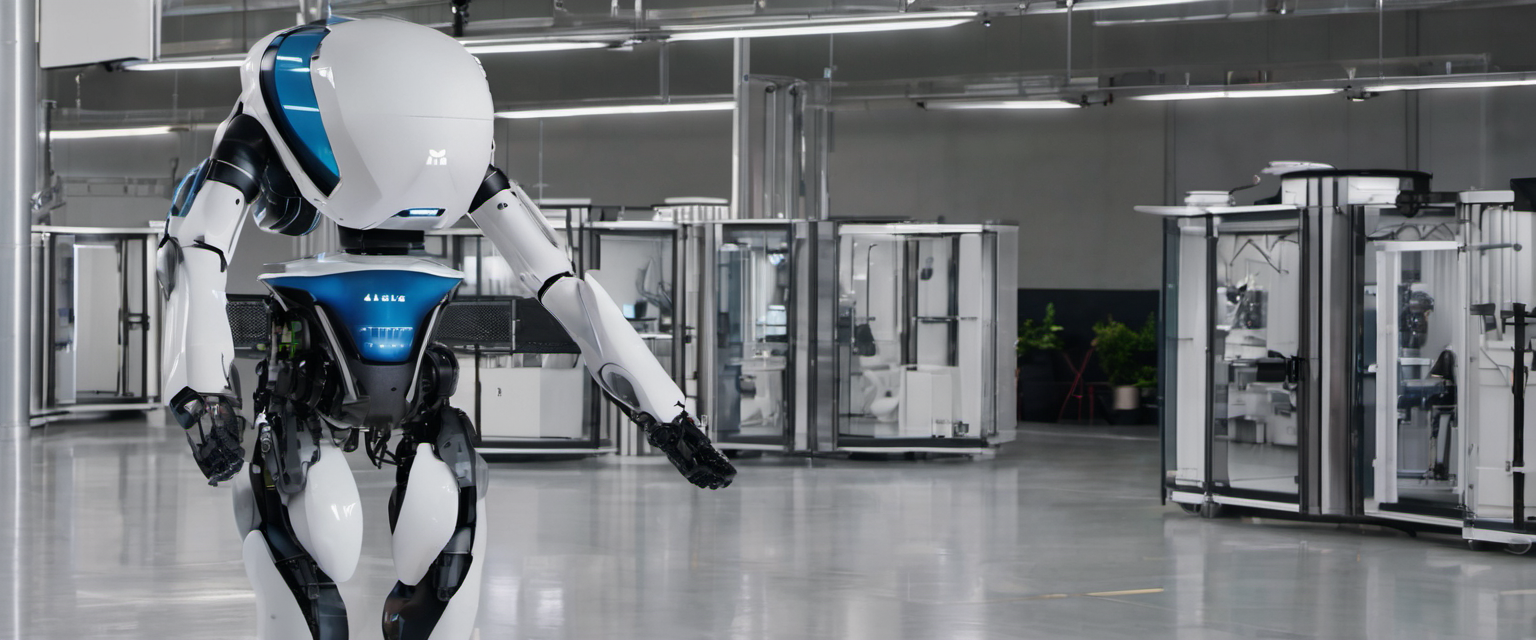
There are two ways a humanoid-robot announcement can move the field. The first is a unit count — the version Hyundai used on May 19 when it told JPMorgan investors it will deploy 25,000+ Atlas units across its plants by 2028. The second is a methodology disclosure — the version Boston Dynamics quietly used the day before, on May 18, with a technical blog called “Training a Humanoid Robot for Hard Work” authored by Alberto Rodriguez (BD’s Director of Robot Behavior for Atlas), Shane Rozen-Levy, and Vinay Kamidi.
The Hyundai number says how many. The BD blog says how. The combination, packaged into the May 22 Tech Times follow-on, is what makes the 25,000-unit number readable as a deployment plan rather than a press-release target.
What the May 18 blog actually disclosed
The behavior the blog explains is Atlas walking up to an unfamiliar mini-fridge, gripping it, lifting it, walking with it, and putting it down — without prior knowledge of the fridge’s mass, center of gravity, surface friction, or contact configuration. The published demo lifts a 50-pound fridge. The unpublished internal testing pushed the same policy past 110 pounds, a load outside the training distribution the policy ever saw in simulation. The robot adapted without additional training.
Roboticists call this zero-shot sim-to-real transfer: a behavior developed entirely in simulation deploying directly to physical hardware, generalising past the training envelope. It is the version of generalisation that classical industrial robotics does not have. A six-axis arm spot-welding a Civic frame can spot-weld that exact frame to specification all day; ask it to weld a slightly different frame and the line stops. The Atlas demo is the opposite shape: train inside a narrow distribution, deploy across a wide one.
The mechanism the blog credits is proprioception — an internal body-awareness system that reads weight distribution, grip resistance, and balance across all joints at once. The interesting word is implicit. The robot does not visually identify the fridge, look up its mass, plan a lift, and execute the plan. It picks up the object and reads what is happening to its own body, then adjusts force and torque at every joint to keep itself stable. In Rodriguez’s framing, “the hardest part is not seeing the fridge or knowing how to lift it, but learning to adapt to whatever version of the fridge that Atlas will encounter in the real world.”
The training pipeline is GPU-parallel reinforcement-learning simulation: millions of simulated hours practising the lift with randomised masses, friction values, grip qualities, and object positions. The entire behavior, according to the blog, was developed within weeks of Atlas’s January 2026 production debut.
Why “weeks” is the actual headline number
Industrial-robotics line readiness, classically, takes 18 to 36 months. The line is engineered around a fixed task envelope, the robot is specified, the FMEA is written, OSHA-permitted, change-controlled, and qualified. The unit cost on a six-axis arm at scale is in the low tens of thousands; the integration cost is in the millions, and that integration cost is what bounds how fast you can deploy.
The May 18 blog is BD putting on record that for one new behavior — pick up and carry an unknown fridge — its development cost from production-debut to demonstrated-on-hardware was on the order of weeks. Not 18 months. Not 6 months. Weeks. Most of that time was simulation compute, which is a line item Boston Dynamics writes once and amortises across every behavior in the catalogue.
This is the part that makes a 25,000-unit number defensible at an investor session. If the integration cost to add a new task is a weeks-scale simulation training run, the deployment economics of a humanoid robot are not the deployment economics of an industrial arm. They are closer to the economics of software: build once, deploy at marginal cost.
The robot the blog is describing
The production-spec Atlas, per Boston Dynamics’ own technical disclosures, has 56 degrees of freedom, 2.3-metre reach, certified 50 kg (110 lb) lift, and fully rotational joints at the hips, waist, and neck (the joints can swing 360°, letting the robot reposition loads in a tight factory aisle without turning its torso). It autonomously swaps its own battery in under three minutes — the detail that makes a 24-hour shift schedule plausible without human handlers on a battery-swap rotation. Hyundai Mobis manufactures the actuators at automotive scale; actuator cost is roughly 60% of each robot’s material cost, which is why the 300,000-actuator-per-year U.S. facility is the load-bearing supply-chain claim in the May 19 investor deck.
The robot in the May 18 blog is the same robot. The methodology in the blog is the bridge between the May 6 handstand demo (here is a humanoid that can do gymnastics in a studio) and the May 19 investor commitment (here is the deployment plan that says 25,000 units inside Hyundai and Kia plants by 2028).
The May 22 footnote: nobody regulates this yet
The detail the Tech Times piece foregrounded is the one the BD blog did not say out loud. OSHA has no regulation specific to humanoid robots operating alongside human workers. Not “loose regulation.” Not “inadequate regulation.” No regulation. The U.S. occupational safety apparatus that decided exactly how a robotic welding cell must be guarded — fences, light curtains, e-stop architecture, certified safety PLCs — has not written rules for what a 2.3-metre, 56-DOF, 110-lb-lifting humanoid is allowed to do within reach of a person.
The international body is working on it. ISO 25785-1, a new safety standard specifically for “dynamically stable walking robots,” is under development. The U.S. delegation is led by Federico Vicentini of Boston Dynamics, Kevin Reese of Agility Robotics, and Carole Franklin of the Association for Advancing Automation. Publication is expected in 2026 or 2027 at the earliest.
Read the dates on top of each other. The 25,000-unit Hyundai order is for 2028. ISO 25785-1 is expected to publish in 2026 or 2027, after which it has to be adopted into national standards (in the U.S., that means a multi-year process before it becomes regulation rather than guidance). The deployment will arrive inside a regulatory window that does not yet have a written rule for the specific machine being deployed.
This is not unusual — it is the standard pattern for any new category of factory tool. It is also the pattern that gives any given OEM 18 to 24 months of unilateral discretion on how to deploy a class of machine before the standards-body answer is locked in. Hyundai’s Robotics Metaplant Application Center (RMAC), described by BD CEO Robert Playter as “a data factory,” is exactly the kind of program a manufacturer runs inside that window: get to scale, generate the operating data, get the data into the standards conversation while it is still in committee.
The union’s arithmetic
The Korean Metal Workers’ Union has already done the math the regulator has not. In its January 22, 2026 public statement, the Hyundai Motor branch of the union pegged Atlas’s unit cost at roughly 200 million Korean won (~$145,000) based on internal calculations. Run that unit round-the-clock at automotive-shift utilisation, amortise the capital over a two-year cycle, and the union’s claim is that one Atlas replaces the work of three human workers at a total two-year cost lower than the wages of one of those workers. The union’s parenthetical was direct: “Not a single robot can enter the workplace without labour-management agreement.”
BD CEO Playter has — separately, on 60 Minutes — said the quiet part: “the really repetitive, really back-breaking labour is going to end up being done by robots.” Hyundai Vice Chair Jaehoon Chang has — also separately — said the polite part: humans will shift to higher-value roles, training, supervising, maintaining the robots. Both can be true at once. The chronic-shortage frame and the displaced-worker frame are not mutually exclusive; the shortage gets filled by the robot and the existing worker is also displaced because the role gets eliminated rather than retrained into a new one.
The union’s leverage point is the 2026 summer contract negotiations. That is the next moment where the labor-management agreement gets renegotiated, and it is the moment the union has identified as the expected escalation. The May 19 investor commitment did not put a number on the labor cost. The May 22 follow-on did not put a number on the regulatory cost. The 2026 summer contract talks are where both numbers stop being optional.
What to watch
- The Q3 + Q4 2026 BD blog cadence. The May 18 piece is the first in what is almost certainly a series — proprioception is one capability, but the same training pipeline applies to dexterous manipulation, tool use, multi-object handling. Each new published methodology is another behavior crossed off the “blocks investor commitment” list. Count the blog posts; multiply by ~12 weeks development time.
- ISO 25785-1 committee draft circulation. The standard is in committee. Whether the draft circulates in late 2026 (early case) or slips to 2027 (the more likely case) shapes whether Hyundai’s 2028 deployment arrives into a standard-bound regulatory environment or a discretionary one.
- The Korean Metal Workers’ Union summer 2026 contract round. Hyundai’s deployment plan needs a labor agreement signed before 2028, ideally well before. The summer 2026 negotiations are where the union’s “not a single robot” line gets tested against Hyundai’s “25,000 robots by 2028” line. Either the line bends or the deployment slips.
- The first non-Hyundai Atlas order. Boston Dynamics has said external orders will open from 2027. The first announced enterprise customer outside Hyundai and Google DeepMind is the moment the deployment number stops being a single-OEM commitment and starts being a market.