
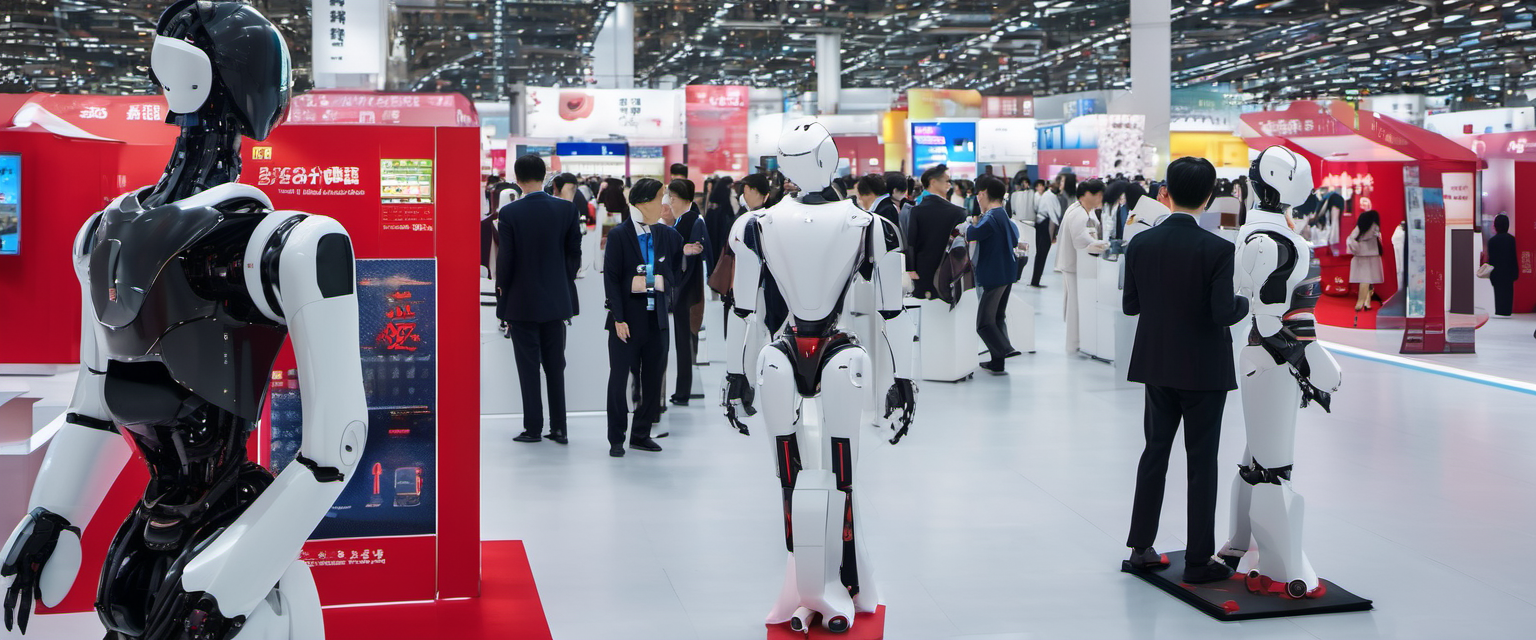
Last Wednesday morning, April 15, the 139th Canton Fair — the biggest export trade show on Earth — opened its Spring edition in Guangzhou. This year’s theme, unofficially, was humanoid robot clearance sale.
Queues for the service-robot hall, per state outlet People’s Daily, hit 90 meters long. Visitor capacity had to be capped. Ti5 Robot’s showcase unit waved at buyers more than 7,000 times in one day. Phybot’s 135-cm bipedal humanoid played autonomous badminton against human opponents in a roped-off ring. Dobot’s ice-cream-making arm produced something like 400 cones an hour. In between the demos was the number everyone actually came to see: the sticker price.
The chart everyone is staring at
Per Yicai Global’s on-the-floor reporting, here is the year-over-year price shift for a Chinese-made humanoid at Canton Fair:
- Spring 2025: roughly 700,000 to 800,000 yuan (~$96,000–$110,000) per unit
- Spring 2026: roughly 500,000 yuan (~$73,340) per unit
- Entry-level bipeds, spring 2026: as low as 200,000–300,000 yuan (~$27,500–$41,000)
That is roughly a 35% drop on the mid-range, and a 60–70% drop on the low end, in twelve calendar months. Most of the low-end units on display are not research-grade — they are, per the spec sheets, meant for logistics, light manufacturing, reception, and guided-tour roles. In other words: jobs that currently employ people.
Ti5 Robot’s founder Duan Chenghong (quoted by Yicai) said the quiet part plainly from the trade-show floor: “The technology for humanoid robots still needs further improvement, and costs must decrease before there is an opportunity for true large-scale implementation.” His own booth is part of how that happens. The humanoid joints Ti5 sells to other manufacturers have themselves been halving in price year over year. When the supplier of the actuators knocks their BOM in half, every humanoid on the downstream line drops with it. That is the curve that showed up at Canton Fair this week.
The cast list
A non-exhaustive snapshot of who was on the floor and what they were showing:
Phybot. A Chinese startup that started mass production of its 135-cm bipedal humanoid in February 2026. The floor demo was autonomous badminton — visual tracking, serve-and-return, no tether — plus “table tidying, tea serving, tour guiding” use cases listed in the spec sheet. Phybot told reporters they have already received inquiries from Europe, the United States, Japan, South Korea, Southeast Asia, and South America. If there was one booth generating actual unit-economics conversations with foreign buyers, it was this one.
Ti5 Robot. The actuator and body supplier mentioned above. Ti5 is not quite a consumer humanoid brand — it sells the joints, torso, and integration kits that other Chinese humanoid brands buy to build their own units. This is why Ti5’s presence at Canton Fair matters more than the crowd size suggests: when the people selling the limbs come to the trade show with prices, you can tell where next spring’s robots will end up.
ChangingTek Robotics (Suzhou). Launched what it is calling the world’s first left-right dexterous humanoid hand, priced at approximately 20,000 yuan — around $2,935 — per unit. That is “buy it on a PO without calling finance” pricing for any automation integrator. Hands have been the gating variable on humanoid economics for a decade. This is the hand becoming cheap.
Dobot Robotics. An ice-cream-making arm that has already shipped to several countries, used here less as a headline act and more as a reminder: the boring robots — single-task manipulators in hospitality — have been profitable for a while, which is part of why the humanoid attempt is getting priced competitively now.
Plus, per TechRepublic’s floor coverage, Ti5’s T170D (six-mic voice array), the T230 line (88-lb payload), ChangingTek’s X2 five-fingered hand, and a running-away-from-listing number of smaller Chinese regional manufacturers showing their own bipeds.
The export number in the background
The data point that reframes all of the above: per Chinese customs, China exported 3,140 intelligent bionic robots in just the first two months of 2026, generating US$16.5 million in export value. Averaging out, that is roughly $5,250 per robot on the export invoice — which, notably, is below the cheapest Canton Fair sticker, because the export data blends humanoids with cheaper bionic arms and service-robot frames.
But the directional message is what matters: Chinese humanoid and bionic-robot units are already being shipped out of the country in the thousands per two-month window, at prices that would not have been plausible twelve months ago. The Canton Fair is the trade-show view of that flow — the port data is the real-time confirmation. One is the brochure; the other is the bill of lading.
What this actually means for labor
Two things can be true at once:
One: the Canton Fair humanoids are, on a live factory floor, not yet as capable as AgiBot’s G2 running an 8-hour Longcheer tablet line last Friday or the Siemens-Nvidia HMND 01 logistics pilot in Erlangen. Canton Fair’s floor models are, mostly, demo-grade. They won’t pass QA on a precision electronics line next month.
Two: the category that Canton Fair does sell — logistics handlers, reception robots, guided-tour units, light-industrial bipeds, and one very confident badminton player — is priced at 200,000 to 500,000 yuan. That is, per unit, in the same zone as a single factory worker’s fully-loaded annual comp in China, on a one-to-one basis for the mid-range, and substantially under that for the entry models. Amortized over three years of three-shift-a-day operation, the math closes in the robot’s favor long before any American-factory payback calculation does.
The people the Canton Fair humanoid displaces are not, today, precision tablet QA line operators in Nanchang. They are the security guard at the lobby desk, the server bringing tea in a small restaurant, the warehouse associate pushing cages from receiving to storage, the guide at the museum, the front-office greeter at the dentist’s office. These are 30 million–plus jobs in China alone, by the National Bureau of Statistics’ own rollups. They are the jobs whose comp has just crossed the one-year-payback line on a Canton Fair biped.
What to watch next
- Unit shipments in Q2 2026. The 3,140-in-two-months number will be reported through Chinese customs again in early July. If that climbs past 10,000 for April–June, Canton Fair pricing was not a trade-show gimmick — it was the real curve.
- Western industrial orders. Phybot’s “inquiries from Europe and the United States” comment is a soft data point. The hard version is whether any U.S. or EU logistics integrator announces a Canton-Fair-sourced pilot before year-end.
- Ti5’s BOM disclosure. If Ti5 publicly knocks its actuator price in half again at the Autumn Canton Fair in October, every humanoid on the floor drops another 25% with it. That is a price curve that breaks a lot of corporate headcount spreadsheets.
Last year, a Canton Fair humanoid cost roughly what a nice EV sedan costs. This year, the low end costs roughly what a nice road bike and a used sedan cost combined. The headline isn’t that humanoid robots got cheaper; the headline is that “humanoid robot” is now the kind of line item a mid-sized Chinese municipality is expected to buy at trade-show volume, the same way it used to buy ride-share scooters.