
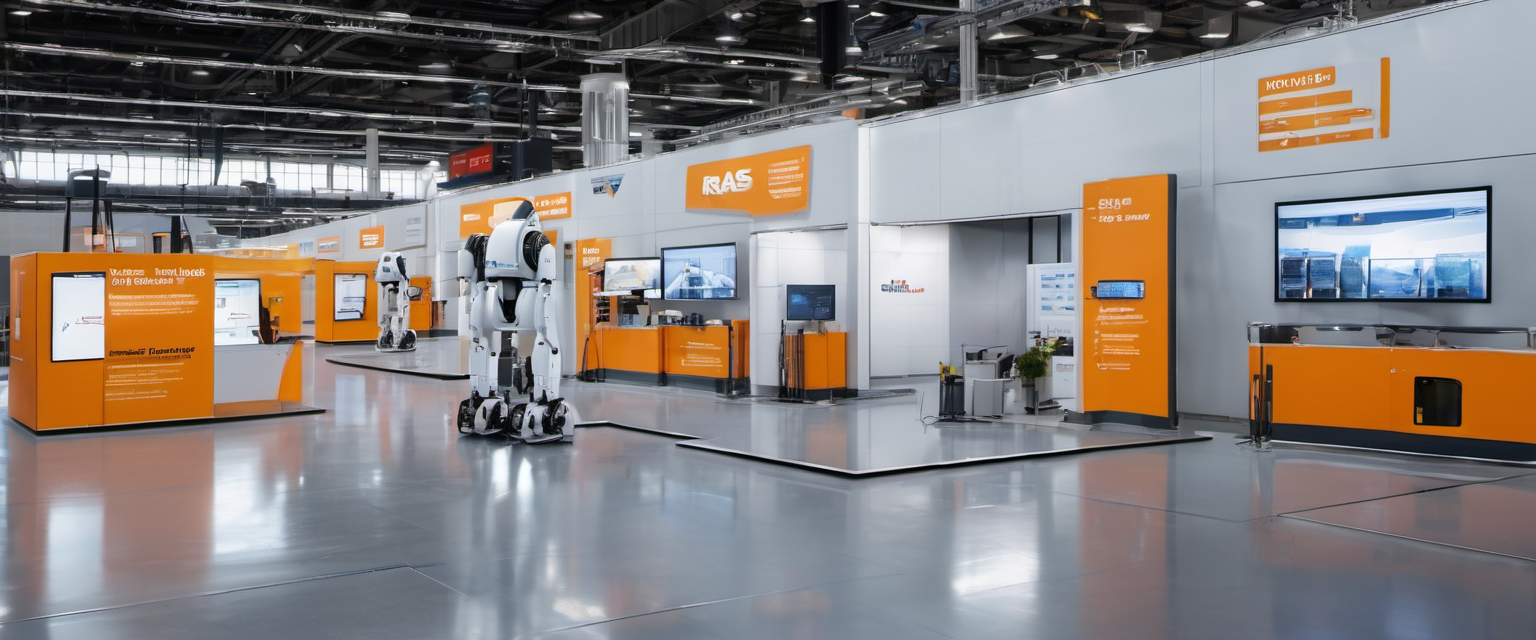
DEEP Robotics opened Hannover Messe 2026 on April 20–24 with a booth that did not pretend to be a research demo. Three quadruped robot dogs — LYNX M20, X30, and Lite3 — all carrying EU-CE certification, all configured for sale, all with reference customers in Switzerland and Germany already running them in production. The trade-show recap was published on April 24 by GlobeNewswire and picked up by The Manila Times.
The headline number from DEEP Robotics is the one to anchor on: #1 global market share in industrial quadrupeds in 2025, deployments across 50+ countries and what the company describes as 1,200 industrial scenarios. That is not a roadmap. That is an installed base.
What the dogs are actually doing
The interesting part of the briefing is not the morphology — quadrupeds have been ready for prime time for two years. The interesting part is the task list. DEEP Robotics’ robot dogs are running, in live European plants, the following:
- Gas leak sweeps in chemical and energy facilities, walking pre-mapped routes with onboard methane / hydrogen sensors.
- Overload checks on industrial transformers and switchgear in substations.
- Partial discharge scans on high-voltage gear — picking up the picocoulomb-scale signals that tell you a dielectric is starting to fail before it actually does.
- Stair, ramp, and tunnel traversal in confined infrastructure (cable tunnels, pipe galleries, stairwells) where neither a wheeled mobile robot nor a drone is the right tool.
Every one of those tasks used to be a human walking with a handheld instrument on a clipboard schedule, often at off-hours, often in PPE. They are not glamour jobs. They are also not optional jobs — most are mandated by national grid or chemical-plant safety codes, with a fixed inspection cadence. That is exactly the shape of work robots are good at: regular, geometric, hazard-tolerant, weather-permitting, and audited.
The business model is the news, not the hardware
Two paragraphs into the company’s GlobeNewswire release, the framing turns from product to service:
“DEEP Robotics does not just sell hardware — it sells the whole job: robot, software, data pipeline.”
That is a Robot-as-a-Service (RaaS) pitch said out loud. The customer signs a contract for inspection coverage, not for a quadruped. The vendor delivers the dog, the navigation stack, the inspection-data pipeline, and the dashboard the safety officer signs off on. When the dog needs to be replaced or upgraded, the contract continues; the metal underneath is the vendor’s problem, not the customer’s. The economic model is closer to managed-services for IT than to capital equipment for manufacturing.
If that sounds familiar, it is the same playbook that turned Spot (Boston Dynamics) and ANYmal (ANYbotics) into commercial businesses in the U.S. and Switzerland respectively. What is new in 2026 is that a Chinese vendor is shipping a comparable RaaS offering at a price that European utilities and industrial groups can sign. Three years ago, the question was “can a Chinese quadruped clear EU import safety certification?” The April 24 booth answered that question with three machines on the floor.
Why the #1 share claim matters (and how to read it)
DEEP Robotics’ “No. 1 global share in industrial quadrupeds in 2025” claim is not the same as Boston Dynamics owning the U.S. utility-inspection market or ANYbotics owning EU oil-and-gas. It is a unit-shipment claim, dominated by the Chinese domestic deployment volume in power utilities, oil refining, mining, and high-voltage substations — the verticals where China’s national grid build-out has driven inspection-robot procurement at scale. The export tail to Europe and Southeast Asia is real but smaller.
The CE-certification and the live Swiss + German plant references are the data points that say the export tail is now real enough to chase. DEEP Robotics’ stated goal on the Hannover floor: “to become the top quadruped robot vendor on the continent.” That is a direct shot at ANYbotics in their home market.
What gets quietly displaced
A quadruped on a substation walkdown does not eliminate the substation engineer; it eliminates the inspection technician who walks the perimeter twice a shift with a thermal camera and a clipboard. Same for gas leak sweeps in the chemical industry, where the role displaced is the licensed third-party inspector, often a shift-work contractor.
The job-loss arithmetic for a single utility deployment is unsexy:
- Before: 2 inspection technicians × 3 shifts × 365 days = ~2,200 walkdowns/year, ~$140K loaded cost per technician × 2 = $280K/yr.
- After: 1 RaaS contract at €60K–€80K/yr per dog × 1 dog = ~€70K/yr, with a partial human inspector kept on for triage and exception handling.
That is a ~70% labor-cost compression on an audited, mandated inspection function. Multiplied across the German chemical industry (the world’s third-largest), or across UK/Spain/Italy power transmission, the back-of-envelope job-loss number lands in the low five figures across Europe by 2028. None of those jobs make headlines individually. All of them disappear quietly, one substation at a time.
Why LostJobs cares
The humanoid robotics story has consumed every line of robotics news in 2026 — Tesla’s Optimus, Figure, Hexagon’s AEON, 1X, the Beijing half-marathon. Quadrupeds are the boring sibling that has actually been booking revenue for five years. DEEP Robotics’ Hannover Messe booth is a useful corrective: the most economically real robotics deployment in 2026 is not the bipedal demo on a basketball court. It is a four-legged Chinese inspection dog walking a Swiss substation at 4 a.m. on a maintenance window the local IBEW representative never gets to negotiate.
There is a particular European nuance worth flagging: utility-inspection labor is, in most EU member states, a unionized contract segment. The RaaS model is a clean way to substitute capital for labor without ever opening a collective-bargaining table. The dog has no work council. Das ist genau der Punkt, as the procurement officer would say.