
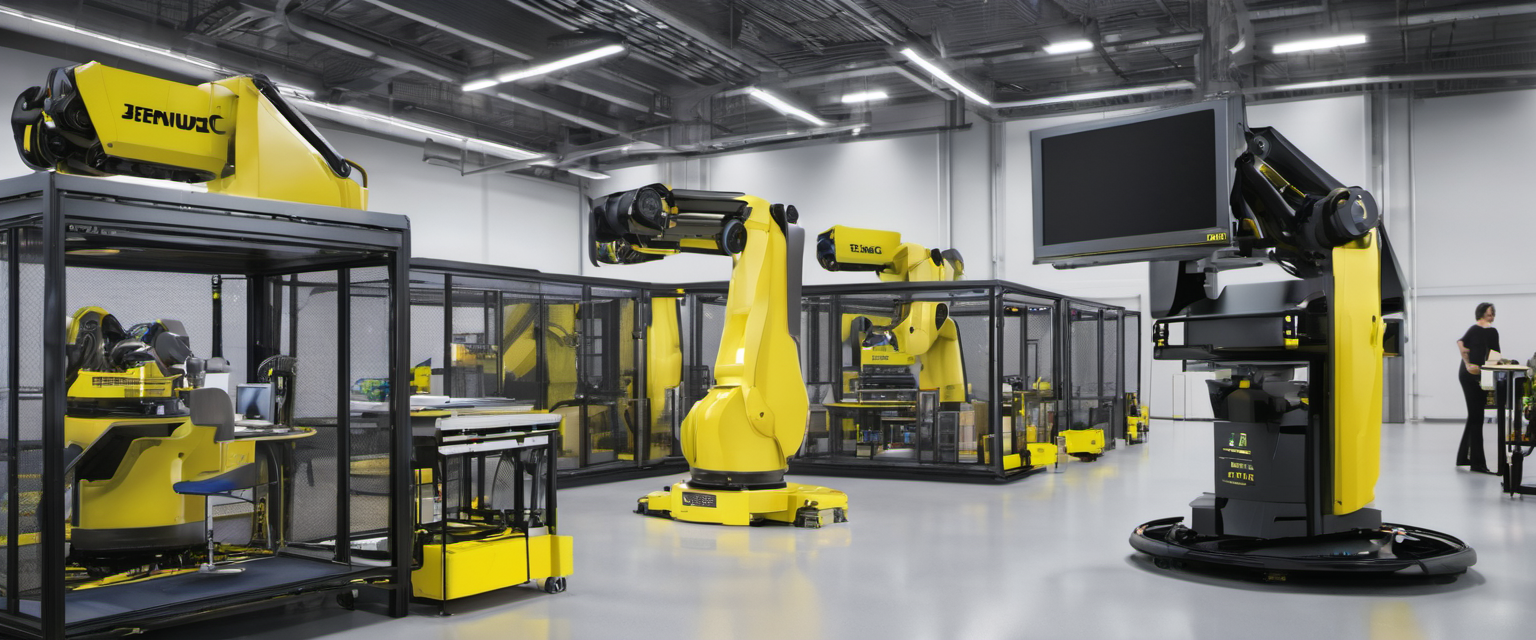
Three days after Fanuc told the world it had wired Google Gemini into the natural-language programming layer of its 1.1M installed robots, the company announced on May 18 that it has also deepened the Nvidia stack underneath. RoboGuide and Nvidia Isaac Sim are now bidirectional digital twins, a dual-arm CRX cell folds T-shirts via Nvidia’s Isaac GR00T N foundation model, and the long-running 「robot that avoids humans」 demo just got a 7.5× compute uplift after Fanuc swapped Jetson AGX Orin for Jetson Thor.
This is the dual-vendor strategy made plain. Fanuc, the world’s largest industrial-robot installed base, is now publicly running on Google’s model on top and Nvidia’s everything-else underneath. The two announcements landed three days apart.
What actually changed in the simulator
Two integration modes ship in the new release.
Mode 1 — Isaac Sim foreground, RoboGuide background. The user opens Nvidia Isaac Sim, picks up a virtual or physical teach pendant connected to RoboGuide, and jogs the robot inside the simulator in real time, using the same control algorithms the physical robot would run. Programs can be taught, executed, and verified entirely inside Isaac Sim. Fanuc claims 「identical trajectories and cycle times」 between the virtual and real cells.
Mode 2 — RoboGuide foreground, Nvidia PhysX physics engine in the background. RoboGuide now uses PhysX to simulate the awkward physical events the prior version could not — bin picking from a randomly piled bin, flexible-cable manipulation, insertion and assembly with non-rigid objects. The pitch is feasibility studies for bin-picking systems entirely inside the simulator, without burning a single real part on iteration.
The marketing claim that matters is the sim-to-real gap collapsing toward zero. In practice that means the integrator can quote a bin-picking project, run hundreds of PhysX iterations overnight, and arrive on site with a program that works on the first run. The chargeable hours on the floor compress in a way the layoff cohort tends to call 「productivity」 and engineering teams tend to call 「reskill or rotate」.
The dual-arm T-shirt fold and why it matters
Fanuc demoed two CRX collaborative arms folding T-shirts via imitation learning on Nvidia’s Isaac GR00T N foundation model. A human operator performs the folding task using the CRX arms in teach mode, the system learns from the examples, and the arms then reproduce the fold autonomously while watching the shirt with cameras.
The novelty is not the fold itself — robot laundry-folding demos are a well-worn YouTube genre. The novelty is the smoothness. Imitation-learned robot motion historically 「appeared segmented and jerky」. Pairing GR00T N’s policy with Fanuc’s motion-control layer produces continuous motion that is finally close enough to human fold cadence to ship into a customer demo.
This is exactly the class of soft-object, low-rigidity task that an industrial-robot installed base has been historically bad at, and which a humanoid-robot pitch deck has historically claimed as the wedge. If Fanuc’s industrial-cobot platform can also do flexible-object manipulation by feeding imitation data into GR00T N, the humanoid wedge narrows.
Jetson Thor and the 7.5× compute jump
Fanuc also swapped the brain in its 「AI robot that avoids human」 demo. The system previously ran on Nvidia Jetson AGX Orin; it now runs on Nvidia Jetson Thor (T5000). Fanuc’s reported AI-compute uplift is 7.5×. The robot avoids human movement「more quickly and smoothly」 — which, for a safety-rated collaborative cell, is the gap between a cobot you can stand near and a cobot you actually want to stand near.
The 7.5× number is also the harder-to-write-around point in the dual-vendor pitch. A Gemini-on-top, Nvidia-everywhere-else stack is not symmetric — Nvidia’s edge compute is doing the part of the workload where latency directly governs whether the cell is safe to share with a human worker. Google’s role is the natural-language layer; Nvidia’s role is the millisecond layer.
The dual-vendor read
Memory-checking against this week’s other Fanuc story: on May 14, Fanuc rolled Google Gemini into the natural-language reprogramming layer of its installed base of roughly 1.1M robots. That was a software-update story aimed at the line-engineer persona — type English, get a robot program. The May 18 announcement is the underlying compute story — simulate accurately, learn from demonstration, react in milliseconds.
The two stories together describe a strategy: keep the existing customer base on Fanuc steel, swap the entire software brain to a Google-plus-Nvidia stack, and price the upgrade as a service. None of the upstart humanoid vendors has a 1.1M-installed-base distribution path. Fanuc does.
What to watch
- GR00T N task-library expansion. T-shirt fold is the photogenic demo. The interesting number is the second task the same CRX cell learns without rebuilding the cell — wire-harness routing, cable-tying, glove-fitting. If the platform can absorb new tasks via demonstration data alone, the integrator-hour curve bends.
- Jetson Thor on humanoid platforms. A 7.5× compute uplift on an industrial cobot will not stay confined to industrial cobots. Watch which humanoid vendors quietly drop Orin from their datasheets in the next ninety days.
- The Gemini-vs-Isaac handoff. Fanuc has not publicly described how a Gemini-generated program lands in an Isaac Sim test before going to the real robot. The clean engineering answer is 「Gemini emits, Isaac Sim verifies, robot executes.」 If the integration ships that way at the Fanuc Open House, the dual-vendor pitch becomes a one-shot deploy story.
- Yaskawa, ABB, Kuka response. Fanuc is the largest installed base, but the other three big industrial-robot vendors share the same customer concerns — sim-to-real gap, soft-object manipulation, safety-cell latency. The next 30 days of competitor press releases will tell us whether the Fanuc model becomes the template or stays a Fanuc-only advantage.
The defensible read on the May 18 announcement is that Fanuc is consolidating a vendor stack rather than launching a new product. The harder-to-defend read is the one the demo lineup advertises: every category that humanoid startups have used to justify their valuations — flexible-object handling, soft motion, fast safety response — just got demoed on the industrial-cobot installed base by the company that already owns the customer relationships.
Sources
- Robotics & Automation News — Fanuc strengthens Nvidia partnership for AI robot simulation and digital twins (May 18, 2026)
- Interesting Engineering — New FANUC-NVIDIA system lets virtual robots behave like real machines
- Fanuc America — Fanuc accelerates physical AI in industrial robotics leveraging Nvidia technologies (March 2026)
- Nvidia Newsroom — Nvidia and global robotics leaders take physical AI to the real world