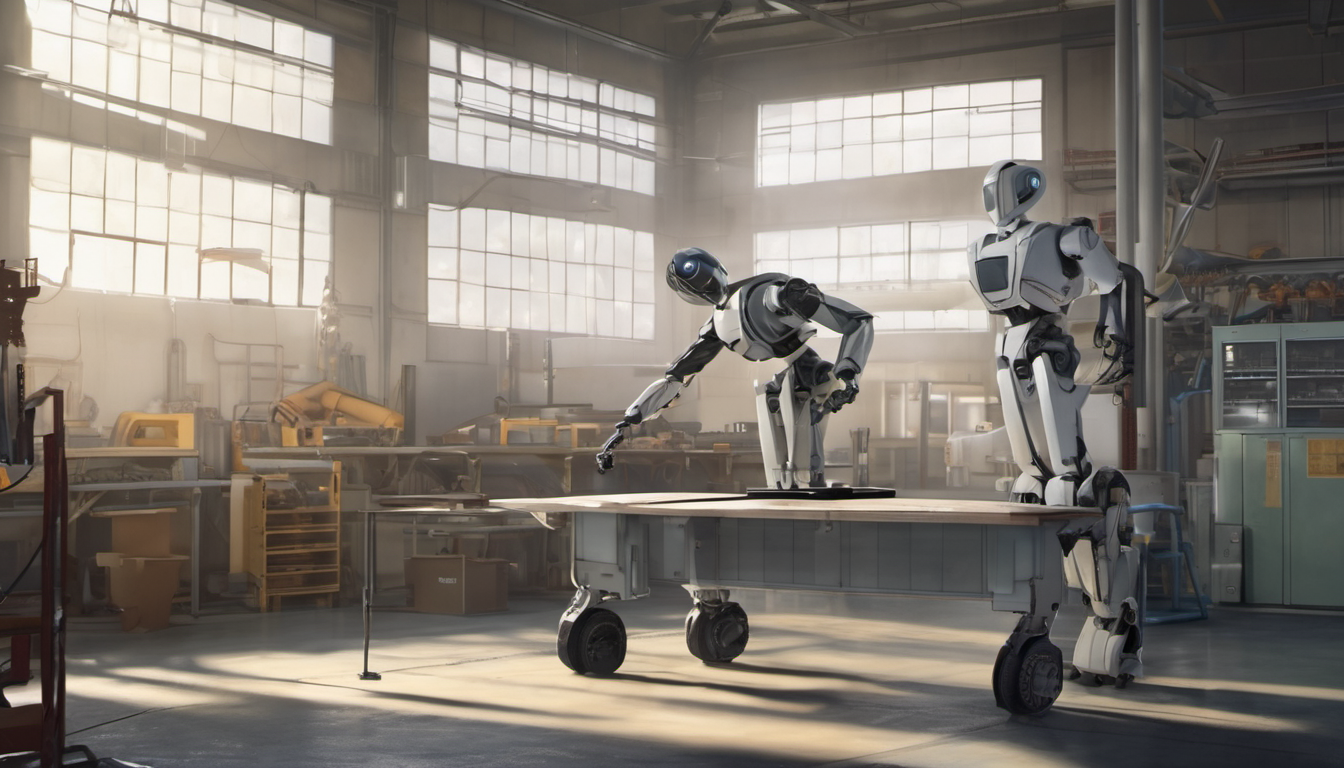
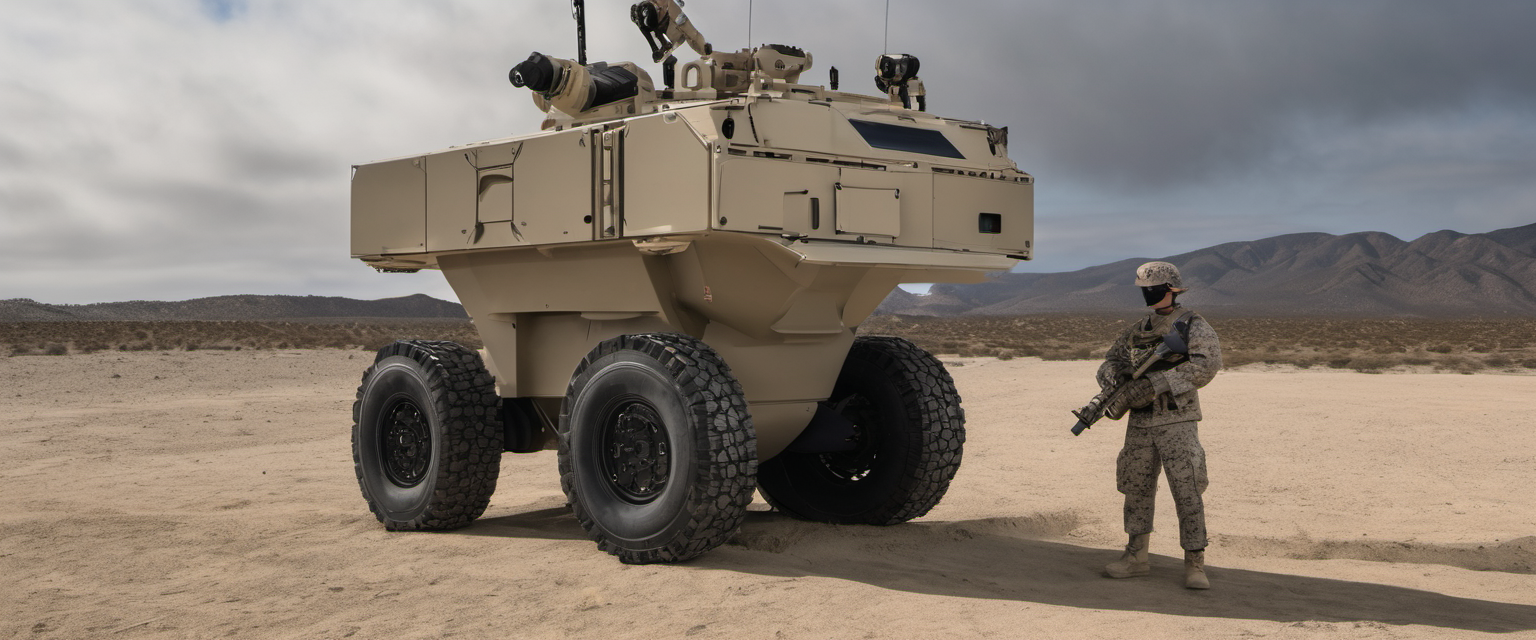
On April 23, San Francisco-based Foundation Future Industries announced a $24 million Pentagon contract to test its Phantom humanoid robot with the United States Marine Corps. Eric Trump — chief strategy adviser since March — and CEO Sankaet Pathak took the victory lap on Fox Business with Maria Bartiromo on April 24. The deal lit up two news cycles in parallel: humanoid-robotics watchers saw the first sizable US military contract for a general-purpose biped, and Washington reporters saw Eric Trump’s name on a federal contract twelve months into his father’s administration.
Both stories are happening. The robotics one is the more durable one.
What’s actually being bought
The contract funds testing of Phantom, a 5’11”, roughly 180-pound humanoid that Foundation has positioned as a “heavy-duty” platform for military and industrial work. Pathak’s pitch to the Marines, per the Mediaite recap, centers on tasks that get Marines killed: breaching enemy structures, moving heavy ordnance under fire, recovering casualties, doing the first ten meters of a contested entry. The promise is “spare American lives.” The technology being bought is the chassis plus its onboard autonomy stack; weapons integration is, at least officially, off the table for this contract.
What separates this from the half-dozen other “DoD evaluating humanoid robots” stories of the last eighteen months is that two Phantom MK-1 units are already in Ukraine. Foundation shipped them in February — the first deployment of humanoid robots to an active combat zone. The Ukrainian units are running unarmed logistics: lifting and carrying transport crates between forward positions and rear supply points. That use case is exactly what Marines want a robot to do at a beach, except with seawater instead of mud.
Why the Marines, specifically
Marine Corps acquisition is the right entry door for a startup’s first DoD humanoid contract for three reasons:
- Smaller dollars, faster cycle. A $24M test contract through Marine Corps Attack and the NavalX ecosystem closes in months. The equivalent inside the Army’s program offices closes in years.
- Operational appetite. The Corps has been the most public DoD branch about wanting unmanned ground systems on the leading edge of an amphibious or urban entry. A biped that can climb a stairway and carry a wounded Marine has higher salience inside the Corps than inside, say, Air Combat Command.
- Doctrinal rehearsal. The Marines have been running Force Design 2030 experiments for five years where the question is “which jobs in the rifle company get unmanned first?” A test contract for Phantom is one experiment in that long-running set.
The contract is small. Small contracts are how this industry actually moves. A $24M Marines test that produces useful field data is more strategic ammunition for Foundation than another $200M private round at a fancy valuation.
The Eric Trump dimension
Foundation hired Eric Trump as chief strategy adviser in March. The Pentagon awarded the contract one month later. Democracy Now characterized this as nepotism; House Democrats issued a more measured “review the procurement record” letter the same day. Pathak’s response, in the Fox segment, was that Foundation has been on the Pentagon’s radar for years and that the company submitted to the same SBIR / OTA evaluation process as everyone else.
Both things can be true at once: Foundation may have a competitive technology, and the appearance of an Eric Trump–assisted procurement creates a reasonable case for an inspector-general review. From a labor-market angle, the political controversy is the part that fades; the contract — and the test data it produces — is the part that compounds.
What this means for jobs
LostJobs covers two threads of humanoid-robot displacement: industrial (warehouse, factory, logistics) and what the spec sheets call “public-safety adjacent” — police, fire, security guard, infantry. Industrial humanoids are roughly four years ahead. Defense humanoids are catching up faster than anyone in 2024 expected, and the Ukraine combat-zone deployment is the proof.
The numbers worth tracking:
- The US Marine Corps has roughly 178,000 active-duty Marines. A meaningful fraction of those billets — drivers, supply, ammo handlers, casualty evacuation, breachers, perimeter security — are the exact jobs that Phantom is being tested against. The Corps is not going to fire humans. It will fail to recruit replacements for retirements while quietly absorbing more autonomous platforms into the unit table of organization.
- Defense contractors employ another 1.1 million Americans in production and sustainment of legacy unmanned systems. Humanoid systems will pull jobs into that sector before they push jobs out: a Phantom needs a maintainer, an operator, a software-update technician, a field-service rep. What is structural is the kind of job — fewer junior infantry billets, more depot-level robotics technicians.
- The political economy of military humanoids is closer to drones than to factory automation. Drones did not collapse military aviation employment; they restructured it. The fastest-growing MOS in the US Air Force over the last decade was 18X / RPA pilot. Humanoids will have a similar slot in the Marine Corps within five years.
Why LostJobs cares
A Pentagon humanoid contract sits at the intersection of three things this site tracks:
- Mass production for non-industrial buyers. Defense is a buyer who pays for ruggedization, certification, and lifecycle support. A successful Marines test contract drags the rest of the platform — civilian utility, infrastructure, security, disaster response — onto the same maturity ladder.
- The Ukraine combat-zone proof point. Foundation’s Phantom MK-1 already lifting boxes near the front line is the first non-laboratory humanoid deployment to an active war. That data, if it survives contact with reality, is more persuasive than any demo reel from Tesla or Figure.
- The “Phantom 2” reveal that’s coming. Pathak told Bartiromo, on camera, that what Foundation will unveil in “the next couple of months” will be “the strongest humanoid robot that exists anywhere in the world, including China.” That is a falsifiable claim with a deadline. Mark the calendar.
A dry footnote: the criticism that this is a nepotism contract doesn’t change whether the robot works. The robot working — or not — is what determines whether the Marines, and the rest of the Pentagon, place follow-on orders measured in nine and ten figures. The $24M test contract is the audition. The follow-on is the show.