
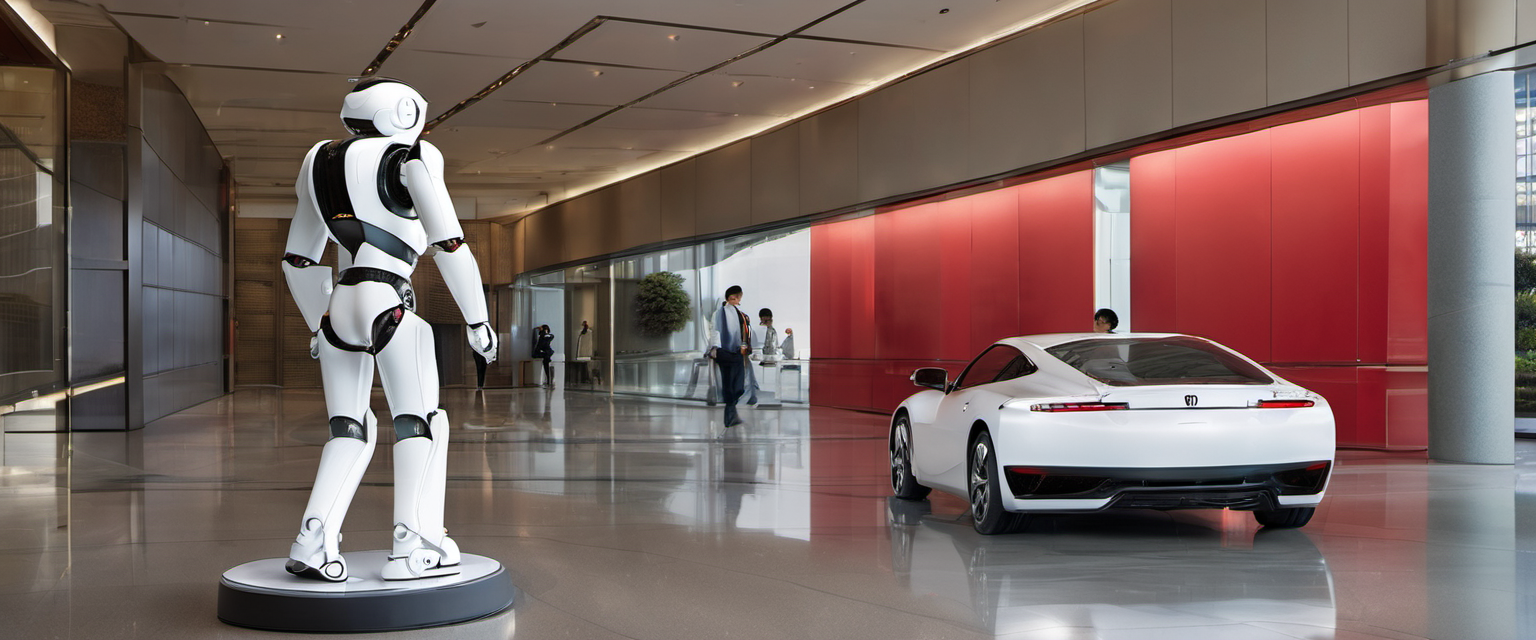
On Tuesday April 28, in the lobby of the Honda Wako Building in Saitama, Toshio Fukuda — Nagoya University professor emeritus, 2020 IEEE President, the first IEEE President from the Asia-Pacific region — handed over a bronze plaque. The plaque read, per the Honda corporate announcement and the IEEE Spectrum writeup:
Honda P2 · First Autonomous Bipedal Humanoid Robot · 1996
That is the IEEE Milestone designation. Since the program started in 1983, IEEE has awarded 293 of them globally, covering the kind of engineering achievement IEEE thinks the rest of civilization needs to remember 200 years from now — Edison’s incandescent lamp, Bell’s telephone, the Apollo Guidance Computer, the first SMS message. The 1996 Honda P2 just joined that list. It is Honda’s second IEEE Milestone, after the 1981 Electro Gyrocator navigation unit recognized in 2017.
The plaque will live at the Honda Collection Hall at Mobility Resort Motegi in Tochigi, where the actual 1996 P2 unit — 1.82m, 210 kg, with a backpack-mounted battery and computer — is on permanent display.
That is the news. The interesting bit is the timing.
What P2 actually did in 1996
The P2 was unveiled in December 1996. Per the IEEE Milestone proposal and Honda’s own P2 technical brief, the things it did for the first time anywhere on Earth were:
- Walked dynamically without an external power tether. Battery and computer were on board.
- Walked with a natural gait, rather than the static shuffling-step approach that had defined every prior bipedal research robot. Real-time posture control, dynamic balance, gait generation, and multi-joint coordination were running on board.
- Climbed stairs. Not as a demo of a single set of stairs but as a generalized capability.
- Did the above without falling. The press demo footage from the December 1996 reveal is the moment that a generation of roboticists describes as the first time a robot looked like it might actually be useful.
That was 30 years ago this December. ASIMO, the humanoid Honda is famous for, came out in 2000 — four years later, and entirely built on the P2 control stack. The 30-year gap between the engineering accomplishment and the IEEE Milestone is roughly typical for the program; IEEE Milestones are, by design, awarded long after the dust has settled and the impact is unambiguous.
The week the plaque arrived
The reason this site cares about a December-1996 engineering achievement getting a 2026 plaque is the calendar coincidence. Honda’s plaque ceremony on April 28 happened inside the same seven-day window as:
- April 23: Brett Adcock posts the Figure production chart showing 240 Figure 03 humanoids shipped in April 2026 — a single-month figure that exceeds Figure’s entire 2025 annual output of ~150. Sunnyvale plant cadence: one robot every 90 minutes.
- April 24: State Grid Corporation of China issues its 2026 Embodied Intelligence Development Plan: ¥6.8B (~$995M) earmarked, 8,500 robots to be procured this year, 500 of them named-spec humanoids for live-line work on ultra-high-voltage grids, with Unitree, Deep Robotics, AgiBot, UBTech, and Fourier as named suppliers.
- April 28: Honda’s IEEE Milestone ceremony.
- April 29: Robotera closes a strategic round above ¥2B (~$280M) led by SF Group, with delivery already in the thousands across more than 10 logistics centers.
- April 30 (today): Aaron Saunders, Boston Dynamics CTO, gives the opening keynote at Robotics Summit & Expo Boston titled “Redesigning Atlas: Boston Dynamics on the Future of Humanoids.” Atlas’s 2026 production allocation is already fully committed to Hyundai RMAC and Google DeepMind.
If you laid those five datapoints out as a single timeline, the IEEE Milestone for “the first robot to walk without falling” is being awarded the same calendar week the binding constraint on the field shifted from can the robot walk to can the customer install it before the next quarterly earnings call.
The 30-year arc, in three numbers
Here is the engineering history of dynamic bipedal walking, condensed to three production-volume numbers:
- 1996: 1 robot existed that could walk autonomously. Honda built it. It was hand-assembled in a research lab.
- 2000–2018: Honda built roughly 100 ASIMO units across 18 years. Most were demo units. Total commercial deployments at meaningful work tasks: zero.
- April 2026: Figure ships 240 humanoids in a single month. AgiBot has shipped 10,000 cumulative Expedition A3 units. Unitree targets 20,000 humanoids in 2026 alone. State Grid alone is procuring 8,500 robots this year. Combined Western + Chinese 2026 humanoid output is on track for 50,000–80,000 units.
The three numbers — 1, ~100, ~50,000-80,000 — span exactly 30 years. The slope of the line is not the steady exponential the headlines like to draw. It is two near-flat decades, followed by a knee that arrived between roughly Q3 2024 and Q1 2026, followed by something nobody at the 1996 P2 reveal predicted publicly: the field’s binding constraint moving away from whether the technology works and toward whether the customer’s facilities team can absorb the units coming off the line.
The IEEE plaque sitting in Saitama on April 28 is, in this sense, an artifact of the second-derivative inflection. It commemorates the engineering work that made the field possible. It arrives the year the field stopped being a research field.
Why Honda did not get to be Figure
There is an obvious, bitter sub-question every Western humanoid VC asks privately when looking at the Honda timeline: Honda spent fifteen years and an estimated $140-150M of internal R&D building the technology that the entire current humanoid industry is built on, and then ran ASIMO as a corporate ambassador product for 18 years before discontinuing it in 2018. Why didn’t Honda become Figure? Why didn’t ASIMO become the Optimus?
The honest answer, per the IEEE Spectrum retrospective and Honda’s own retrospective, has three parts:
- The control stack worked. The economics didn’t. A 2010-vintage ASIMO unit cost on the order of a million dollars to build and required a small team of engineers to operate. Without an LLM-class behavioral foundation model on top, every new task was a six-month bespoke programming project.
- The end-to-end policy revolution arrived 25 years too late for ASIMO’s product window. What NVIDIA GR00T N1.7’s EgoScale paper and Figure Helix 02 demonstrate is the upper-half of the stack — the part that turns a walking robot into a task-doing robot. Honda’s P2 had the lower half. They did not have the upper half because the upper half required transformers, which required GPUs, which required Hopper-class compute, which required 2023.
- The capital structure was wrong. Honda funded P2 / ASIMO out of an automotive R&D budget that expected a 5-year payback. There was no 5-year payback. Figure raised $1.5B at a $40B+ valuation precisely because the payback expectation is now the next decade, not the next product generation, and the LP base doing the funding is different from the one Honda answered to in 1998.
The same engineering achievement, awarded a Milestone in 2026, would have been awarded a much larger market-cap windfall if it had been founded in 2022 instead of 1996.
What LostJobs is watching
- Whether Honda re-enters humanoids commercially in CY2026. Honda has been quietly hiring humanoid roboticists for the past 18 months. The Milestone ceremony is a marketing-coherent moment for a re-entry announcement. None has been made yet. If one comes within 90 days, it lands inside a fundamentally different competitive set than ASIMO did.
- Whether the “first to do X” historical framing gets used by Western OEMs to push back on Chinese volume narratives. Unitree, AgiBot, and UBTech own the volume side of 2026. The “where the technology actually came from” framing is a non-trivial counter-narrative — and the Honda plaque is a citable artifact of it, useful for both BD AI-foundation marketing and for Figure’s BMW deployment story.
- Whether the next IEEE Milestone in robotics goes to a learned-policy result instead of a hardware result. The 2026 plaque went to first robot to walk autonomously. The candidate set for the 2050 plaques will plausibly include “first robot to operate end-to-end in a real factory shift,” “first robot to learn a task from human demonstration only,” and “first humanoid to displace a measurable share of a labor category.” Those plaques will not go to hardware companies.
The dry coda
The single most-shared quote in the Japanese press coverage on April 28 was from Honda’s research wing, lifted from the Honda Tech P2 brief: “The basic concept of the technology has been carried into ASIMO and continues to influence the design of humanoid robots being developed today.”
Translation: every Figure 03 rolling off the Sunnyvale line at one robot every 90 minutes today has, somewhere in its zero-moment-point control loop, a direct lineage to the 1996 P2 walking down a hallway in Saitama. The IEEE Milestone is, in this sense, ratifying the lineage rather than the pioneer. The pioneer’s reward for being 30 years early is a bronze plaque. The companies who arrive 30 years later get the contracts.