
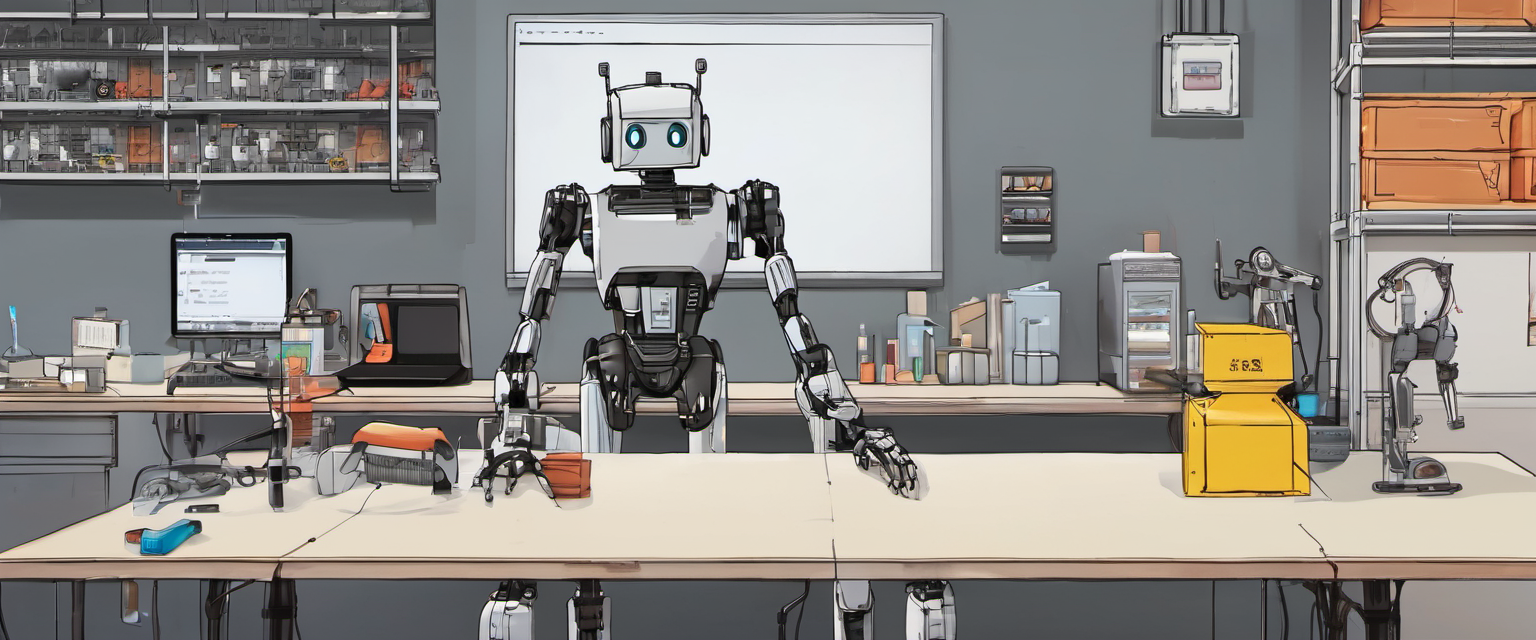
On Thursday afternoon, May 21, 2026, the LeRobot account posted a 1:19 PM tweet that did more for the humanoid software stack than the past six months of Series-C rounds combined: “We built a bipedal robot for about $2,500. A real, mostly 3D-printed robot you can build, repair, simulate, train, and control.”
Hugging Face’s robotics division released LeRobot Humanoid — an open-source, 3D-printable, bipedal lower-body platform with a complete bill of materials, simulator, sim-to-real identification pipeline, runtime, and reinforcement-learning training environments. The release is the next move in a strategy that already includes the Pollen Robotics acquisition, the sub-$3,000 HOPEJr humanoid, and the desktop Reachy Mini.
The funny part is the price tag relative to the rest of the industry.
What $2,500 actually buys you
The LeRobot team is unusually honest about what this is: “If you are looking for the most advanced humanoid robot, this is not it. If you are looking for a humanoid you can build, understand, repair, instrument, simulate, and use for learning experiments, this is the robot we are trying to make.”
The current release is the bipedal lower body — legs only, no upper body integration yet. Per the Humanoids Daily writeup, it ships as five integrated pieces:
- Hardware. A complete BOM, 3D-printable parts, wiring documentation, and motor setup instructions. Predominantly 3D-printed structural components plus off-the-shelf actuators.
- Design tools. A control-oriented workflow to evaluate mechanical design choices in simulation before committing to a physical build.
- Runtime. Calibration, safety checks, and control bridging simulation to real-world hardware.
- Identification. Pipelines to replay real-world datasets in simulation, reducing the persistent sim-to-real gap by fitting better simulator parameters.
- Training zoo. MJLab training environments integrated with lerobot-legged-zoo to train locomotion policies.
The pitch is mundane and devastating at the same time. When a 3D-printed knee bracket snaps during an aggressive locomotion test, the researcher reprints it overnight rather than waiting eight weeks for a proprietary replacement to ship from Shenzhen. That is the entire competitive advantage in a single sentence: iteration speed on a hardware target you actually control.
The price comparison that lands the punchline
The same week Hugging Face shipped a $2,500 reference humanoid, the leaderboard at the top of the humanoid market looked like this:
- Figure AI — $39B valuation on a Series C, a few hundred commercial units deployed, Helix-02 closed-source.
- Apptronik — ~$5B valuation, $935M raised, Apollo platform in pilots with Mercedes-Benz, GXO, and Jabil.
- Unitree — 5,500+ humanoids shipped in 2025, G1 listed on Amazon at $17,990, $608M STAR Market IPO filed.
- 1X — NEO pre-orders for 2026 home delivery at $20,000+.
- Hugging Face LeRobot Humanoid — $2,500, MIT-licensed, lower body only.
The cheapest commercial humanoid on the table is roughly 7× the price of the open-source reference platform that landed on Thursday. That gap is exactly the gap that killed proprietary mobile operating systems against Android, that killed proprietary deep-learning frameworks against PyTorch, and that — every time it shows up — is a gap that takes longer than expected to close and then closes faster than expected.
Why the timing matters
Yann LeCun spent the past month arguing that the current Vision-Language-Action (VLA) paradigm is brittle and overly dependent on massive proprietary datasets. The implicit fix in LeCun’s worldview is more researchers running more experiments with more diverse hardware — which is the exact bottleneck a $2,500 reproducible platform breaks.
LeRobot Humanoid is not the answer to the world-model question. It is the answer to the who-gets-to-ask-it question. When the hardware target costs $2,500 and prints overnight, the population of people who can iterate on locomotion policies expands from a few corporate-lab head counts to anyone with a Prusa printer and a $400 GPU rig.
The closed-source counterpart to this argument is Figure’s “Bob, Frank, and Gary” livestream that crossed 60 hours of autonomous package sorting earlier this month — impressive, demonstrably useful, and locked behind a Figure-controlled hardware stack that nobody outside the company can iterate on. Both bets are real bets. The Hugging Face bet just happens to be the one that any university grad student can clone tonight.
What this doesn’t fix
The release is honest about what it isn’t. LeRobot Humanoid is bipedal, lower-body only, in an experimental research phase. Running policies on the physical hardware still requires careful calibration, low-gain testing, and a reliable power cutoff. There is no end-user “buy a domestic helper” pathway on this device. There is no commercial deployment in 2026. There is no replacement for Apollo at Mercedes-Benz or Atlas at Hyundai.
What there is, instead, is a credible BOM, a working simulator, and the social signal that the open-source physical-AI community now has Hugging Face’s full-stack thinking applied to humanoids. That is closer to “PyTorch for robotics hardware” than to “humanoid you can order.” If the previous moves — Pollen acquisition, HOPEJr, Reachy Mini — were the warm-up, this is the first piece that the locomotion-research community has been explicitly asking for.
What to watch
- Fork count. LeRobot’s existing GitHub repos already pull thousands of stars. The fork rate on
lerobot-humanoidin the next 30 days is the leading indicator of whether the open-source physical-AI community sees this as a real reference platform or a vanity drop. - Whether Pollen Robotics ships the upper body. The roadmap promises whole-body integration. If the upper body lands before the end of 2026 with the same BOM discipline, the open-source humanoid stack reaches feature parity with last year’s proprietary research platforms — at 10× lower cost.
- University reaction. MIT, Stanford, ETH, Tsinghua — every major robotics lab has spent six-figure budgets on humanoid research platforms. A $2,500 alternative changes the lab-grant math for the next academic cycle.
- The Chinese open-source response. Unitree, AGIBOT, and EngineAI all have low-cost hardware. None of them has opened the stack the way Hugging Face just did. The next 90 days will test whether the Chinese open-source robotics scene matches the move or doubles down on closed-source consumer pricing.
The cheapest seriously useful humanoid hardware target is now a $2,500 file on Hugging Face. That is the part of the May 21, 2026 news cycle worth bookmarking.
Sources
- Hugging Face Blog — Introducing LeRobot Humanoid
- Humanoids Daily — Hugging Face Drops a $2,500 3D-Printed Humanoid for Open Robot Learning (May 21, 2026)
- LeRobotHF on X — We built a bipedal robot for about $2,500 (May 21, 2026)
- Humanoids Daily — Hugging Face Acquires Pollen Robotics
- Humanoids Daily — Hugging Face Introduces HOPEJr and Reachy Mini
- Humanoids Daily — Yann LeCun predicts “paradigm shift” in robotics by 2027 (May 18, 2026)
- CNBC — Apptronik raises $520M at $5B valuation (Feb 11, 2026)
- SCMP — Inside Unitree’s landmark IPO