
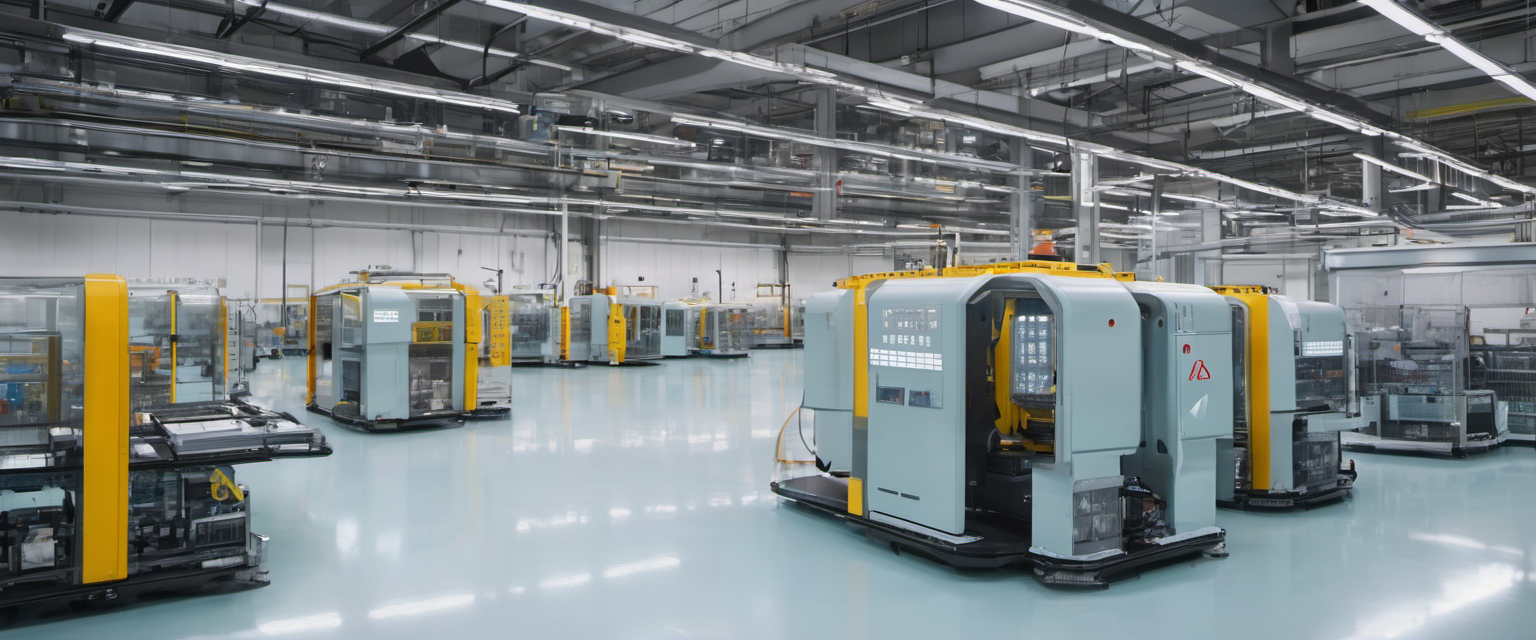
The May-2026 Chinese humanoid build added a structural piece on Wednesday morning, May 13, that is more boring and more important than another funding round. At CIBF 2026 in Shenzhen, Lead Intelligent Equipment — China’s largest manufacturer of lithium-battery production equipment — signed a strategic cooperation agreement with the Beijing Humanoid Robot Innovation Center, the national-tier embodied-AI platform that builds the open-source Tiangong (天工) humanoid.
Per the PR Newswire / Manila Times release and ChinaTechNews’s syndication, the two parties signed in a CIBF-floor ceremony in Shenzhen and committed to:
「Jointly accelerate the large-scale deployment of humanoid robots from laboratories to real-world industrial production lines, reshaping the future of new energy and advanced manufacturing industries.」
The transaction is not a funding round, not a unit count, not a demo. It is a vendor relationship at the layer where every other Chinese-humanoid deal gets bottlenecked: who actually installs the robot on the customer’s factory floor.
What Lead Intelligent actually is
Lead Intelligent Equipment Co., Ltd. (赢合科技 / 先导智能, Shenzhen-listed, ticker 300450) is China’s largest manufacturer of lithium-ion-battery production equipment. Its customer list is the part that matters: per the company’s own investor relations disclosures and industry coverage, LEAD’s equipment is on the production lines of CATL, BYD, EVE, Gotion, CALB, SK On, LG Energy Solution, Panasonic, and almost every other meaningful EV-battery cell maker on the planet. Globally, lithium-cell-equipment cap-ex is a $30-50 billion annual market; LEAD’s share of new Chinese line builds in the last three years has been the largest single share.
That is the customer base that just got handed a humanoid co-marketing partner. When LEAD sells a turnkey battery production line to a CATL or a BYD, it sells the slitter, the winder, the formation chamber, the dry-room handling — and starting now, an optional humanoid SKU sourced from the Beijing Humanoid Robot Innovation Center.
What the Beijing Humanoid Robot Innovation Center actually is
The Beijing Humanoid Robot Innovation Center (北京人形机器人创新中心) is not a private startup. Per the Beijing municipal government’s official announcement it was established in November 2023 as China’s first national-tier embodied-intelligence innovation platform, with backing from Xiaomi, UBTech, JD.com, Yizhuang state-owned-investment and Beijing municipal funds, and is the institutional home of the Tiangong (天工) open-source humanoid platform — the same one whose predecessor won the Beijing half-marathon humanoid race in April and that AGIBOT and others have publicly built derivatives on.
Tiangong is open-sourced. That is the part of the package that distinguishes this deal from any Western equivalent. The Beijing Innovation Center is not selling a closed humanoid platform like Figure or Apptronik; it is licensing a national-tier reference design that downstream Chinese OEMs can fork, modify, and deploy. Per the MERICS report on China’s embodied-AI strategy, the Beijing center is one of six national-tier humanoid innovation centers — the Beijing one is the highest-profile of the six because of Tiangong’s open-source publishing and its athletic-demo press cycle.
What changes after the signature
In Western robot-deployment narrative, the bottleneck after a humanoid demo is integration: the customer’s facilities team has to design the robot into a cell, the safety team has to sign off, the operations team has to write the standard work, and the OEM has to do the deal as a one-off pilot. BMW Spartanburg with Figure was integration-first. Tesla Optimus at Tesla is internal-first. Apptronik at Mercedes-Benz Hungary is integration-first.
Lead Intelligent flips the bottleneck. LEAD already designs the production line. LEAD already does the customer’s facilities integration. LEAD already does the standard work. Adding a humanoid SKU to a LEAD turnkey line is a factory-equipment SKU change, not a separate pilot project. The Beijing center, in turn, gets:
- Compute, mechanical, and safety integration done by an industrial-equipment vendor that has been doing it for 20 years. This is the part Tiangong itself, as a research-and-publishing center, cannot do at scale.
- A funnel into every new Chinese battery-line build for the next 3–5 years. Battery-cell cap-ex from CATL, BYD, and the second-tier Chinese cell makers has continued growing through 2025 and 2026 even as the EV market has cooled, because the cell-factory build cycle leads vehicle demand by ~2–3 years.
- Co-developed control software for battery-production tasks specifically — dry-room handling, electrode stack assembly, formation-chamber loading, and the long, repetitive material-handling tasks that battery lines have historically run on a mix of SCARAs, gantries, and humans. Per the release language, the two parties will co-develop these.
The market that LEAD is implicitly handing the Beijing center is enormous and concentrated. It is also the single hardest market for any Western humanoid to crack: Chinese cell-factory cap-ex stays inside the Chinese supply chain, and US-or-EU humanoid OEMs are not in the conversation.
How this compares to the US humanoid integration story
Side-by-side, as of May 13:
| Humanoid platform | Integration partner | Scope |
|---|---|---|
| Figure (US) | BMW (Spartanburg, Leipzig) | Vehicle final assembly |
| Apptronik Apollo (US) | Mercedes-Benz, GXO Logistics | Vehicle assembly, warehouse pick |
| Agility Digit (US) | GXO, Toyota | Warehouse, vehicle subassembly |
| Atlas / Hyundai (US / KR) | Hyundai (Metaplant America), Google DeepMind | Vehicle assembly, R&D |
| Tiangong / Beijing Center (CN) | Lead Intelligent → every Chinese battery cell maker | EV-battery production lines |
The Tiangong-LEAD pairing is the first one in this list where the integration partner is not a single end customer but a production-line OEM that sells to every end customer. Structurally, this is the difference between Figure-with-BMW (deep, one customer) and Tiangong-with-LEAD (broad, every battery customer LEAD ships to). The former is a pilot pattern. The latter is a distribution pattern.
What this tells us about the China humanoid build, six months in
Three observations, low-confidence to high:
Low-confidence. The deal language is press-release language, not contract language, and the May 13 signing ceremony at CIBF was a ribbon-cutting, not a purchase order. Two parties can announce a “strategic cooperation agreement” and end up never co-shipping a unit. The Chinese humanoid sector has done this before — see the Schaeffler 30-prototype 「three-digit by 2030」 framing in Q1.
Medium-confidence. The Chinese humanoid strategy in 2026 has now produced three distinct distribution channels that don’t depend on direct OEM pilots: (a) ship a quadruped first and self-fund the humanoid — Unitree, AGIBOT, Vbot; (b) deploy via state-owned end customers — State Grid, Sinopec, COSCO; (c) co-sell via an industrial-equipment vendor — Tiangong/LEAD as of today. The third pattern is the newest and potentially the biggest.
High-confidence. Chinese cell-factory cap-ex is a $30-50B/yr global market with LEAD as one of the two largest single suppliers. Even at very small humanoid attach rates — say 0.1 units of humanoid SKU per line built — the volume goes to four-digit unit deliveries per year inside two years. No Western humanoid OEM has access to a distribution channel of this size that doesn’t go through one customer at a time.
What to watch
- The first joint reference customer. A LEAD-Beijing-Center humanoid SKU on a CATL or BYD line, attached to a specific line build, with a publicly named factory and unit count. Until that customer is named, the deal is press release. After it is named, the deal is a distribution channel.
- The Tiangong software fork for battery-line tasks. Tiangong is open-source. LEAD will need a private fork that runs the dry-room handling, electrode stack, and formation-chamber loading. Whether that fork stays in the open-source tree or gets pulled private will tell you which way LEAD is taking the IP.
- Whether the six national humanoid innovation centers each get their own equipment-vendor partner. Shanghai, Guangdong, Sichuan, Zhejiang, and the other regional centers have parallel humanoid programs. If each gets its own industrial-equipment co-seller in the next 6–9 months, China has effectively built a distributed humanoid distribution layer that runs through its own industrial supply chain.
- The Beijing center’s next public funding round or state-investment headline. A LEAD partnership at the customer-distribution layer makes the Beijing center materially more valuable. If the next funding event happens within 60 days, the LEAD deal was structural.
The honest read on a Wednesday morning is that the most important Chinese humanoid news this week was not a $73M Pre-A in Shanghai (which we covered yesterday). It was a ribbon-cutting at a battery industry trade show in Shenzhen, attended by two organizations the Western humanoid press doesn’t write about, signing a partnership that doesn’t ship a single unit. The reason it matters is that LEAD is the supplier that touches every Chinese cell-factory line built between now and 2028. The humanoid that touches LEAD touches all of them. The next twelve months will tell us whether Tiangong is that humanoid.