
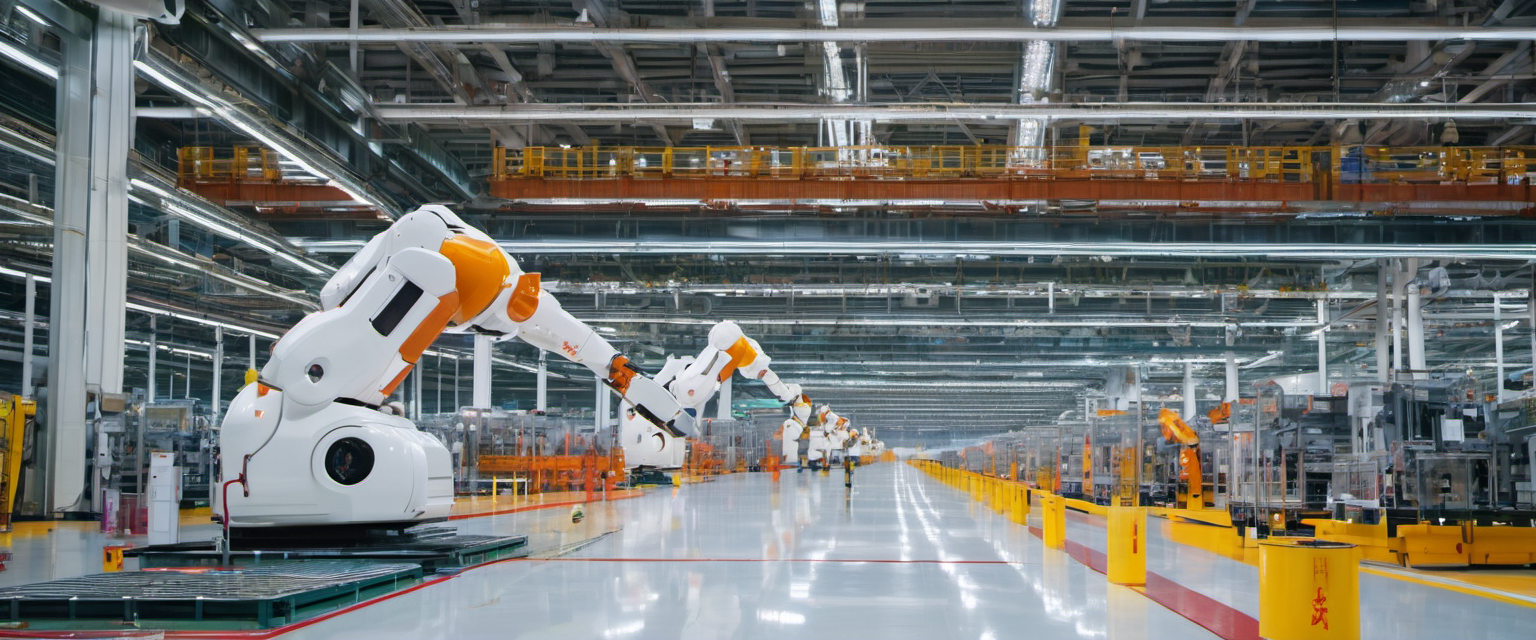
While the American humanoid-robot story this week was Optimus walking a carefully-fenced stretch of Boylston Street for cameras, the Chinese version was a small ceremony in Beijing’s Yizhuang district in which a thousand-unit production run of actual humanoid robots quietly rolled off a conveyor belt. Gasgoo’s AutoNews published the confirmation on April 20. The event itself happened April 17.
The facility belongs to Lingyi iTech, a Shenzhen-listed precision manufacturer best known as an Apple supplier. The robots rolling off the line are Tiangong Ultra and Tiangong 3.0, designed by the Beijing Innovation Center of Humanoid Robotics. The plant is inside Xiaomi’s industrial park. The phrase the organizers chose — and Chinese state media printed back verbatim — is “super factory” (超级工厂).
The numbers
- Annual capacity in 2026: 10,000 humanoid robots
- 2027 target: 20,000 units
- 2030 target: 500,000 units a year — a 50× ramp in four years
- Partner network: 20+ firms, including AgiBot, MagicLab, and the BCI-startup BrainCo
- Export pipeline: “bulk ODM orders” already placed by multiple AI and robotics firms in North America
The “super factory” language is not marketing self-congratulation in the Western sense. In Chinese industrial-policy vocabulary it is a specific designation: the Beijing-Tianjin-Hebei region’s first full-chain embodied-intelligence production facility — i.e., one factory that does chassis fabrication, actuator assembly, perception-module integration, and final robot validation under one roof, with automated material handling between them. It is the humanoid equivalent of what BYD built for EVs a decade ago.
The part nobody in the West is printing
The ODM detail is the one to sit with.
ODM — original design manufacturer — means Lingyi is not just taking contract-manufacturing orders to build someone else’s robot. It is selling a Chinese-designed robot platform, branded and tuned for a foreign buyer, to be shipped out of Beijing into the US and Canadian markets. The same structural playbook as the smartphone industry in 2014, the EV industry in 2022, and now humanoids in 2026. The article does not name the North American buyers. It does not need to. If you are a Western humanoid-robot startup whose Series B pitch is “we will be the American answer to Chinese humanoid manufacturing,” the polite way to read this paragraph is that your supply chain is now coming from the thing you were supposed to be competing with.
Why LostJobs cares
A factory that ships 10,000 humanoids this year and plans 500,000 a year by 2030 is not an R&D milestone. It is a labor-supply curve. Every Tiangong 3.0 that comes off the line is a unit destined, per the partner list and ODM pipeline, for logistics sortation, industrial assembly, in-store retail operation, or domestic services — the same job categories that employ roughly 90 million Chinese workers and an overlapping set in North America.
At 10,000 units/year, humanoids are a curiosity. At 500,000 units/year, which is the stated 2030 figure and is only four budget cycles away, they are a meaningful fraction of annual new hires in several service-sector occupations. Note that the 500k number is not an analyst forecast. It is the operator’s own public capacity target, printed at their own ribbon-cutting. The incentive to oversell is obvious; the incentive to print a number that low-performs against the build plan is lower than the incentive to print one that can be slipped.
What to watch next
- The first North American ODM deployment. It will surface, probably in Q3 2026, as “US-branded humanoid launches” from a company whose manufacturing partner quietly reads Lingyi iTech in the fine print. Watch the press releases that don’t say “made in China” anywhere above the fold.
- The Tiangong 3.0 spec sheet vs. Tesla Optimus Gen-3. Tiangong 3.0 is 1.69m, 62kg, 43 degrees of freedom. That is within a few percent of Optimus’s most-quoted specs — except Tiangong 3.0 is rolling down a line at 10,000 units a year in Beijing, while Optimus is doing marathon photo-ops on Boylston Street. Capacity is spec.
- The next Chinese ODM announcement. Lingyi is not the only precision-manufacturing firm pivoting here. Foxconn, Luxshare, BYD Electronic, and Goertek have all signaled similar programs. A “super factory” ribbon-cutting every six weeks for the next eighteen months is the realistic scenario, not the aggressive one.
American humanoid coverage this week was one robot on a sidewalk. Chinese humanoid coverage this week was a conveyor belt. One of those is the story. The other is the press release.