
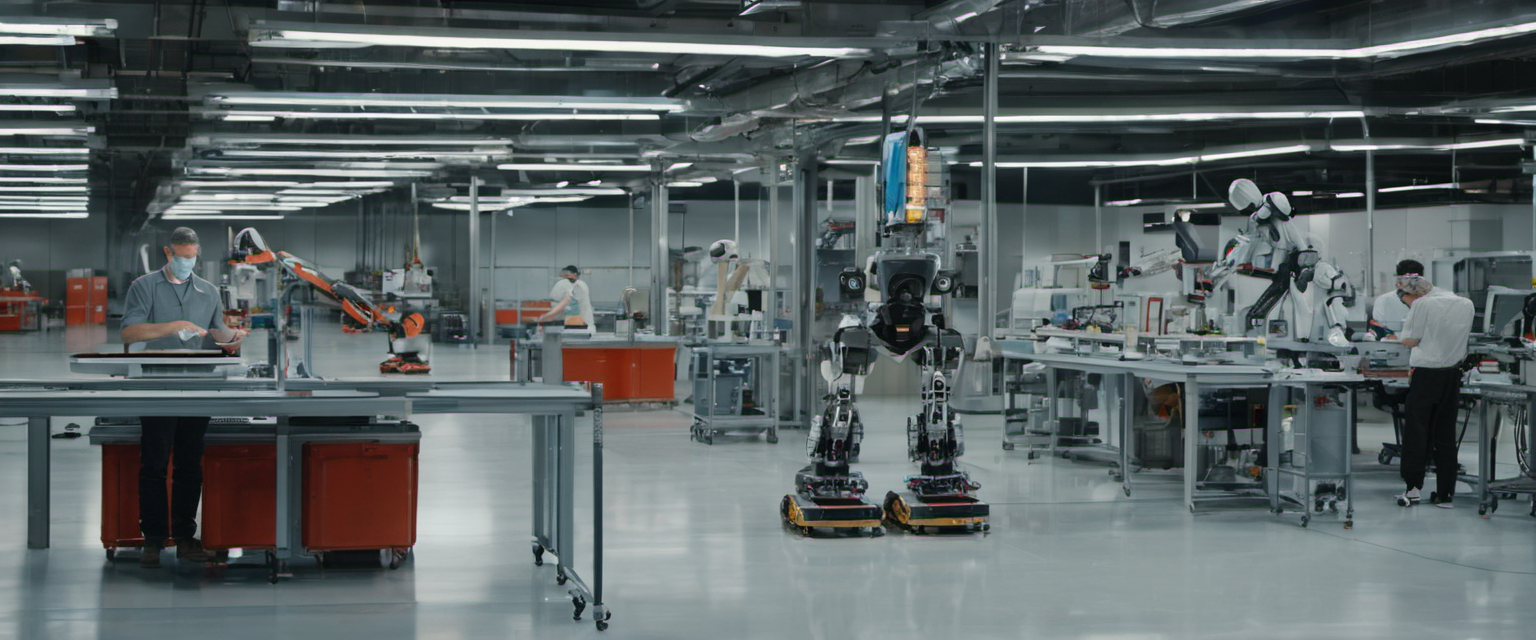
The most quietly important humanoid-robotics announcement of the year so far did not come from Tesla, Figure, 1X, Unitree, or any of the names the 2026 press circuit has conditioned you to watch. It came from a five-year-old Munich startup called RobCo, at Hannover Messe 2026, on a product launch reported out by Robotics & Automation News on April 20. The product is called Autonomous Alfie. The pitch, stripped of the Level-4 marketing gloss, is this: a bimanual industrial humanoid that handles small-batch, high-mix factory work — the kind that classical industrial robots cannot touch — and that you pay for by the month instead of buying outright.
Why Alfie is different
A 2026 industrial-automation buyer looking at humanoids has so far been choosing between three broken offers. Option A: buy a Figure-03 or Apptronik Apollo outright at a multi-hundred-thousand-dollar sticker, custom-integrate it into your line, and hope the deployment partner is still in business in 2028. Option B: contract with Tesla or Unitree for a robot whose “useful factory work” footprint — per Musk’s own January 2026 earnings call admission — is still “primarily for learning and iteration.” Option C: stay on traditional six-axis arms and palletizers, which have worked for forty years and are the reason your floor supervisor still has a job.
Alfie is trying to collapse the middle of that matrix. The RobCo unveil at Hannover Messe described the robot as combining “bimanual manipulation with tightly integrated hardware and software across perception and execution,” capable of precision assembly, sensitive material handling, and intralogistics tasks like picking, kitting, and palletizing. The distinguishing pitch is Level 4 autonomy: per RobCo’s framing, the robot “learns, adapts, and executes tasks with minimal human intervention,” handling dynamic environments that change “without the need for extensive manual programming.”
If you have been reading humanoid press releases for three years, you have a healthy allergy to “Level 4 autonomy.” Fair. The actual evidence that Alfie is different is threefold. First, the company is not a humanoid-first startup — RobCo spent five years selling modular robotic arms under a RaaS model to mid-market European manufacturers, has roughly 300 deployments in production, and raised $100M in Series C specifically to productize the foundation model on top of that installed base. Second, the claimed deployment target is small-batch high-mix contract manufacturing — precisely the factory class that traditional industrial automation has never been able to economically serve, and where the labor cost of human reconfiguration is the dominant line item. Third, Alfie ships via the same Robotics-as-a-Service subscription model that sold RobCo’s arms — which means adoption is gated by monthly opex rather than capex, and the unit economics work for a shop with 50 employees instead of 5,000.
The labor implication is the small factory, not the big one
Tesla, BMW, Siemens — the 2026 humanoid headlines have centered on brand-name megafactories because that’s where press releases are written. The actual addressable labor shift sits downstream. The US alone has roughly 220,000 small-and-mid-sized manufacturers employing about 6 million production workers. Roughly 1.2 million of those workers are in job roles classified by BLS as “production supervisors, first-line” or “setup and changeover technicians” — the exact middle layer whose core function is reconfiguring the floor every time the product mix changes. That is the layer Alfie claims to eat.
The mechanism is again not “humanoid replaces operator.” Operators at a $25-million-revenue contract shop are already the bottleneck the owner cannot hire their way out of. The mechanism is that Alfie’s advertised ability to “adapt to new objects, workflows and conditions without extensive manual programming” is a direct substitute for the changeover technician who today spends two days reconfiguring fixtures, retooling arms, and rewriting PLC programs every time a new batch comes in. If Alfie’s actual Level 4 autonomy is half as good as the unveil deck claims, the changeover-technician headcount per shop drops from four to one. That compression, multiplied across 220,000 shops, is a five-to-six-figure labor displacement story that will take three to five years to show up in the BLS data and which no one will classify as an AI layoff because nobody is being laid off — they are simply not being rehired when they retire.
What Hannover Messe tells you about the full picture
Alfie is one signal in a week of signals. At the same fair, Siemens and Humanoid finished reporting on the HMND 01 wheeled humanoid completing an 8-hour autonomous logistics shift in Erlangen at 60 containers/hour and >90% pick success. BMW confirmed the AEON humanoid’s Leipzig pilot ramps to full production use by end of 2026 across high-voltage battery and component manufacturing. Zoomlion debuted the Robot Ops orchestration OS and the Z1 mass-produced humanoid on April 22. NVIDIA released Isaac GR00T N1.7 and expanded the Nemotron coalition with partners including LG, NEURA, and Noble Machines adopting the foundation model for production humanoids. Schaeffler won the Hermes Award — the fair’s headline industrial prize — for a humanoid actuator platform. Xinhua’s opening-day wrap called it the first year humanoid robots “took center stage” at the show, which ran with 2,900 exhibitors across 50 countries.
The pattern is not any single deployment. The pattern is that industrial humanoids crossed the boundary between “prototype shown at a trade show to generate press” and “production unit with named customers and a subscription price tag” in the same 72-hour window, at the same trade show, across roughly a dozen vendors spanning Germany, the US, and China. RobCo’s Alfie is the one that matters for LostJobs readers because Alfie is the one pricing the transition so that a $30-million-revenue European stamping shop can afford it next quarter. The megafactory headlines are the distraction. The shop-floor subscriptions are the story.
Watch the first RobCo Alfie customer announcement — RobCo has said “later in 2026,” which in industrial-robotics-speak usually means the press release is already drafted and waiting for the pilot to cross its KPI gate. When that name drops, note the employee count of the target plant, and the percentage of its floor that is “high-mix low-volume.” That number will be the leading indicator of what the 2028-2030 labor curve in European contract manufacturing looks like.