
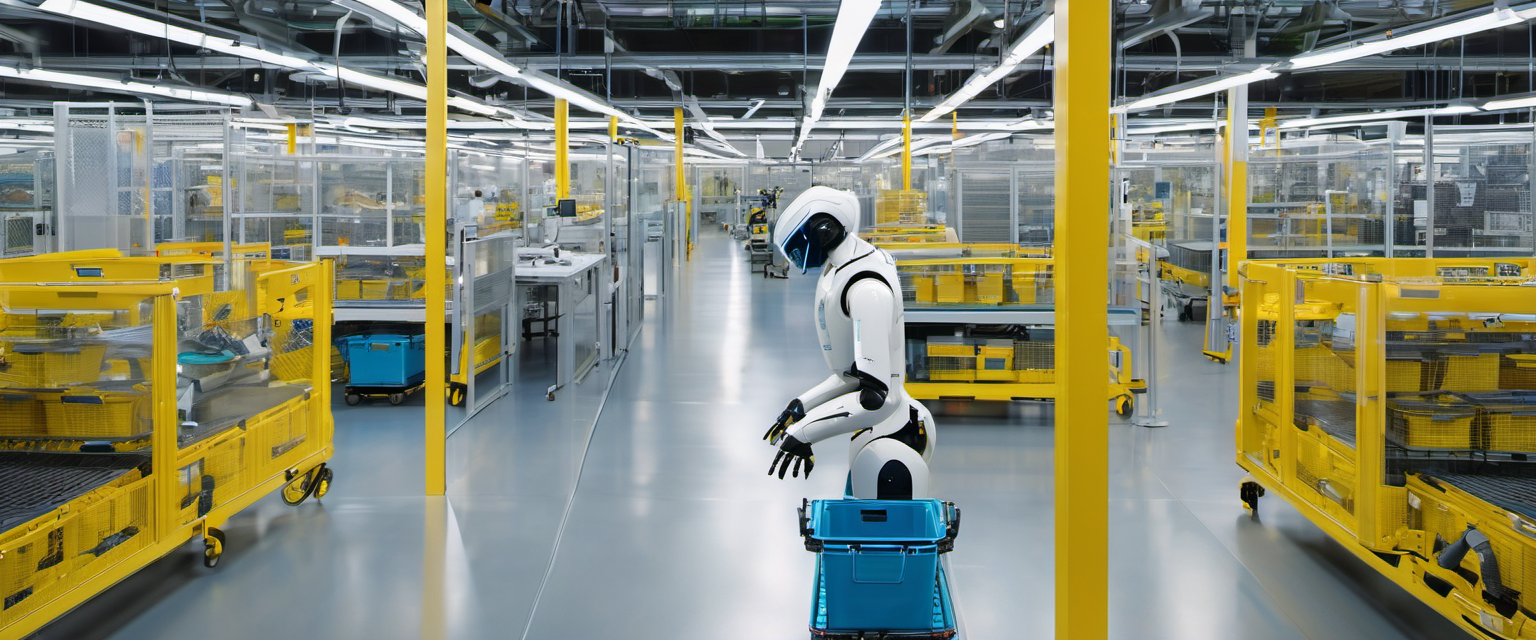
For the last four years the humanoid-robotics pitch has been the same: watch our robot do a backflip, watch our robot fold laundry on a perfectly staged table, watch our robot hand a CEO a cup of coffee at a trade-show booth. Everybody’s wondering when one actually clocks in and does a real shift. The answer, as of this week, is April 17, 2026, in Erlangen, Germany.
Siemens and UK startup Humanoid announced that the HMND 01 Alpha wheeled humanoid has completed live autonomous tote-handling shifts at Siemens’ Erlangen electronics plant — one of the company’s flagship Industrie-4.0 showcase factories. No handlers off-camera. No trade-show lighting. Just totes.
The numbers that matter
Per the joint announcement:
- 60 tote moves per hour — picking totes off a rack, transporting them, placing them for human line operators
- Over 8 hours of continuous operation — a full shift, not a 20-minute demo
- 90%+ autonomous pick-and-place success rate — unattended, no prompt tweaking mid-task
These are not exciting numbers if you’re used to a human worker. Sixty totes an hour is a reasonable warehouse rate, not a superhuman one. That’s exactly the point. The humanoid didn’t have to be better than a human at this job. It had to be boring enough to leave alone for a shift, and it was.
That is the threshold the industry has been chasing since the Figure-Amazon pilots of 2024. A robot that’s 80% as productive as a human, but runs three shifts, doesn’t join a union, and doesn’t need 20 minutes of handler babysitting per hour — that robot changes logistics economics. We just got the first credible public data point for it.
The stack behind the stunt
The HMND 01 Alpha runs on Nvidia’s full physical-AI stack, according to coverage in TechRepublic’s coverage of the broader 2026 robotics wave and the Siemens-NVIDIA release:
- Jetson Thor for on-robot edge compute
- Isaac Sim for simulated environment training
- Isaac Lab for reinforcement-learning policy development
The reinforcement-learning side matters more than the hardware. Humanoid’s team reportedly cut their prototype cycle from 18–24 months down to 7 months by doing most of the tuning inside Isaac Sim rather than on the physical robot. If that figure holds industry-wide, we are about to see a Cambrian explosion of industrial humanoids — not because the robots got smarter, but because the time from “concept” to “tote on shelf” just collapsed by a factor of three.
Why Erlangen, and why now
Erlangen is not a coincidence. It’s Siemens’ showcase Industrie-4.0 electronics plant, where the company sends customers who want to see their own factory of the future. Every hour the HMND 01 runs there is simultaneously a commercial reference site, a training dataset, and a sales pitch. Siemens gets factory-logistics data; Humanoid gets a deployment story for the next funding round; Nvidia gets to show that the “physical AI” branding wasn’t just Jensen keynote filler.
What’s different from, say, Tesla Optimus or AGIBOT’s 10,000-unit production ramp is the customer side. Siemens is a paying Fortune 100 industrial buyer with hard numbers in a press release. That is a very different object than a video of a robot at a factory Tesla also owns.
The honest limitation
This is Alpha hardware. Ninety percent is not a hundred percent — the robot still got stuck or misplaced a tote roughly one time in ten. In a real warehouse, that’s a human supervisor at the end of every aisle and a restart button within arm’s reach. Nobody at Siemens is laying off their warehouse staff on Monday because of this result.
But that’s not the story. The story is that the trendline has a data point with real production numbers attached, and it’s in a production environment, and the environment isn’t owned by the robot vendor. Every point like this lowers the unit economics required to justify the next pilot. Someone at Amazon, FedEx, DB Schenker, JD.com, and Yamato Transport read this press release on April 17 and sent it to their robotics procurement VP.
What to watch next
Humanoid will likely announce a second Siemens site, maybe a second Fortune 500 customer, and a Series C that prices off the Erlangen reference within 90 days. Nvidia will absorb the deployment into its next keynote. Siemens will quietly ask a third-party consultant to model what happens if 60 tote-moves-per-hour becomes 200 in 2028.
The humans who move totes at Erlangen this morning are not out of a job this quarter. They’re out of a job category this decade. That’s the real half-life of a 90% success rate: not the shift it runs tomorrow, but the hiring plan it deletes in 2029.
The robot still can’t do the other 10% of the task. Human supervisors exist to do that 10%, for about a third of the salary they used to be paid. Efficiency!