
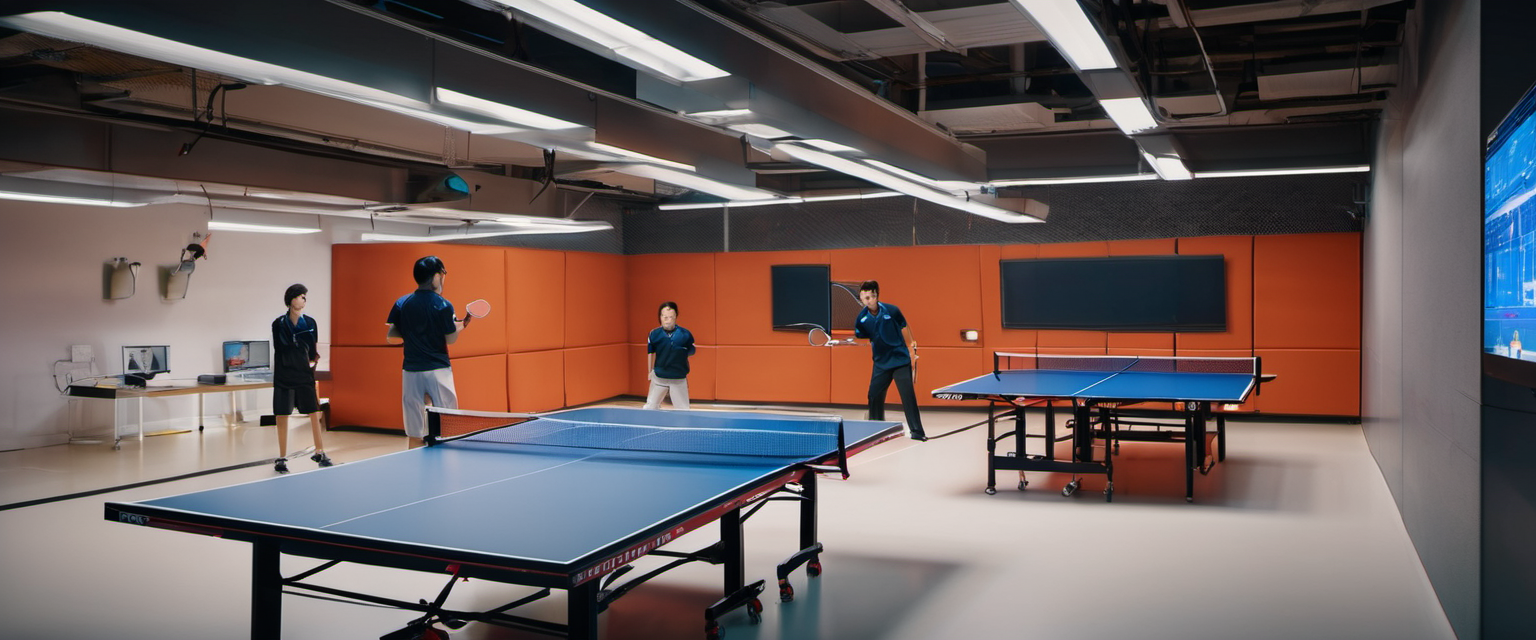
On Thursday April 23, Nature published — on the cover — Sony AI’s paper “Outplaying Elite Table Tennis Players with an Autonomous Robot.” The robot, called Ace, won 7 of 13 individual games against five elite amateur players (each with 10+ years of competitive experience), and won 3 full matches out of the seven it played against two active professionals from the Japanese pro league. Sony’s official announcement and Inside Project Ace blog drop the technical detail; Fortune’s writeup and ScienceAlert carry the public-facing version.
This is the first peer-reviewed result claiming human-professional-level robot performance in a real, contested competitive sport. The headline is the win column. The interesting fact, as usual, is buried in the methods section.
What Ace actually is
Ace is not a humanoid. It is a single eight-DOF arm (six revolute, two prismatic) mounted on a linear rail that runs the length of the table, holding a standard paddle, with a small cup holding a ball for autonomous serves. Vision is a stereo camera pair sampling at 700 Hz — roughly ten times faster than the human visual system can resolve a fast-moving ball. The control loop estimates ball position and spin, predicts trajectory, plans the racket angle and stroke, and executes — repeatedly, every few hundred milliseconds, throughout a rally.
The training stack is the part the field will care about. Sony combined:
- Sim-to-real policy training in a physics simulator with a large library of randomized opponent strokes.
- Real-world fine-tuning against a ball machine, then human practice partners, then players of progressively higher rank.
- Hierarchical control: a high-level “tactic” module decides whether to attack, defend, or place; a mid-level “stroke” module picks topspin / backspin / push / drive; a low-level “motor” module does the contact mechanics.
- No teleoperation, no human-in-the-loop, no scripted match. Ace plays autonomously against a human, in real time, with the same rules a human-vs-human match uses.
The robot is not stronger than the best players in the world. The professional players in the study were active Japanese-league pros, not world-tour ranked competitors at the very top of the sport. Ace does not yet beat that tier consistently. But it beat that tier sometimes, and that “sometimes” is the line the field has been chasing for fifteen years.
What just got crossed
Sport robotics research has a long bench. There was Omron Forpheus (table-tennis demos since 2014, never beat trained players consistently). There was DeepMind’s 2024 table-tennis paper demonstrating “amateur-level” play. There was Boston Dynamics doing parkour. There was Toyota CUE7 hitting a free throw from the top of the arc earlier this month.
What’s new on April 23 is direct head-to-head wins against professionals in their own primary discipline, in a setting they cannot game (full match, full rules, full stakes), at a publication standard (Nature, peer-reviewed, full method disclosure) that the field treats as authoritative. This is not a YouTube highlight reel. It is a cover paper.
The capability the paper is actually about
It is tempting to read this as a sports story. It is not a sports story. Table tennis is the load test Sony chose because it is hard for very specific reasons:
- Sub-300-millisecond decision cycle. A 22 m/s incoming ball arrives in roughly 350 ms; the robot has to perceive, predict, plan, and execute inside that envelope.
- Continuous sensorimotor coupling. Spin (up to 70+ revolutions per second), velocity, and angle interact non-linearly. There is no “discrete state” to plan against.
- Adversarial opponent. The human is actively trying to be unpredictable. The robot cannot pre-plan; it has to adapt, every shot.
- Dexterous contact at the millimeter scale. The contact patch between a 40mm ball and a sponge-rubber paddle is a few square millimeters. Small errors in approach angle cause large errors in return.
These are exactly the four properties that have kept robots out of fast, contact-heavy, adversarial, contested workspaces — kitchens, construction sites, hospital surgical rooms, vehicle interiors during crashes. Ace is a single-instance proof that the stack now works for one such workspace. Sony’s own press language is careful — “a stepping stone toward general-purpose dexterity” — but the technical contribution is real, and the implication for what robotics will be able to attempt in 2027–2028 is large.
The LostJobs read on a research result
Two reasons a non-research site cares.
First — the transferability is the part to watch. The Ace control architecture is, broadly, the same architecture humanoid robotics labs are using for warehouse manipulation: hierarchical control, sim-to-real, vision-driven prediction, real-time execution under contact uncertainty. A research artifact that beats a Japan-league pro at table tennis is also, structurally, a research artifact whose ideas will land in factory pick-and-place, surgical assist, and autonomous-vehicle adversarial driving inside two years. Sony is not selling Ace to factories. The companies that will sell to factories are reading this paper.
Second — the timing is not coincidental. Two days after Tesla’s Q1 earnings call where Optimus V3 mass production was officially set for July–August, the same week as Schaeffler’s 1,000-AEON deal and the Accenture–Vodafone Duisburg humanoid pilot, Sony AI publishes a Nature cover demonstrating that the AI control problem at the heart of all of those deployments has been solved at expert human level for one well-defined task. The robotics industrial story and the robotics research story are converging on the same week. They have been converging quietly for two years; this is the loudest April so far.
What this does NOT mean
A few things to keep on the floor:
- Ace is not “intelligence.” It is exquisite real-time control on top of a vast amount of structured training. It does not “understand” table tennis any more than AlphaGo understood Go. It does, however, win.
- Ace is not a humanoid. A linear-rail-mounted arm cannot move around your kitchen. Translating Ace’s control techniques to a free-walking platform is a separate, harder, multi-year problem.
- The pro players Ace beat are not the world’s top tier. A match against Tomokazu Harimoto or Wang Chuqin would go very differently in 2026. But the road from “beats Japan-league pros 3 matches in 7” to “beats world-tour top 10” historically takes 18–36 months in fields where the underlying recipe is right.
Why LostJobs cares
The headline robotics story of April 2026 in the LostJobs feed has been industrial: humanoid factory pilots, EU procurement, mass production lines coming online. Ace is a different story shape. It is the research half of why those industrial pilots are about to get harder to ignore. When the academic state of the art crosses “beats pros at the thing they trained twenty years for,” every pilot deployment from now on inherits a stronger control stack within a year or two.
A modest footnote: the elite human players in the Sony study averaged about 20 hours of practice per week plus over a decade of accumulated training. Ace was trained in simulation in roughly six months. The compute-time-versus-practice-hours curve in adversarial physical skills now bends the same way it bent for chess in 1997, Go in 2016, and protein folding in 2021. The next thing the curve bends for is the part of physical work that we used to call irreducibly human.
The polite phrasing for this, used in the abstract of the Nature paper, is “a milestone in real-world embodied AI.” The blunt phrasing is the headline.