
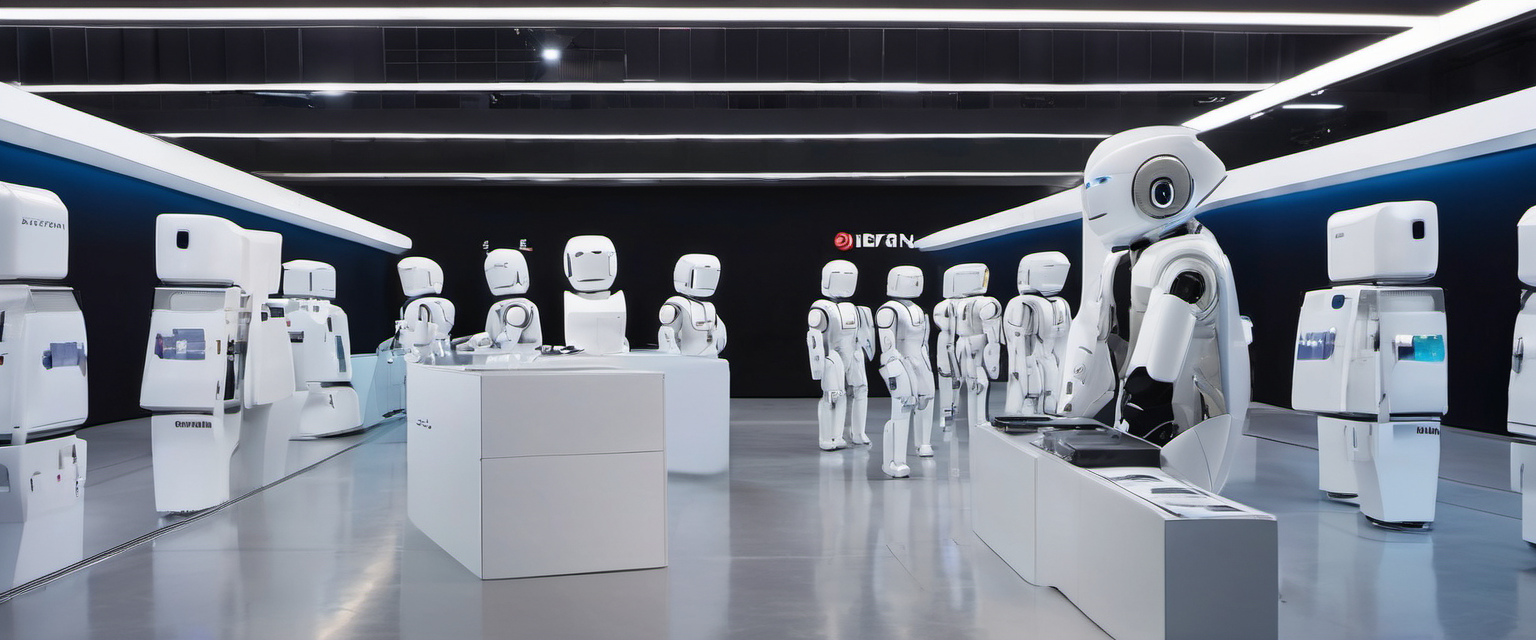
There is a specific genre of trade-show moment where the host country’s exhibitor does the most beautiful demo and loses the show. The Humanoids Summit Tokyo, which opened on Thursday May 28 at the Takanawa Convention Center, was that show.
Honda — Japan’s original humanoid prophet, the company that introduced Asimo in 2000 — demonstrated a motorized four-fingered hand that could screw tiny bolts on and off, or thread a sewing needle. It is genuine engineering. Assistant chief engineer Keisuke Tsuta calmly told the AP reporter that the Honda hand was more durable and powerful than the rival hands on the floor. That part is almost certainly true.
It was also almost certainly not the part of the show that mattered.
The visitors looked at the Chinese booths
Per AP’s Yuri Kageyama on the floor, “the big stars now were clearly the Chinese.” The named names this week: Booster Robotics, LimX Dynamics, Unitree, and High Torque — whose Mini Pi Plus dancing robot starts at $5,500. None of those companies can do what Honda’s hand can do. All of them can ship. That is the entire industry’s 2026 problem reduced to one exhibition floor.
The cleanest illustration was inside a Japanese exhibitor’s booth. Tokyo-based AI and robotics firm GMO is building a humanoid for Japan Airlines cargo handling at Haneda. The body is the Japanese product. The brains and the limbs — the actual robot — are licensed from Unitree, the Chinese firm whose H1, G1 and R1 are already shipping into US and Canadian buyers. The story Japanese companies are now telling, even at a Japanese summit in a Japanese convention centre, is “our robot uses a Unitree inside.”
Tim Hornyak, author of Loving the Machine: The Art and Science of Japanese Robots, supplied the line of the week: “I really hope that Japan can come up with a Ford Model T-version of humanoid robots. But I think China has already stolen their lunch. It’s a bit too little too late.”
Galapagos again
The pattern is one Japan has lived through before. AP and most of the on-the-ground coverage reached for the same word — Galapagos syndrome — the long-running phrase for innovative Japanese products that evolve in isolation and never translate for the global market. Consumer electronics did it. Mobile phones did it. Electric vehicles did it. Humanoid robotics is doing it now, fifteen years after Honda was the only company on Earth with a walking humanoid worth photographing.
What Japan has, demonstrably, is precision. Honda’s hand. Toyota’s reliability. Boston Dynamics-via-Hyundai’s Atlas with 2026 production fully committed. Honda’s confidence that quality mass production is a Japanese specialty is historically grounded — it built modern auto manufacturing on that thesis.
What Japan does not appear to have is the cost curve. Unitree’s units land in the $13,000–$20,000 range. High Torque’s Mini Pi Plus is $5,500. The Honda hand has no public price because it is still a research demo. A platform that ships at one-tenth the price of a platform that doesn’t ship at all wins the procurement conversation by default, regardless of how delicately it threads a needle.
The labor side of the same exhibit
The reason the Tokyo summit matters more than the Silicon Valley one is the underlying market. Japan is 28.7% over 65, has roughly 80,000 centenarians, and its population is projected to drop from 127M in 2015 to about 88M by 2065. The immigration lever is closed by policy. The automation lever is the only one left.
That is also why GMO’s airport cargo humanoid is being trialled at Haneda and not in a research lab — Japan Airlines has cargo that needs to move, and a chronic worker shortage at the bays where it gets moved. Whether the inside of that humanoid is Honda silicon or Unitree silicon is, from JAL’s perspective, an entirely secondary question. The robot that can be deployed this fiscal year is the robot that wins.
Pew’s recent global survey, which Kageyama cites, found AI anxiety in Japan at 28% versus the US at 50%. The number explains the booth traffic. A country that is not afraid of robots, has a demographic crisis that can only be solved by them, and has a cultural willingness to let them do real public-facing work, is the natural buyer of the cheapest credible humanoid on offer. The cheapest credible humanoid on offer in Tokyo this week was Chinese.
What this summit will be remembered for
Three things, probably.
- The moment a flagship Japanese deployment publicly named a Chinese platform as its core. GMO + Unitree + JAL is now the reference architecture for “Japan deploys a humanoid” in 2026. That sentence does not flatter Japanese robotics; it flatters Japanese pragmatism.
- The Honda hand as the consolation prize. Threading a needle is the kind of demo that wins TV B-roll and loses procurement RFPs. Honda’s bet is that durability and precision will matter once humanoid deployments cross the line from novelty pilots to industrial scale. That bet may yet pay out — the next three years are the test.
- Hiroshi Ishiguro’s Geminoid keynote as the spiritual cover. The professor’s clone-android still does the philosophical work — “robots are the mirror of human beings” — that the engineering booths don’t have time to do. A summit that opens with Ishiguro and closes with Unitree-inside is a summit telling on itself.
The Tokyo Humanoids Summit was the moment Japan publicly accepted that it might be the world’s best customer for humanoid robots without being the world’s leading supplier. That is not a defeat — it is the same trade Japan made on smartphones in the 2010s and electric vehicles in the 2020s. It is, however, the trade. May 28 was the day it stopped being deniable.