
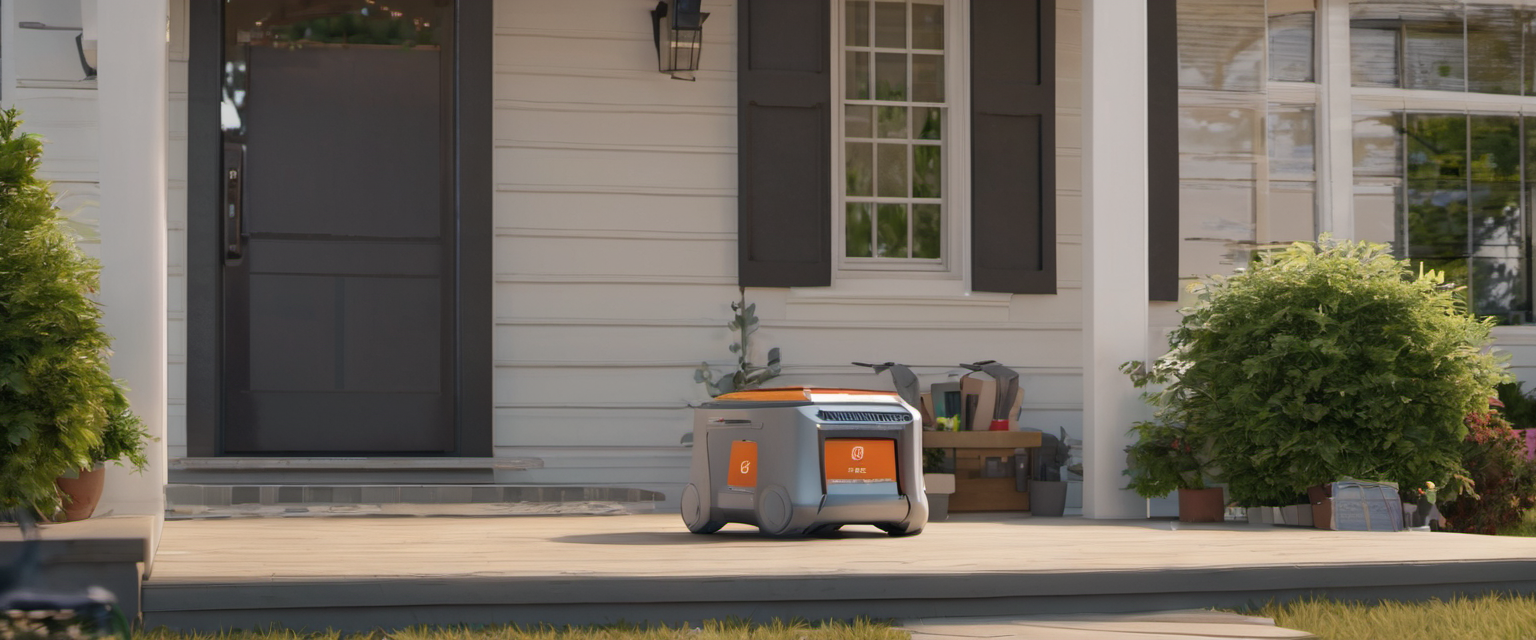
The humanoid-robot industry just quietly skipped a stage. Three years ago it was academic. Eighteen months ago it was the hottest VC pitch in San Francisco. This week, it is an AliExpress listing with a “Free shipping to United States” badge.
On April 15, Unitree Robotics — the Hangzhou company whose quadruped robot dogs you have seen sprinting through dozens of viral videos — opened international sales of its R1 humanoid robot on Alibaba’s AliExpress. The list price, with import fees bundled in, is $8,150 for the standard R1 and $6,800 for the scaled-down R1 AIR. Shipping to the United States, Canada, Japan, Singapore, and the UAE is free. First deliveries arrive June 30, 2026.
The same humanoid you will start seeing on your AliExpress homepage next to iPhone cases.
The price wedge, visualized
Here is the current pricing of a “you can actually ship this to me” humanoid:
- Unitree R1 AIR (AliExpress): $6,800 — ships June 30, free to the US
- Unitree R1 standard (AliExpress): $8,150 — ships June 30, free to the US
- Unitree R1 domestic China price: ~29,900 yuan / ~$4,370 — same robot, without the “global premium”
- Tesla Optimus (not yet shippable at any price): Elon Musk’s target range is $20,000–$30,000; consumer sales still have no date
- 1X NEO (Early Access): $20,000, Q3–Q4 2026 delivery — heavily teleoperated by humans in Norway
- Boston Dynamics Atlas: Not available to you at any price — all 2026 production is committed to Hyundai and Google DeepMind
Read the list again. The only consumer humanoid you can actually put on a credit card today is Chinese. It is less than half the price of the nearest American competitor that will not even ship until Q3. And Unitree will deliver it to your front door with the same logistics pipeline that just sent you a USB cable.
What $6,800 actually gets you
The R1 is 123 cm tall (about 4 feet) and weighs roughly 27 kg. Per VnExpress’s coverage of the launch, it can do cartwheels, run downhill, stand itself up from the ground, and execute complex motion routines — the same stunts you have seen Unitree’s demo reels flogging since last summer. It is biased toward research, education, and developer kits rather than “fold my laundry,” which is the category 1X NEO and Figure are still struggling to deliver.
Translation: you are not going to put it to work scrubbing your floors on day one. You are going to put it to work being a robot in your garage, and the AI community that bought Unitree Go1 quadrupeds for $2,700 three years ago — and then fed them the research papers that made everyone else’s robot move better — is now going to do the same thing, faster, with a biped. The R1 is not a consumer cleaning appliance. It is a developer platform priced at consumer impulse-buy.
Which, historically, is the price point that changes industries. PCs did this. Drones did this. 3D printers did this. Each of them went from “expensive professional toolkit” to “a box in someone’s garage running weekend experiments” right around the $1K–$8K mark. The weekend experiments compound. Five years later there is no more professional category — just the commodity.
Unitree’s IPO is the real footnote
The R1 launch is not a standalone product announcement. It is a pre-IPO brand moment. Unitree has filed for a $610 million Shanghai STAR Market IPO and its 2025 operating income grew 335% year over year to 1.708 billion yuan. The company shipped ~5,500 humanoids in 2025. For comparison, Tesla, Figure AI, and Agility Robotics shipped roughly 150 units each. That is not a typo. The 2025 humanoid shipment race was won by a factor of 36×, before most Western consumers even knew it was happening.
The AliExpress launch is Unitree signaling to global investors before the IPO that its distribution story is not a PowerPoint — it is a live consumer product with a functioning international logistics chain. For US investors bidding up SoftBank-backed Western humanoid startups at $14–20 billion valuations, the subtext is: the cheapest working humanoid is a Chinese product, it’s on sale right now, and the factory behind it is going public in Shanghai.
Who should be paying attention
- Tesla’s Optimus team. The $20K–$30K target that looked aggressive in 2024 now looks like a premium tier. The bottom of the market just priced itself at one-third of that, shipping today, with the same dexterity tier for the developer-facing use case.
- Figure AI and 1X. Their moat was supposed to be consumer-ready polish. Polish is hard to sell when the competition is three times cheaper and the developers can buy it with a Visa.
- US robotics export-control hawks. A $6,800 Chinese humanoid shipping freely into American garages via AliExpress is not a hypothetical — it is a June 30 delivery commitment. If there is going to be a regulatory argument about this, it is going to happen after the first boxes already shipped, which is the usual ordering for these things.
- Developers in the Global South. The most interesting consequence is not American — it’s that a functional bipedal humanoid at under $7,000 is now economically reachable by labs and solo robotics hackers in places that have historically had to wait five years for that kind of capability to trickle down.
The honest part
The R1 will not replace a human worker out of the box in June 2026. You do not need to panic-sell your dexterity. But that was not what cheap PCs did in the 1980s either — they replaced nothing, they just sat in dens and inspired a decade of software that eventually ate every industry on earth. The consumer-priced humanoid follows the same curve, and we are now officially on its first step.
Humanoid robotics did not have an 「iPhone moment.」 It had an AliExpress moment. The difference is that the AliExpress moment is harder to romanticize and easier to check out.