The most useful way to understand what happened on May 7 in Hangzhou is to remember that the iPhone was a very expensive screen until July 10, 2008.
That was the day the App Store launched. Four hundred apps, eleven categories, one tap to install. The hardware did not change. The economics did. Every iPhone sold after that date was a different product than every iPhone sold before, because the catalog of what the device could be told to do was no longer the responsibility of the company that made the device.
On May 7, 2026, Unitree opened UniStore, which it is calling the world’s first humanoid robot task-and-action app store. Twenty-four motion apps were available at launch, according to Pandaily, including dancing, boxing, and striding from CnTechPost’s announcement coverage, plus more theatrical entries like Michael Jackson dance moves, Jeet Kune Do, and the Charleston. The catalog lives at unistore.unitree.com/actions. It is currently compatible with the Unitree G1 humanoid (with a minimum system version requirement), with broader compatibility to H1, B2, and Go2 reportedly in the pipeline.
In product terms, this is the smaller story. In economic terms, it is the bigger one.
What an “action” actually is on UniStore
The unit being distributed isn’t a screen-based app. It’s a packaged behavior program — a sequence of motion and logic that, once installed onto a G1, lets the operator trigger an expressive movement or a technical demonstration of balance, coordination, and control. Tap “boxing.” The robot enters guard. Tap “Jackson.” It starts moonwalking. Tap “stride.” It walks to where you point.
The reason this is more than a party trick is the iPhone-2008 reason. Until May 7, what a Unitree G1 could do was a function of what Unitree’s engineers had taught it to do, gated by Unitree’s release cadence. After May 7, what a Unitree G1 can do is a function of how many people choose to publish actions to UniStore, gated by Unitree’s review process. Those are two completely different supply curves.
The dryly funny part is that the launch catalog is heavy on dancing. The world’s first humanoid robot app store opened with twenty-four ways for your bipedal robot to move around your living room being expressive. That is not by accident. Consumer markets train on novelty. Factory markets do not. Unitree, the company that already shipped 5,500+ humanoids in 2025 and is targeting 10,000–20,000 in 2026, has been shaping the humanoid demand curve from the consumer-app side first. UniStore is the moment that strategy stops being implicit.
The week before UniStore
To understand the timing, it helps to lay out what Unitree shipped in the seven days leading up to May 7:
- April 16, 2026. Unitree begins selling humanoid robots globally on AliExpress, according to CnTechPost. Cross-border e-commerce. Low-priced bipeds shipping to consumers, not procurement departments.
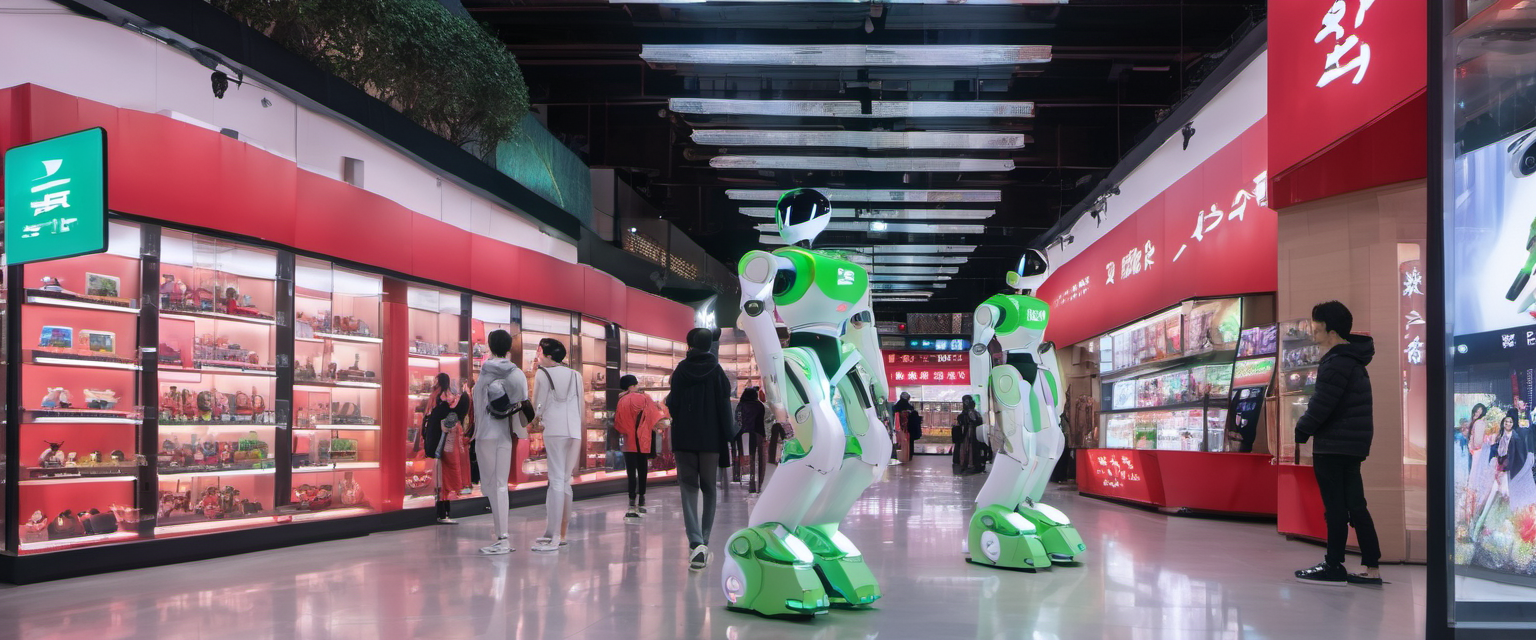
- April 29, 2026. Unitree’s first direct-sale store opens in Beijing’s Wangfujing commercial district — i.e., the same kind of physical retail real estate Apple and Huawei occupy. Demo robots dance in the window. Tourists film them.
- April 30, 2026. Unitree releases the R1, a dual-arm humanoid starting at ¥26,900 (about $3,949) per CnTechPost, with 15–31 degrees of freedom, OTA upgrades, and an optional Nvidia compute module. At that price, the R1 is meaningfully below the going floor for a hobbyist humanoid in 2026.
- May 7, 2026. UniStore opens. Twenty-four motion apps. G1-compatible.
What you are looking at is not four announcements. It is one story released as four chapters: a global sales channel (AliExpress), a physical retail footprint (Wangfujing), an entry-priced product (R1 at $3,949), and a software distribution platform (UniStore). That is the first four pieces of the iPhone-era playbook. The fifth piece, third-party developer revenue share, is the one to watch over the next two quarters.
Where this fits next to Tesla, Figure, and Boston Dynamics
The May 2026 humanoid landscape sorts cleanly into two columns.
Column A — factory-first. Figure 03 ramping to one robot per hour at BotQ targeting 12,000 units/year, BMW Spartanburg pilot. Boston Dynamics / Hyundai Atlas, 2026 production fully committed. Tesla Optimus, V3 reveal pushed to July/August 2026, useful “outside Tesla sometime next year” per Musk. Apptronik Apollo with Mercedes-Benz and GXO. Agility Digit at Toyota Canada with 7+ commercial units. All of these companies are selling robots into industrial workflows, with deployment success measured in pallets-per-hour and uptime percentages.
Column B — consumer-first. Unitree, G1 starting at $21,500 and shipping today, H1 at $99,900–$128,900, R1 at $3,949 starting May 1, retail store on Wangfujing, AliExpress availability worldwide, and as of May 7 a developer/user-facing app store. Plus an April 13 viral demo of a Unitree humanoid hitting 10 m/s, nearing Usain Bolt’s peak.
The two columns are not in direct competition yet, because they’re solving different unit economics — Figure earns its money on warehouse RaaS contracts, Unitree earns it on shipped boxes plus, now, on whatever take-rate UniStore attaches to third-party motion apps. But the directional signal from May 7 is clear: the consumer-first column has just shipped the first real distribution layer in the humanoid category. That is the most defensible piece of the iPhone analogy, and the part the factory-first column does not yet have an answer for.
The Shanghai filing makes the timing rhyme
It is not lost on anyone that UniStore opened a week after Unitree was reported to have opened its IPO file for a Shanghai STAR Market listing of up to ¥4.2 billion (about $610 million). The company’s 2025 revenue was ¥1.708 billion, up 335.4% year over year — a number that, if it sustains, hands the IPO a hardware story already in the public market.
UniStore is the software story. It is the story bankers will use on the second day of the roadshow to argue that Unitree is not, in fact, a robot OEM. It is a robot platform. The same multiple difference that separated Garmin from Apple in 2010 is the multiple difference between selling humanoid hardware at industry margins and capturing third-party developer revenue at platform margins. Whether UniStore actually develops into the second is a five-year question. But Unitree has put the rails down on the timeline that maps to its IPO listing window, which is the most legible alignment of product and corporate-finance moves any humanoid company has executed to date.
What to watch next
- Compatibility scope-out. UniStore is G1-only at launch, with H1/B2/Go2 reportedly in the pipeline. The first real compatibility extension — and how cleanly motion apps port across hardware tiers — is the test of whether UniStore is a platform or a G1-specific feature.
- Third-party publishing. As of May 7 the catalog is Unitree-published. The interesting moment is when an external developer ships an action that Unitree did not write — and what take rate Unitree charges. App Store launched with Apple-published apps too. The third-party flood happened over the next twelve months.
- R1 attach rate. A $3,949 humanoid with a phone-tap install path for new behaviors is a fundamentally different consumer proposition than a $21,500 G1. Unit volume on R1 over Q3 will tell us whether the consumer-first thesis has a real demand curve under it.
- The Figure / Boston Dynamics response. Figure has 350+ Figure 03 units shipped, a BotQ line, and an OpenAI partnership for Helix AI. It does not have a developer SDK story for end users, and as of today, neither does Boston Dynamics for Atlas. UniStore is the first move that forces those companies to either ship a developer platform or accept that the consumer humanoid ecosystem is going to coalesce around a Hangzhou-built app catalog.
- The IPO bookbuild. UniStore lands inside the window where Unitree will be answering questions from STAR Market investors about software margin upside. Whatever take rate gets disclosed in the prospectus is the number every other humanoid OEM in the world will then be evaluated against.
The dryly funny part
The world’s first humanoid robot app store opened with a Charleston motion pack. There is something almost touchingly Silicon-Valley-circa-2008 about it: the first thing the new platform’s most enthusiastic users want is for the device to dance. Apps for productivity arrive in year three. The first actual money on an app store is always made by the people who built games and novelty toys.
The interesting consequence is that, as of May 7, “what a Unitree humanoid is for” is no longer Unitree’s question to answer. The robot does what UniStore says it does. UniStore does what its publishers say it does. And its publishers, on day one, said the robot is for boxing, dancing, and walking to where you pointed. That is the same answer the iPhone had for the first six months of 2008.
By 2010 the answer was Uber, Instagram, and Square. The humanoid version of that timeline starts on May 7, 2026.