There is a difference between being newsworthy and being canonical. Amazon Vulcan crossed that line on May 28, 2026, when the RBR50 Robotics Innovation Awards named it Robot of the Year at the closing of the Boston Robotics Summit. The industry has spent the past twelve months arguing about who is shipping which humanoid where; the top honour went to a one-armed warehouse stower that does not look like anything from a CES press render.
What Vulcan actually does
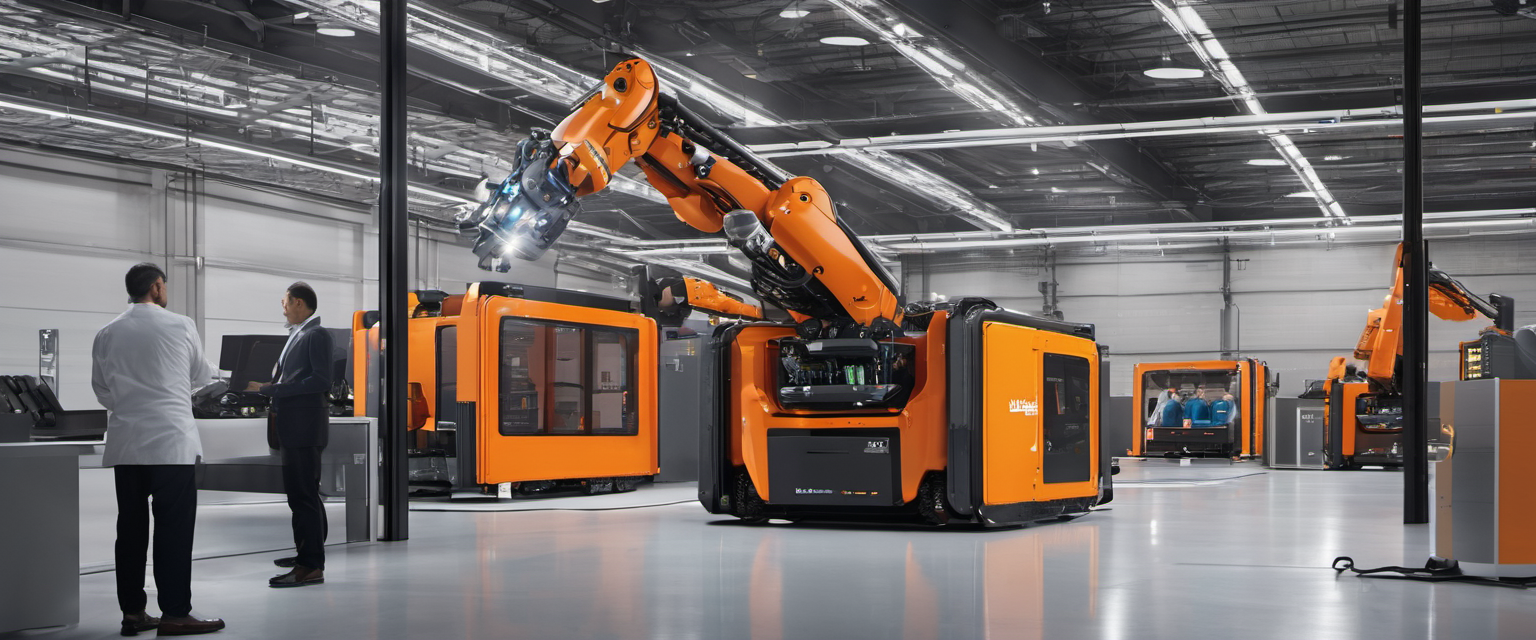
Vulcan is the first warehouse robot Amazon has deployed with a genuine sense of touch — AI-driven force and torque sensors at the wrist and along the arm, paired with computer vision, that let it determine the precise pressure required to insert or extract an item from a tightly packed fabric storage pod. It runs about 20 hours a day on a three-shift rotation, at picking speeds comparable to a human associate, and Amazon claims it can handle approximately 75% of the unique SKUs the average Amazon warehouse stocks.
The 75% number is the number that mattered to RBR50. The dominant warehouse-automation paradigm — Symbotic, Locus, Covariant, Berkshire Grey, Pickle — gets most of the way to the customer order by treating warehouse robotics as a logistics problem: case-handling, AMR routing, sortation. The fingertip-grade stow-and-pick problem at the SKU level is what Amazon had been doing by hand. Vulcan is the first credible bid that the SKU-level stowage step — the one that requires reaching into a stuffed cubby, feeling around for a half-inch of give, and inserting a new item without bruising it — can be done by a machine.
Vulcan has been operating at fulfillment centers in Spokane, Washington and Hamburg, Germany since May 2025 and has processed more than 500,000 orders. The award is for sustained deployment, not the demo reel.
What the RBR50 award actually says
The RBR50 — now in its 15th year — is the most credible industry-side prize in robotics, run by The Robot Report and adjudicated by working roboticists. Robot of the Year is its top category, awarded to a single deployed system per year. Past winners have skewed toward serious industrial work — sortation, surgical, agricultural — rather than the humanoid spectacle that has dominated the consumer press cycle. Picking Vulcan in 2026 is a deliberate corrective: the most-covered robotics story of the past year is the humanoid race, and the industry’s working roboticists handed the top award to a stationary one-armed warehouse system.
Amazon Robotics’ Aaron Parness (director of applied science) and Bhavana Chandrashekhar (senior manager of applied science) joined an on-record dinner conversation at the summit walking through the engineering path from early sensor prototyping to warehouse deployment — which is also a way of saying we shipped this, here is the deployment data, we are not waiting for next year’s demo cycle. The implicit comparison to the humanoid build-and-show cohort was not subtle.
The Neuralink coda
The summit closed with a different kind of statement. Noland Arbaugh, the world’s first human recipient of a Neuralink brain-computer interface implant, delivered the closing keynote and a live demonstration — neural cursor control onstage, drawing a standing ovation. Arbaugh, who was injured in his early 20s in a shallow water diving accident and was implanted in January 2024 as the first participant in Neuralink’s clinical trial, is now completing a neuroscience degree, runs a small business, plays chess and games, and writes — all through the implant. The talk title was “Rewiring What’s Possible.”
The pairing — Robot of the Year goes to a stowing arm, closing keynote to a man controlling a cursor with his thoughts — sketched the field’s two boundaries. At one end, robots that touch things. At the other end, humans that move cursors without touching anything. Everything else in 2026 robotics is somewhere on the line between those two points.
What this means for the displacement story
Vulcan does not eliminate the warehouse associate role. Amazon’s public framing is that Vulcan handles the top- and bottom-shelf stowage tasks — the parts that injure backs — and lets human associates work in the “ergonomic power zone” between mid-thigh and chest. That framing is technically accurate and politically necessary: Amazon currently employs roughly 1.5 million workers globally and any cleaner “robot replaces person” story would be regulatorily expensive.
But the operating math is what it is. If Vulcan handles 75% of items at 20 hours per day, and Amazon scales it across the more than 175 fulfillment centers in the network, the associate-to-pod ratio inside each building changes structurally. Some of that gets absorbed by demand growth — Amazon shipments are still scaling — and some of it does not. The deployment plan Amazon disclosed at the summit calls for rollout across additional US and EU sites over 2026–2028. The labor outcome will land sometime around 2028.
What to watch
- Per-site associate counts at Spokane and Hamburg. The cleanest read on Vulcan’s labor impact is the same building before and after. Amazon does not break out per-site headcount, but the WARN-style state filings in Washington will.
- Whether Vulcan ships outside Amazon. Boston Dynamics, Universal Robots, and Sanctuary AI have all worked on tactile arms. Amazon Robotics has historically kept its internal stack internal. If Vulcan or its descendant ever ships externally, the warehouse-robotics market changes shape overnight.
- The 75% number’s next leg. The interesting question is not whether Vulcan handles 75% — the interesting question is whether the next-generation system handles 90%, and what the remaining 10% of SKUs look like. (Hint: small, soft, and irregularly shaped.)
RBR50 picked the robot that learned to feel. The humanoid cohort will keep shipping press releases. The deployment data is what the award judges actually read.