Stelco told Hamilton on Monday that its cold-rolling and coating operations are going dark indefinitely, with layoffs starting October 9. United Steelworkers Local 1005 counts 350 jobs. Coverage of the company’s own framing runs as high as 500 production workers. In the coverage we read, the company’s stated reasons never mention AI or automation.
We’re filing it next to our Prudential, Bristol Myers Squibb and Bosch Nuremberg pieces. Big cut, AI not the stated cause. Knowing which cuts aren’t AI is part of reading the labor market correctly.
What stops and what keeps running
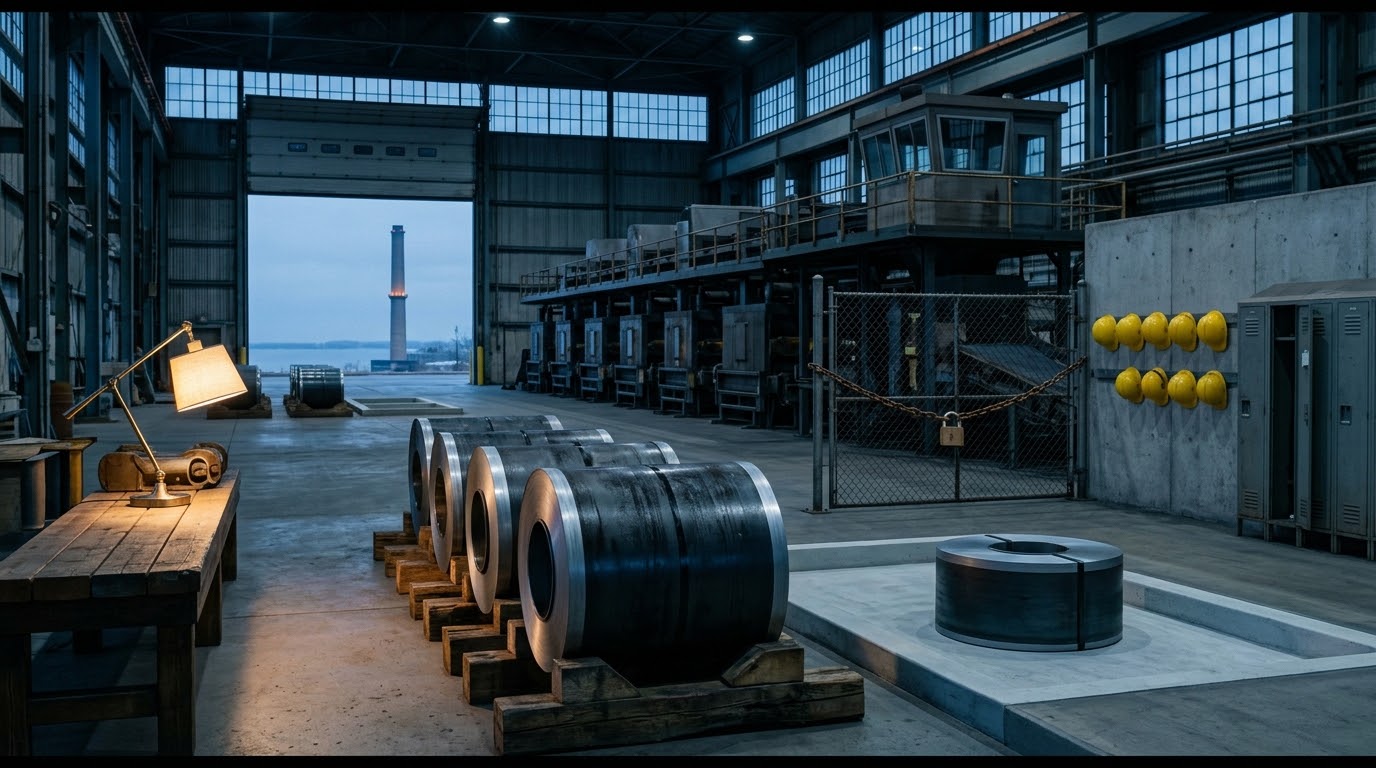
Hamilton Works loses its finishing end: cold-rolled and coated production. Hot-rolled capacity stays. Stelco says it is concentrating steel production at Lake Erie Works in Haldimand County and shifting its mix toward hot-rolled products. It expects a significant number of the affected Hamilton employees to be absorbed there. It gave no headcount for that.
Here is the detail worth holding onto. Total tonnage stays the same. The same steel gets made in one place instead of two, and the payroll drops anyway. Output didn’t move; the number of people standing beside the line did.
Frederic Fafard, Stelco’s vice-president of sales, called the move necessary for the company’s survival in a market he described as unsustainable. Local 1005 president Ron Wells raised a different question: how long. He said the union has no idea of the duration, and that Christmas isn’t far off.
The cause on the record: tariffs
The reason given is U.S. tariffs of up to 50% on Canadian steel. Wells relayed that the company described pricing on coated products as very low under those duties. That’s the union president’s account, not a company release, and we’re marking it as such.
Cleveland-Cliffs bought Stelco in November 2024 for a reported C$3.4B, with commitments to keep the unionized workforce intact. Cleveland-Cliffs CEO Lourenco Goncalves had already warned publicly that without more trade protection, the competitiveness of the Hamilton galvanizing lines was at risk. Monday’s idling lands exactly where that warning pointed.
Ottawa is in the story too. Federal Industry Minister Melanie Joly’s office said it is willing to provide financial support, and called Stelco’s rejection of the government’s proposals extremely disappointing. Neither side has put a number on the table.
The percentage nobody has published
Bosch gave a ratio: 900 of 1,800, half the plant. Stelco hasn’t. None of the coverage we read reports total Hamilton Works headcount, so 350 can’t be turned into a share of the site, and the gap between the union’s 350 and the roughly 500 attributed to the company is unexplained. Different counting is the likely reason, since the union speaks for its members and the company for its production staff, but that is our inference, not a reported fact. Until Stelco publishes the base, treat both figures as ranges around a line shutdown, not as a precise cut.
Set beside Bosch, same day
Bosch told its Nuremberg plant on September 28 that 900 of 1,800 jobs go by 2029. Two continents, one date, one shape: a named plant, a named line, a hard date, a cause pinned on trade policy or product demand. Stelco’s 350 to 500 is smaller than Bosch’s 900 but it’s the same kind of cut, a line switched off rather than a headcount trimmed.
It’s also a different animal from the group-level programs. Volkswagen’s 50,000 is a corporate plan; JLR’s 4,000 roles is a voluntary program aimed at managers. What the industrial cuts of the past three weeks share isn’t a technology. It’s an address.
The “AI not named” ledger, three weeks in
Put the recent no-AI cuts in one column and the shapes separate. Prudential’s 89 Newark jobs on September 18 brought its 2026 WARN total to 196, in language about being leaner and investing in technology. Bristol Myers Squibb’s 265 at its New Jersey headquarters on September 22 took its year to 718. Both are white-collar back-office rounds that hint at technology without naming it. Bosch’s 900 at Nuremberg and Stelco’s 350 to 500 at Hamilton are the opposite: shop-floor cuts where the stated cause is external and nobody hints at anything.
That split matters for anyone building a displacement model. A layoff notice that says “efficiency” while headcount falls and technology spending rises is one kind of signal. A notice that says tariffs while output stays flat is another. Counting both as AI overstates the technology’s reach; counting neither understates how much of the year’s headcount loss has nothing to do with it.
What it means for the people on the floor
Start with who. Cold-mill and coating-line operators, the electricians and mechanics who maintain those lines, the crane and materials crews who feed them. That mapping comes from how a finishing line is staffed, not from a company list; Stelco hasn’t broken the numbers down by trade.
Then when. October 9 is the only date. After it, the idle is open-ended and the union says it has no end date to plan around. AI displacement usually has a different rhythm: a tool ships, a number follows, and the people are affected months later. Here the sequence is tariff, line stops, people follow the line.
For readers sizing their own exposure, the practical read is this. If your job sits in export-exposed manufacturing where duties are squeezing the margin, the risk runs through order books and which site keeps the work, not through software. The hedge changes too. Being transferable to the plant that stays open matters more than learning a new tool. How many Hamilton workers Lake Erie Works actually absorbs is the number to watch, and the company has so far offered only “a significant number.”
What to watch
Three things, the first two inside the next few weeks. Whether Stelco puts a headcount on the Lake Erie Works transfers. Whether the layoffs after October 9 turn out to be temporary or permanent, which the union hasn’t been told. And whether Ottawa’s money materializes or the two sides keep trading statements.