
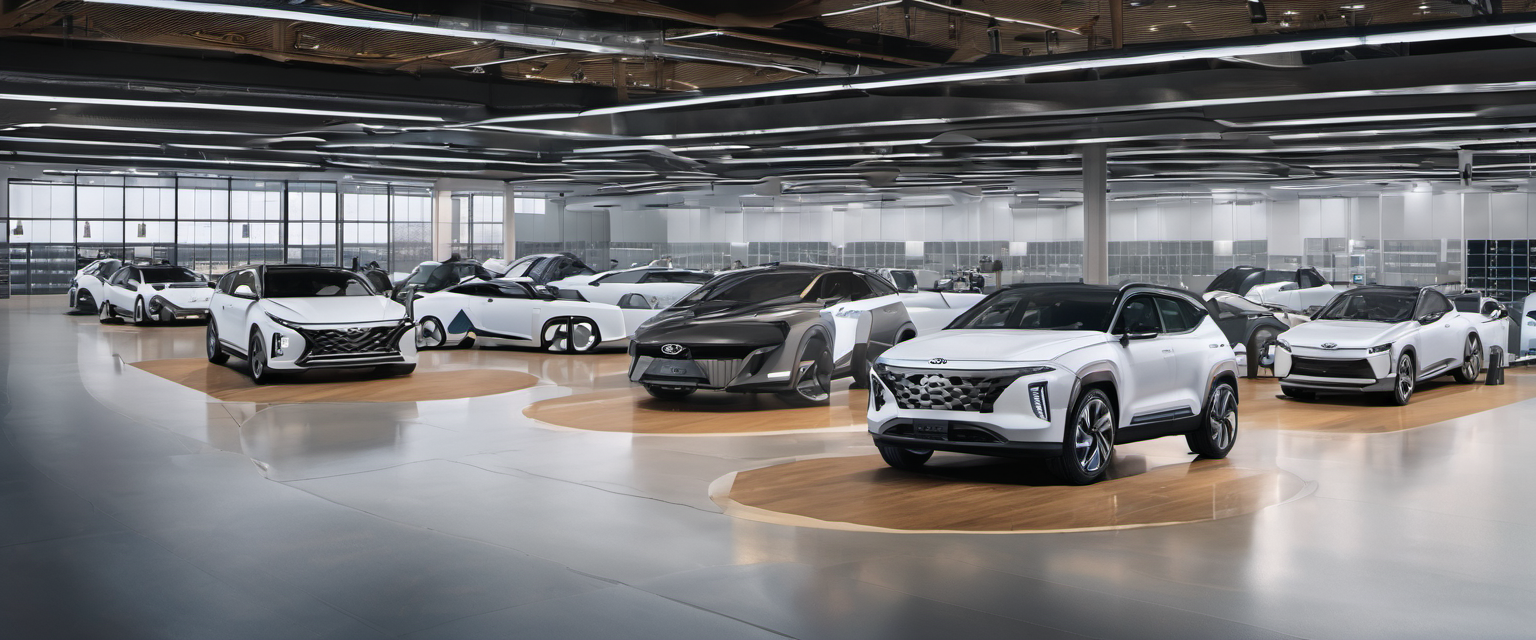
The Hyundai humanoid program ran the standard sequence in five steps. First, buy Boston Dynamics from SoftBank (2021). Second, build a working humanoid (Atlas reveal, January 2026). Third, prove the working humanoid can do heavy industrial tasks (100-pound zero-shot lifts, May 2026). Fourth, name a unit number against a date in front of a tier-1 bank (25,000+ Atlas across Hyundai + Kia, 30K/year capacity by 2028, 300,000 onshored actuator units per year — JPMorgan IR, May 19). Fifth, build the org chart that will actually execute on the number.
The fifth step happened on Sunday, May 25, 2026, with two announcements that landed in UPI, Korea Herald, and Korea Herald follow-up reporting over the weekend. They are individually small. Together they are the most important corporate-structure announcement in the industrial humanoid sector this year.
What Hyundai created
Two new divisions, two new executive seats, one location decision.
Software-Defined Factory (SDF) Transformation Center. A newly created group-level division whose mandate is to integrate AI across factory production, quality management, and logistics through a unified software stack — the manufacturing-side equivalent of what software-defined networking did to telecom. The SDF unit’s other and arguably more important role is to act as the control tower for Atlas deployment at Hyundai and Kia’s global production sites. Atlas does not roll into a Georgia plant in 2028 and figure out on its own how to load parts; it rolls in connected to a software layer that knows what every other robot, AGV, and conveyor on the line is doing. SDF is that software layer.
The head of the SDF Transformation Center is Alpesh Patel, per his Org profile, a former McKinsey partner who ran Digital Capability Centers for Asia-Pacific before joining Hyundai in 2023 as chief innovation officer at the Hyundai Motor Group Innovation Center Singapore. Patel is, in McKinsey terms, a “digital transformation” practice lead. In Hyundai terms, he is the executive accountable for whether a 30,000-units-per-year humanoid plan actually shows up on a manufacturing P&L instead of in a board deck.
Robotics Parts Procurement Office. A second, separate division stood up to handle supply-chain economics for the humanoid program — sourcing, cost competitiveness, and supplier qualification for the six core component categories that Hyundai Mobis is developing in-house (joint actuators, hand grippers, head modules, and three others). The director is So Hyun-sung, former head of development and planning at Beijing Hyundai. So’s previous role is the tell: he ran the joint-venture playbook of negotiating with mainland Chinese suppliers on margin and capacity, which is exactly the skill required to push an actuator supplier — likely some combination of Mobis, a Korean tier-2, and one or two Chinese vendors — into the ~$1K-per-actuator zone that makes a $25K humanoid plausible.
The May 19 IR session disclosed a 300,000-actuator-per-year U.S. onshored target. The May 25 reporting raised that figure to a 350,000-unit U.S. facility under discussion. Either way, the actuator alone is a billion-dollar component program before any humanoid is sold.
Georgia, not Massachusetts
The May 25 reporting confirmed that Hyundai Motor Group Metaplant America (HMGMA) in Bryan County, Georgia is the leading candidate for Atlas mass production. The site that lost is Boston Dynamics’ Waltham, Massachusetts headquarters.
This is a small geographic detail with a large strategic content. Massachusetts has the R&D talent, the MIT-adjacent ecosystem, and the existing Boston Dynamics build infrastructure. Georgia has the customer — the HMGMA plant where the first 25,000 Atlas units will actually go to work, and where Hyundai has already taken delivery of an active Atlas production allocation. Hyundai picked the customer’s address over the inventor’s address. It is the choice of a company that has decided humanoid robots are a manufacturing input, not a research artifact.
Atlas will start work in Georgia in 2028, doing parts sequencing — moving the right component to the right station at the right time, the unglamorous logistics work that pays for itself in five-figure savings per line per year. Assembly work begins in 2030. The two-year gap between sequencing and assembly is Hyundai admitting that the easy task is two years from now and the hard one is four.
What to watch
- Patel’s first-quarter SDF deliverable. Patel is on the clock to ship something nameable inside the next quarter or two — a digital-twin pilot at HMGMA, a Mobis-Atlas integration spec, a unified SDF data fabric. Hyundai disclosing what Patel ships against will signal how seriously SDF is being run.
- So’s first supplier announcement. A named US-based actuator supplier (Mobis itself, Sanctuary AI, or a Korean-Chinese consortium) becomes the second-loudest tell about the per-actuator cost curve, after Mobis’s own internal margin disclosures.
- The Korean union response. Korean union leadership has already signaled it will demand a labor agreement before factory deployment. The first US-shop response — Georgia’s UAW status is not the same as Ulsan’s — is the next data point. Hyundai’s choice of a right-to-work state for Atlas mass production was not subtle.
- The next humanoid company to copy this org structure. Hyundai is the first major humanoid customer to formally create a manufacturing-side org for it. Toyota, Ford, GM, BMW, and Stellantis all have to decide whether they need a Patel and a So. The next “VP, Head of Software-Defined Factory” hire at a Tier-1 OEM is the leading indicator for whether this becomes the industry pattern or stays a Korean experiment.