
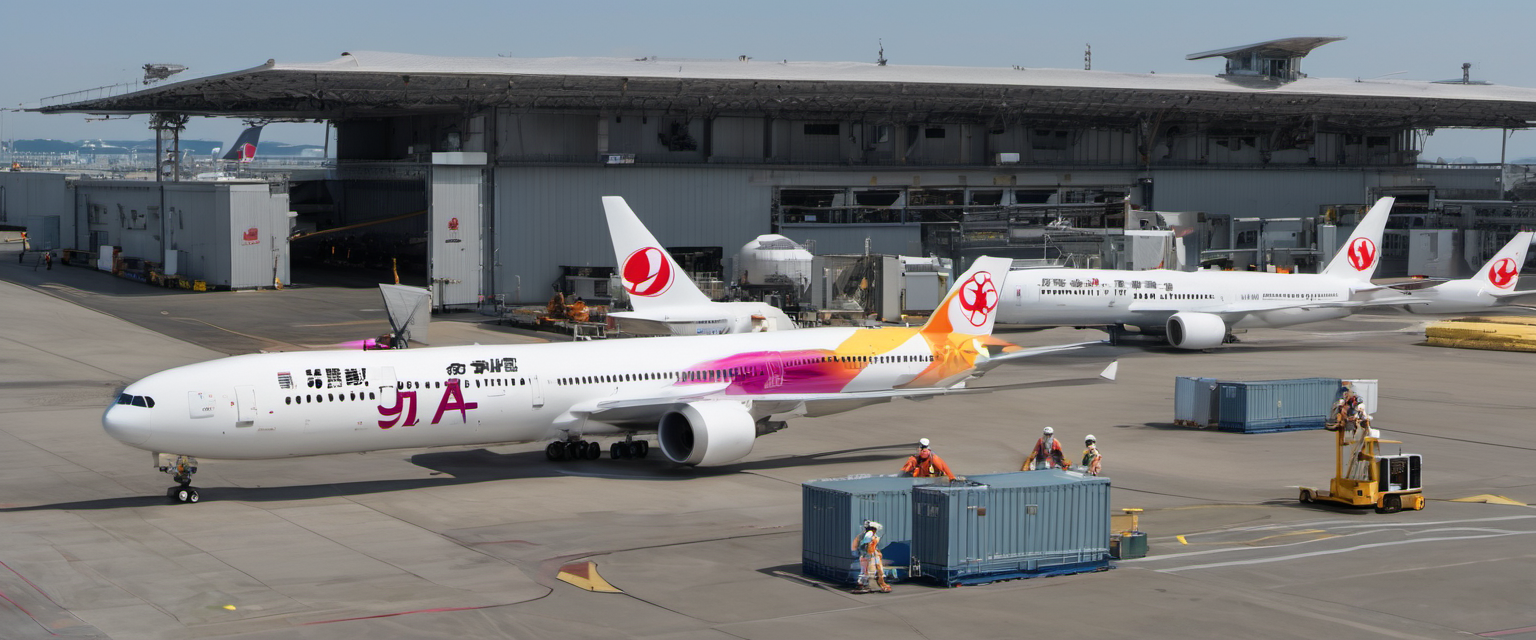
The most consequential humanoid-robot deployment announcement of this week did not come from California, Texas, or Shanghai. It came from a press conference at Haneda Airport.
On April 27, JAL Grand Service Co., Ltd. — the ground-handling subsidiary that has serviced Japan Airlines aircraft since 1951 — and GMO AI & Robotics Trading Co., Ltd., the AI/robotics arm of the GMO Internet Group, announced Japan’s first demonstration experiment of humanoid robots in airport ground operations. The pilot starts at Haneda in May 2026 and runs through 2028 as a phased program.
Two robots, both made in China. Initial tasks: container handling, ULD-securing levers, baggage transport. Forward roadmap: aircraft cabin cleaning, ground support equipment operation, broader apron work.
What is actually being deployed
Per Nippon.com’s coverage and the JAL/GMO joint release:
- Two China-made wheeled humanoids with dual articulated arms and grippers. Specific vendor not yet named in the public release; analysts watching the space suggest they are most likely Pudu or X Square-style wheeled dual-arm units rather than bipedal humanoids.
- Phase 1 tasks (May 2026 onward): moving aviation containers (ULDs, including LD3 family), opening and closing the levers that secure containers in cargo holds and on dollies, transporting bags between the aircraft and the sortation conveyor.
- Phase 2 (2027–2028, planned): cabin interior cleaning between flights, towing operations, broader ground support equipment integration.
- Operational shape: robots run alongside human ground crew during the pilot, not as replacements. JAL Grand Service brings the operational expertise and the safety envelope; GMO supplies the hardware and the movement programming.
The choice of wheeled rather than bipedal is the same product call X Square Robot made for its home humanoid and that Amazon made years ago for warehouse Proteus. An airport apron is flatter than a Chinese apartment kitchen. Stairs are not part of the job. The robot needs to roll, turn in place, pick up 32-kg unit loads, and not knock anything over near a $300M aircraft.
The cover story: labor shortage
The official framing in every JAL/GMO release is labor shortage and aging population. Both are real.
Japan’s airport ground-handling sector has been bleeding workers since 2019, with the post-COVID inbound tourism rebound stretching the remaining workforce thin. Inbound visitor arrivals to Japan crossed 40 million in 2025 and Haneda’s ground-handling cycle times have been visibly suffering. The official goal of the pilot is, in JAL’s own language, “labor savings and reducing workload by having humanoid robots complement human tasks.”
That is the official goal. It is the right goal. It is also a goal that the Japanese aviation press will report straight, because the alternative framing — “Japan’s largest airline is using a labor crisis as cover to validate the cost case for replacing one of the most stable blue-collar union jobs in the country” — is impolite to write in Tokyo right now.
Both framings are factually true. The decision-relevant question is which one is the operating logic for the post-2028 phase.
The real story: 2028 as a soft deadline
The pilot’s phased structure is the giveaway. JAL is not running a one-quarter PR demo. It is running a 2026–2028 staged validation that walks deliberately through the cost-engineerable parts of the ground-handling job:
- 2026: containers and ULDs. The most physical, most repetitive part of the job. Highest unit-cost per human-hour. Most amenable to a wheeled dual-arm robot. Easiest piece to validate first.
- 2027: cabin cleaning between flights. A discrete, high-frequency task with clear start and stop conditions. Already fully solved as a problem in commercial-cleaning robots (Pudu’s installed base is 70% commercial cleaning). Bringing it into the airport cabin is a packaging exercise, not a research exercise.
- 2028: towing and full ground-support-equipment integration. The piece where the robot graduates from “complementing human tasks” to “doing the human’s task.” This is the validation gate that 1X, Figure, and Apptronik are still failing in factory pilots; JAL is putting it on the public roadmap with a date.
If the 2028 milestone is met — even partially — the operating math for JAL Group changes. JAL Grand Service’s ground-handling cost per turn has been one of the largest controllable line items on the JAL Group P&L for forty years. Replacing the union-staffed marginal ULD-lift with a depreciable robot moves that line from labor (an OPEX with annual wage drift) to capex with depreciation (a fixed-cost item). The CFO of every other Asia-Pacific carrier with a unionized ground-handling subsidiary — Singapore Airlines’s SATS, Korean Air, Cathay’s HAS, ANA’s NAA — will be reading the JAL/GMO 2028 milestone as a proof-or-disprove for their own boards.
Why the robots being Chinese matters
The single most under-reported detail in the press release is the country of origin of the hardware: China.
Japan’s domestic robotics industry — Yaskawa, Fanuc, Kawasaki, Denso, Omron — built the modern industrial-arm category and has a hundred-year head start on humanoids. None of them are in this pilot. The robots Japan’s flag carrier is putting on the apron at Haneda were built by a Chinese vendor, in a Chinese factory, and shipped under a Japanese brand integrator (GMO).
There are two ways to read that:
- Speed to deployment. Chinese wheeled humanoids are shipping in the thousands in Q2 2026 (Pudu, X Square, Robot Era, Star Dynamics all in mass production), while Japanese makers are still in single-unit prototype phase for service humanoids. JAL needed something it could put on the apron in May, not in 2028. China was where the inventory was.
- Strategic dependency. Japan’s domestic robotics industry, the one that built Toyota’s auto factories and SoftBank’s Pepper, has just been bypassed for the most public, most prestigious humanoid pilot in the country, by its own flag carrier, in favor of imported Chinese hardware. That is a story METI and the Japan Robot Association will be quietly furious about.
Both readings are true. The interesting question is whether Japan’s domestic humanoid industry — Kawasaki’s Kaleido, the various Sony robotics-research projects, the Honda lineage that produced Asimo — gets a 12-to-18-month wake-up window from this announcement, or whether the imported-from-China default just becomes the assumption for the next pilot, and the next, and the next.
What LostJobs is watching
- Whether Pudu, X Square, Robot Era, or Star Dynamics names itself as the JAL pilot vendor in May. None of the four has confirmed yet. The vendor that gets credit for putting the first humanoid on a Haneda gate gets a tier-1 reference customer in service-aviation, which is one of the highest-prestige verticals in any robotics deck.
- Whether ANA matches with a counter-pilot at Narita by end of 2026. Japan’s two flag carriers do not let each other take a one-quarter PR lead on infrastructure decisions of this size. If JAL/GMO ships in May, the ANA/
press conference is on the calendar before October. - Which Western flag carrier copies the playbook first. The obvious candidates are Lufthansa Group (Frankfurt, with the Vodafone Duisburg humanoid pilot already on the same continent) and Singapore Airlines’s SATS subsidiary. The first non-Japanese flag carrier to put a humanoid on a gate moves the JAL pilot from “Japan story” to “global airport-operations story.”
The dry coda: the JAL Grand Service ground-handling job has been one of the most stable, unionized, blue-collar career tracks in postwar Japan. The official framing of the pilot is that humanoid robots will complement human work, not replace it. The roadmap timestamp is 2028. The industry’s word for “complement” between 2026 and 2028, and “replace” after, is “phased deployment.” JAL just published the phasing.