
The most useful number in Serve Robotics’ Q1 2026 print is the one that didn’t change.
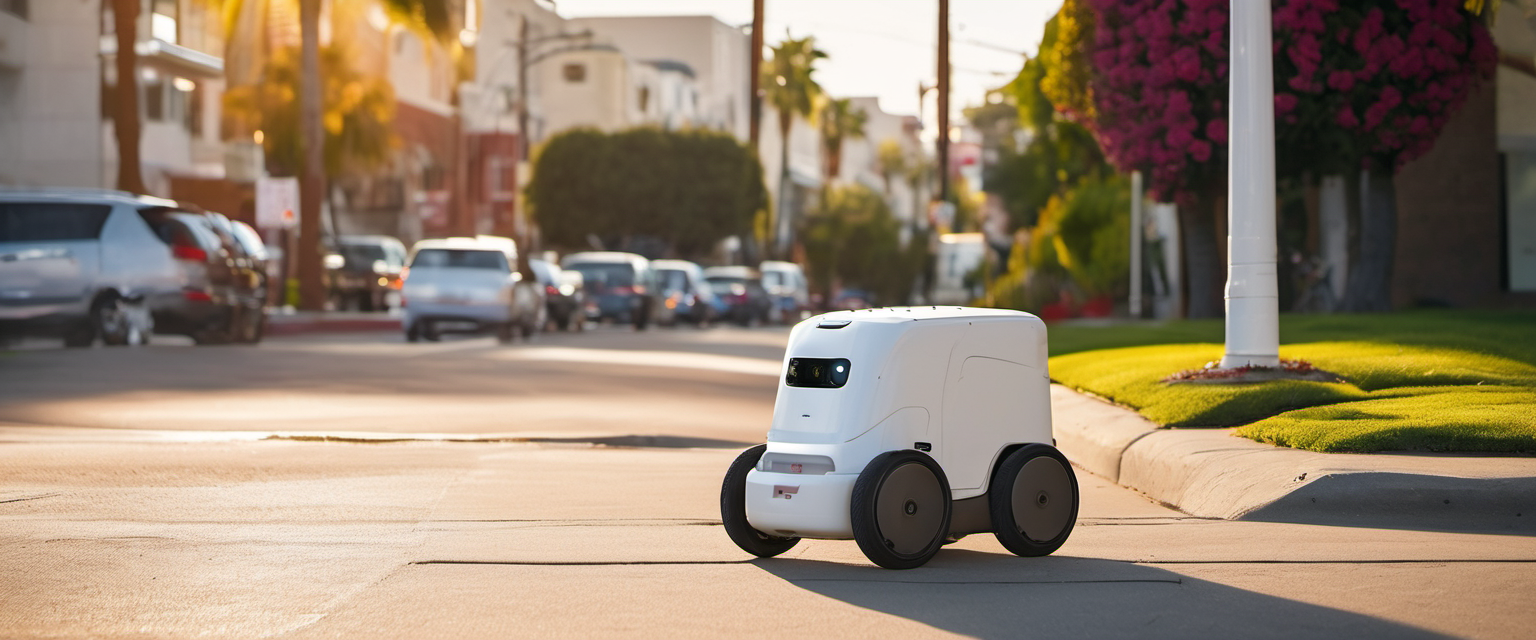
The fleet is still 2,000 sidewalk delivery robots, deployed across 20 cities, as the company confirmed on its May 7 earnings call. That is the same fleet number Serve had at the end of Q4 2025. There were no net new sidewalk robots added in Q1. Management explicitly told investors that no additional sidewalk robots will be deployed in the first half of 2026, with the focus instead on operational density and per-unit utilization.
Against that frozen-fleet backdrop, here is what changed:
- Q1 revenue: ~$3 million, above expectations, up nearly 7x year-over-year and 3.5x sequentially.
- Fleet revenue: from roughly $200,000 in Q1 2025 to ~$2 million in Q1 2026 — about a 10x increase on the line item that’s most directly tied to robots actually doing work.
- Daily active robots: up 10x year-over-year.
- Daily supply hours (the company’s measure of fleet uptime in service): up 13x year-over-year.
- Software services: about one-third of total Q1 revenue.
- Recurring revenue: just under half of total revenue.
- Cash and marketable securities: $197.4 million.
- 2026 revenue guidance: maintained at $26 million, per the prepared remarks summary on Yahoo Finance.
- Geographic footprint: 44 cities across 14 states, including the company’s first healthcare-segment expansion.
The story is not more robots. The story is the same robots doing meaningfully more work.
What “10x daily active robots on a frozen fleet” actually means
If the fleet is fixed at 2,000 and the number of daily active robots is up 10x year-over-year, the implication is straightforward: a year ago, on any given day, only a small fraction of Serve’s deployed fleet was actually rolling. In Q1 2026, a much larger fraction is. That is the difference between owning hardware and operating it.
The 13x lift in daily supply hours sharpens the picture further. Supply hours are the metric that tracks how many robot-hours per day are actually available to merchants for delivery jobs — i.e., how many of the 2,000 robots are not just powered on but parked at a partner location, charged, and accepting tickets. A 13x lift on flat fleet count means uptime per robot is climbing roughly proportionally to the activation count. The bottleneck moved from “do we have the robot” to “is the robot in service” — and the in-service number is rising fast.
This is the part of robotics that doesn’t get press releases. Building a humanoid that dances on a launch stage is one kind of robotics company. Getting 2,000 already-deployed sidewalk robots to actually run, every day, in 20 different cities with 20 different sidewalk regulations and 20 different merchant integrations — that’s a different kind. The Q1 numbers say the second kind is finally working.
The fleet pause is the story underneath the story
Most growth-stage robotics companies grow by deploying more units. Serve, in Q1 2026, is doing the opposite: it announced it will not deploy additional sidewalk robots in H1 2026. Capital that would otherwise go to building the next wave of robots is going to “operational growth and efficiency” — which, in plain English, is the unglamorous work of merchant onboarding, route optimization, charging infrastructure, fleet remote-supervision, and software margin.
This is a confidence trade. Pausing fleet deployment in the middle of revenue ramping 7x is only rational if you believe utilization on the existing fleet has at least another doubling in it. Management is, in effect, telling the market: we are not unit-constrained, we are unit-economics constrained, and the next unlock is in the operating layer, not the manufacturing line.
The other reason it is rational: with $197.4 million in cash and marketable securities and a $26 million revenue guide for the year, Serve is sitting on roughly 8 years of revenue in cash. There is no scenario in 2026 where Serve runs out of money. The fleet pause is therefore not financial. It is operational discipline at the moment the operating discipline has the most leverage.
The recurring-revenue pivot
The single most interesting line in the Q1 disclosure is that just under half of total revenue is now recurring, with about one-third coming from software services. A year ago, Serve was a robotic delivery hardware-and-services company. The Q1 mix is the first quarter where you can credibly call it a software-and-fleet platform — i.e., the ratio of recurring to transactional has crossed the threshold above which sell-side starts modeling the company as SaaS-with-hardware rather than hardware-with-SaaS.
That re-rating, when it lands, is worth multiple turns on the price-to-sales multiple. Recurring SaaS comps trade at 8–15x sales in the current tape; transactional last-mile delivery comps trade at 1–3x. Serve, at a current ARR run-rate well below $10M, is too small for the comparison to drive the stock today. But the Yahoo writeup characterizing Serve as “a physical AI growth story” is exactly the framing the company wants — and it is the framing that justifies the multiple it would need to re-accelerate fleet deployment in H2 with secondary capital.
Where Serve fits in the May 2026 robotics cohort
The May 2026 cohort of robotics announcements has been heavy on humanoids — Atlas’s handstand at Hyundai, Robotera’s $200M and thousand-unit deliveries, Unitree’s UniStore launch, Schaeffler’s 30-prototype rotary actuator program, 1X’s Hayward NEO factory. These are all hardware-platform stories: which biped will win the factory floor.
Serve is the cohort’s reminder that the robotics industry already has a working commercial fleet category — wheeled, low-DOF, last-mile delivery — that is quietly running 2,000 units across 20 cities and posting the kind of revenue inflection that humanoid platforms are still 24–36 months away from showing. The story is not as photogenic as a robot doing a handstand. It is, however, the one with a P&L attached to it.
This is also a useful counterweight to the May 7 ai-jobs cohort. While Cloudflare, PayPal, BILL Holdings, and Microsoft all spent the same week explaining how AI was letting them remove human payroll, Serve spent the same week explaining how more of its 2,000 robots were finally doing what last-mile gig couriers used to do. The replacement layer for the gig economy is, this quarter, no longer entirely theoretical. It is rolling along the sidewalks of Los Angeles, Dallas, Miami, and Vancouver at 4 mph.
What to watch for the rest of 2026
- Whether the fleet pause holds through Q2. If Serve resumes deployments in Q3, the implication is that utilization has saturated on existing units and the operating discipline experiment is over. If the pause extends, expect another 5–10x compounding on revenue per robot before any new units ship.
- The software-services revenue mix in Q2. Crossing 40% would be the moment the SaaS comp argument becomes the dominant valuation framework.
- Healthcare-segment ramp. The Q1 footprint expansion into healthcare is the first non-restaurant vertical. If it scales at all, the addressable market re-prices.
- The $26M guide vs. the H1 trajectory. A ~$3M Q1 implies the company needs roughly $23M across Q2–Q4 to hit the guide. Given the 3.5x sequential trajectory and the frozen fleet, the guide is conspicuously beatable. The relevant question is whether management will raise it on the Q2 call or wait for Q3.
- Whether competitors follow. Coco, Starship Technologies, and Cartken all operate variants of the same wheeled-sidewalk model. None of them are public. None of them have to disclose. A printed 10x-on-flat-fleet quarter from Serve will move private-market term sheets in the rest of the category.
The dryly funny part
The single funniest line in the Q1 transcript was the disclosure that about half of revenue is now recurring sitting next to the disclosure that the company will not deploy any additional sidewalk robots in the first half of 2026. Most growth-stage robotics companies cannot say both of those things in the same paragraph without a contradiction. Serve can, because the recurring half is being generated by hardware that has already been deployed and is being more intensively scheduled.
In a year when every other AI story is about removing payroll to fund GPUs, the 7x revenue print on a frozen fleet of 2,000 robots is a quiet rebuttal: the most expensive part of robotics, in the end, was never the robot. It was the merchant integration, the route software, the remote supervision, the charging logistics, and the operating discipline to make any of it run on Tuesday morning.
Serve Robotics, this quarter, finally has a Tuesday morning that pays.