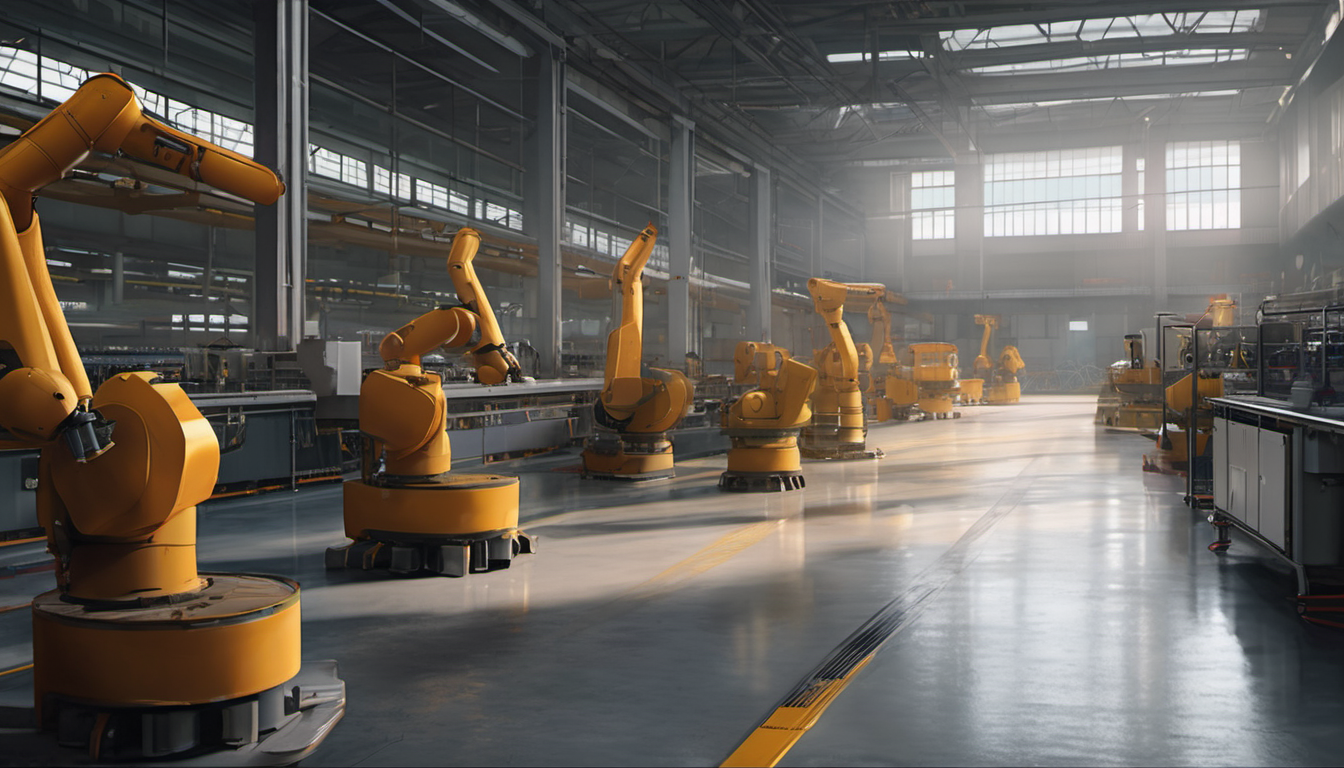
Most of the humanoid-robot news out of China this year has been the same genre of clip: a machine does a backflip, folds a shirt, or scores a goal at RoboCup, and a valuation goes up. Beijing has now decided it is bored of the clip. A joint action plan from the Ministry of Industry and Information Technology and the state-asset regulator, SASAC, has told state-owned enterprises to stop demonstrating and start deploying — 10,000 humanoids in routine operation across more than 100 real scenarios by the end of 2026.
From “look what it can do” to “prove it earns its keep”
The plan, launched in early June, is unusually blunt about its own intent: it names the goal as pushing the industry from a “technical verification” phase to a “practical operation” phase, per the South China Morning Post. The scenarios listed are not stage-friendly party tricks — they are manufacturing, warehousing, logistics, retail, healthcare, equipment inspection, maintenance, emergency response, and disaster relief, according to Pandaily. The message to a Chinese SOE is roughly: we do not want another highlight reel, we want a robot that shows up to a shift.
And because this is a directive with a paper trail, it comes with deadlines that make executives sweat. Local governments and state-owned firms had to submit implementation plans by the end of June, with progress reports due in November. That is the tell that separates this from the usual glossy technology strategy. When a plan attaches a reporting date to a named list of state enterprises, “we’re exploring the space” stops being an acceptable answer.
The quiet part: it was never really about 10,000 robots
Here is the number worth sitting with, and it is not 10,000. A fleet of ten thousand humanoids working real shifts, eleven-plus hours a day, generates something no lab and no commercial market has yet produced at scale: a torrent of messy, real-world operational data — every grasp that slipped, every aisle it misjudged, every human it had to work around. The hardware is the cost of admission. The data is the product. China’s approach reads less like an industrial-policy target and more like a national data-collection program wearing a factory uniform, and the SOE reporting requirement is the mechanism that guarantees the data actually flows back into the models.
The competitive logic is uncomfortable if you are a Western robotics firm burning cash to collect the same data one BMW pilot at a time. Figure runs a 200-hour livestream; AGIBOT counters with a six-day webcam on a real tablet line at Longcheer’s Nanchang factory. China’s answer is to skip the marketing war and simply mandate the deployments, then harvest the data across a hundred sites at once. Morgan Stanley evidently sees the ramp coming — it recently raised its China humanoid shipment forecast to 50,000 units, five times the deployment floor the policy sets.
Where the honesty lives
A mandate is not a capability, and it is worth holding both thoughts. You can order 10,000 robots onto factory floors and still discover that a meaningful share spend the year as expensive, semi-idle mannequins that need a human minder — deployment targets have a long history of being met on paper and fudged in practice, and “routine operation” is doing a lot of quiet work in that sentence. The technology does not care about a November reporting deadline. State grids are already pulling in thousands of robot dogs and humanoids for inspection work, which is real, but inspection is also one of the easier jobs to hand a machine.
Still, the direction is the story. The rest of the industry is trying to earn its way to scale one paying customer at a time; China has decided scale is a policy lever you pull, and worry about the economics later. For anyone watching automation come for their own line of work, the relevant shift is not whether these particular 10,000 robots are any good. It is that the country shipping roughly 90% of the world’s humanoid units just decided the bottleneck was never the hardware — it was the excuse to put it to work.