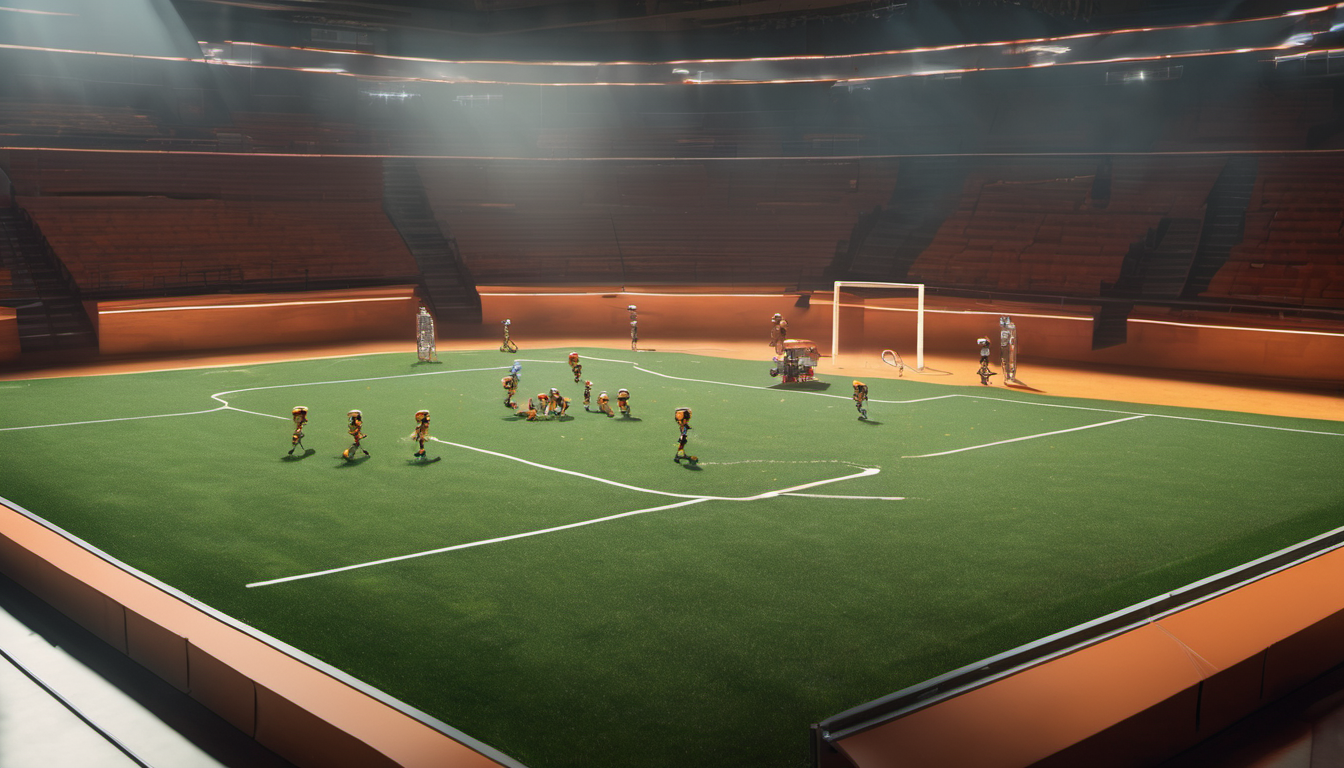
RoboCup 2026 wrapped up on July 6 at Songdo Convensia in Incheon, South Korea, after a week that drew around 3,000 participants from 45 countries. In the headline event — the Humanoid League — Tsinghua University’s THU Huoshen team successfully defended its world title, competing with the Booster T1 humanoid and taking back-to-back championships. The win came a year after the same team ended a 28-year drought for Chinese competitors by taking the title in Brazil. As reported by CGTN and Interesting Engineering, it is easy to file this under “cute robots kicking a ball.” That framing misses the entire point.
The soccer is a benchmark, not a sport
RoboCup has never really been about soccer. Since 1997 it has used the game as a stress test, with a deliberately absurd long-term goal: a team of humanoid robots that can beat the human World Cup champions by 2050. Soccer is the chosen problem because it forces everything hard about robotics to happen at once and in real time — balance on two legs, vision in a chaotic scene, split-second decisions, and coordination with teammates, all without a human at the controls. A robot that can play a passable game of soccer is a robot that has solved a stack of problems that also happen to matter on a factory floor or in a warehouse.
The 2026 edition leaned hard into the part that counts: full autonomy. In the newly merged Humanoid Soccer League, the robots independently perceived the field, tracked the ball, coordinated with teammates, planned their actions, and executed passes and shots with no human control during matches. There is no joystick, no operator off-camera. Whatever the robot does, it decided to do. That is the line that separates a teleoperated demo from an autonomous system, and it is the line that matters for anyone thinking about where physical labor goes next.
Why a college soccer match is a labor story
Here is the connection to work, and it is not a stretch. The hardest, most expensive thing to automate has never been the thinking — it has been the moving. Software ate desk jobs quickly because bits are cheap to push around. Physical jobs held out because a robot that can reliably walk across an uneven floor, see what’s in front of it, and make a decision without a human minding it has been genuinely hard to build. RoboCup is the open, competitive scoreboard for exactly that capability. When the autonomy on display jumps year over year — and it did — that is the clock ticking on the moat that has kept warehouse, logistics, and light-manufacturing jobs relatively safe.
It is also, quietly, a China story. The winning robot, Booster T1, comes from a Chinese humanoid maker, and the top teams increasingly cluster around Chinese universities and companies — Tsinghua took both the flagship AdultSize title and a division win, and Wuhan University’s Invic took another. The same industrial base now spinning up humanoid production lines is also winning the research competition that defines what those humanoids can do. The talent, the hardware, and the manufacturing are lining up in the same place.
Keep the timeline honest
None of this means a robot is coming for a warehouse job next quarter. A RoboCup humanoid plays on a small, controlled pitch with a brightly colored ball and simplified rules; a real warehouse is messier, and the robots that work there today mostly do narrow, structured tasks. The gap between “can play autonomous 3-a-side soccer” and “can do a shift of unstructured physical labor” is real and should not be waved away.
But the direction is not ambiguous. RoboCup exists to measure one thing — how well machines can act on their own in the physical world — and the measurement keeps improving. The useful way to read a robot soccer championship is not as a novelty clip but as a dated data point on a curve. The curve is the one that eventually intersects a lot of jobs. It is worth watching what happens to it each July, precisely because it looks like a toy right up until it doesn’t.
Sources
- CGTN — Robot World Cup 2026: China defends humanoid world football title
- Interesting Engineering — China wins RoboCup 2026 as humanoid AI soccer reaches new heights
- Global Times — Chinese team defends RoboCup 2026 title as embodied AI in sports draws global attention
- RoboCup Humanoid Soccer League — Results 2026