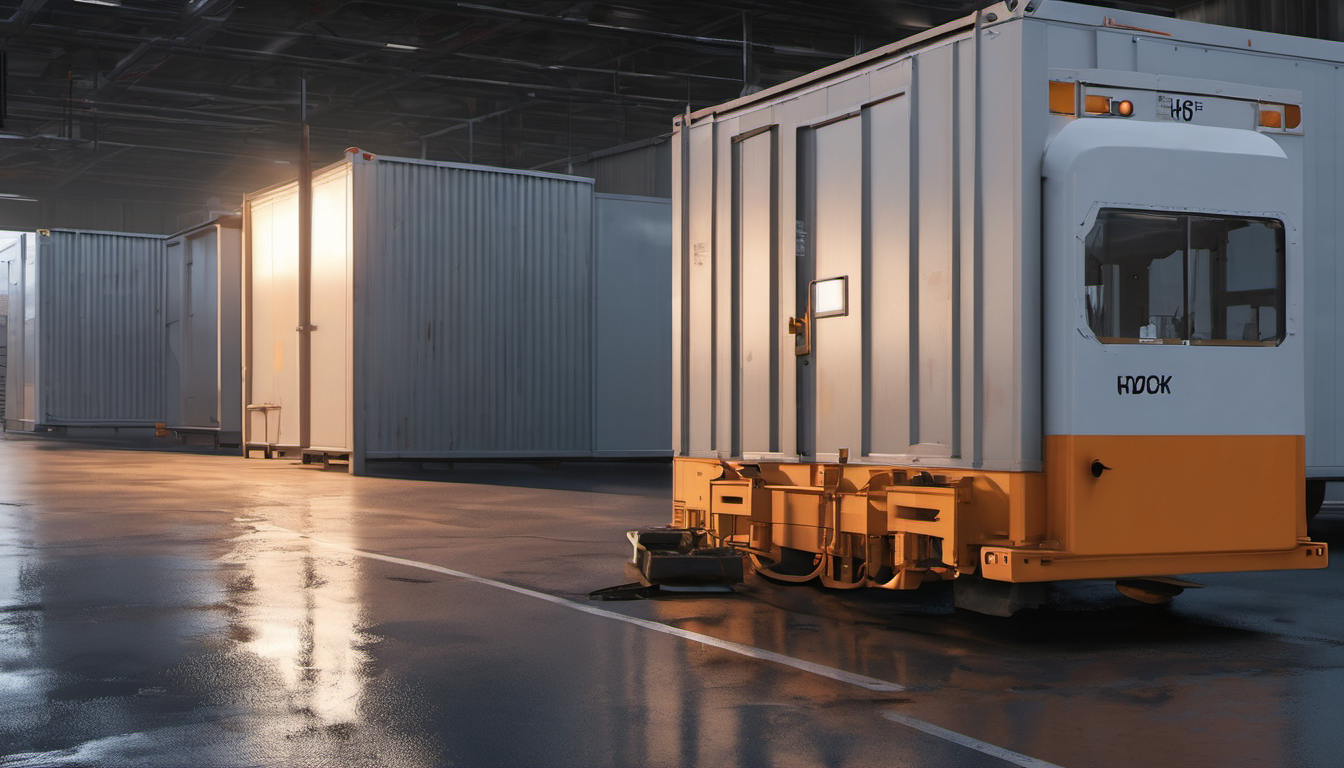
On September 15, in Edermünde, Germany, Einride (Nasdaq: ENRD) and Lidl put a cab-less SAE Level 4 truck into daily operations on a public road.
One sentence in the release does the work: no driver or safety operator on board.
What is actually running
The route is short and specific. A Lidl warehouse and distribution centre at one end, a Lidl store at the other, goods moving between the two every day.
The permit comes from the Federal Motor Transport Authority, the KBA, and the release calls it the first of its kind granted in Germany. Getting it took an extensive safety validation conducted with the KBA to confirm the technology holds up on public roads under real conditions.
Einride CEO Roozbeh Charli: “Germany’s approval process is among the toughest in the world, and obtaining clearance there gives us a foundation to scale with confidence.”
The scaling path is in the release too. The route expands from point-to-point toward a full multi-stop milkrun, and further deployments across the companies of Schwarz Group, Lidl’s parent, are “currently being discussed.”
Lidl’s stated reason is direct: driver shortages, continuity in the flow of goods, supply chain resiliency.
One truck is not the story. One permit is.
Scope first, so nobody over-reads it. This is a single vehicle on a single route. No fleet count, no mileage, no shift figures appear anywhere in the release, and nothing here is a fleet.
The weight is in the permit.
Germany is Europe’s largest road transport market and runs some of the strictest road-safety regulation anywhere, with no general Level 4 type approval on the books. Every driverless deployment there clears regulation individually. Once the first one clears, the rest have a reference. Regulatory approvals tend to work this way: after the hardest signature, the question stops being whether and becomes when your turn comes.
Put it in this year’s sequence. On August 25 we covered Gatik, which raised $200M at Series D against 41 driverless box trucks and roughly $600M in contracted revenue, running the distribution-centre-to-store leg. The read then was that autonomous money had chased robotaxis and long-haul while Gatik took the dullest, most repeatable stretch on the map.
Three weeks later the same stretch went in Europe, under harder regulation.
Why this leg goes first
The warehouse-to-store run has a set of properties that, stacked, describe exactly what automation wants.
The route is fixed and barely varies day to day. The distance is short enough that nobody needs a rest break or a shift change mid-run. Both ends are company property, so loading happens on your own dock without negotiating with a stranger’s receiving desk. The schedule is regular enough to be timetabled weeks ahead.
For a person, that same list describes the least interesting version of the job: repetitive, short-haul, chopped into fragments, and paid below the rest of the freight market. The sector has struggled to fill these seats for years. Lidl’s driver-shortage line is not a pretext.
But “cannot hire enough” and “does not need people” are two different states, and one truck can address the first and then drift into the second. Nothing technical separates them. Only time does.
For scale, the release’s own boilerplate: Lidl runs more than 3,250 stores and 39 administrative and distribution centres in Germany with over 100,000 employees. Schwarz Group overall is some 14,500 stores, 604,000 employees and €185.6B in 2025 sales. How many times the warehouse-to-store leg repeats inside that network is answered by those numbers. What gets copied when permits start clearing is not a truck. It is the route template.
The role that is missing
The most telling thing in this release is a job that does not appear in it.
On September 9 we covered Zurich Airport, where two shuttle buses began running on airport grounds with no safety driver aboard after 15,000 km and 18 months of staged handover. The part that mattered: the safety drivers were not cut. They were retrained into a remote cockpit, watching the buses from screens, with the airport already saying one employee would eventually monitor several vehicles.
That is a job migrating. The human moves from the seat to the console, and one person’s output gets multiplied across a small fleet.
Einride’s release contains no remote cockpit, no monitoring centre, and no human role of any kind. It says there is no driver and no safety operator on board, and stops.
The difference is not a matter of house style. On the Zurich route there is a table a union and an employer can sit at, and the agenda items are how many vehicles one person watches, how the hours are counted, what the rate is. This release does not say where that table is.
The shelf life of “driver shortage”
Addressing driver shortages is the framing attached to nearly every European freight automation announcement, and today it is accurate. The average age of professional drivers in Europe skews old, young people have been entering the trade at declining rates, and the gap is real.
The framing is useful because it files automation under filling a hole rather than taking a seat. Filling a hole does not require bargaining. Taking a seat does.
That framing has a shelf life, and the expiry is calculable. When deployment outruns the rate at which the gap widens, the same vehicles stop filling holes and start holding seats. There will be no press release on that day. It will show up as a route whose driver vacancy simply stops being posted one year.
Here is the signal to watch before then: when Einride and Lidl announce a second route, and whether they use a unit count when they do. One truck is a demonstration. A number of trucks is a fleet. This release has no unit count anywhere in it. Whether the next one does will say more about where this stands than the permit did.
Christian Hirte, Parliamentary State Secretary to the Federal Minister of Transport, also lent his name, saying autonomous and zero-emission driving “has moved from a future vision to a reality on our roads” and committing Germany to pioneering deployment of advanced mobility technology.
The government side of this is on the record. The labour side of it is still blank.
Sources