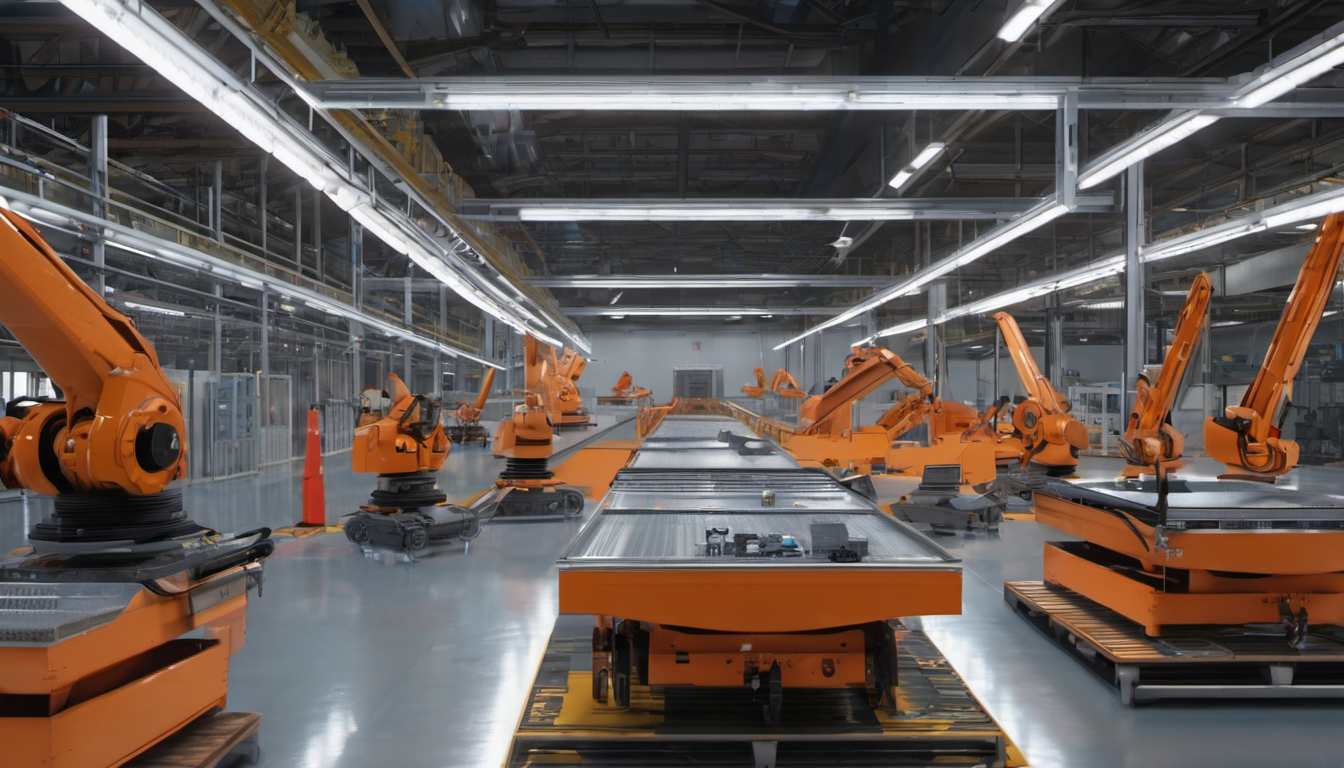
When we covered Robotera’s $200M-plus round on May 8, the deployment claim was a single phrase: robots in more than 10 logistics centers run by China Post and SF Group. No cities, no throughput.
On November 17 Robotera filled in the China Post half. A PR Newswire release datelined Beijing says its humanoids are now working in 11 postal hubs across eight cities in the network of China Post Group’s Guangdong Branch.
The delta
The eight cities are Guangzhou, Shenzhen, Dongguan, Jiangmen, Shantou, Shanwei, Jieyang and Heyuan. The pilot began in March at the Guangzhou Postal District Center. One site to 11 took about eight months.
There is one performance figure: an average induction rate of more than 1,500 parcels an hour, which the release calls comparable to experienced human workers. Induction is the step before sorting, placing mixed parcels onto the sorter, plus rejecting irregular items and adjusting speed to cut jams and missed items. The hands are Robotera’s own five-finger design. The release also says the system is in use at postal operations in East China, with no figures.
What is missing
No robot count. Not per hub, not in total. No model name. No price and no contract value. No number for the “experienced worker” benchmark the 1,500 is being compared to.
Those gaps decide how far the story goes. One or two robots per hub is a wide pilot. A dozen per hub is a reconfigured shift. The release does not let you tell which.
Checking it against our earlier numbers
In July we reported that Chinese humanoids had reached 85% of human output: three robots on a Shenzhen night shift went from 100 to 900 parcels an hour in six months, against 500 to 600 for a human at the same station. The same reporting had Robotera at up to 85% of human efficiency across its 10-plus centers.
The 1,500 and the 900 are not the same measurement. The July site was a different operation, the robot maker was not named, and the task was sorting rather than induction. What we can say is that Robotera’s own framing has moved from “close to human” to “comparable to experienced workers,” and that it is now attached to a named provincial network rather than an unnamed set of centers.
The cohort
This has been a week of humanoid commercial claims, each missing a piece. GXO and Apptronik signed a letter of intent for up to 1,000 Apollo units over four years, starting late 2027, with no price and no sites. XPeng gave IRON a calendar, store trials in Q1 2027, with no volume and no price.
Robotera’s piece is the most concrete of the three: sites and cities that are operating now. Its gap is the same as everyone else’s. No unit count, no price, and so no way to turn the deployment into labor hours.
What it means for jobs
The exposed role is the parcel inducter and sorter in a Chinese postal processing center. It is heavy, night-weighted work with high churn and brutal peak seasons. The release names that as the reason: persistent labor shortages, high turnover, robots taking on strenuous frontline tasks and filling peak-season capacity gaps. Singles’ Day has just passed, and the release describes Guangdong as China’s largest province by parcel volume.
The release says workers can move into robot maintenance, operations coordination and quality control. That is the company’s description of a path, with no numbers attached. How many inducters a hub had, how many remain, and how many were retrained are all unstated.
For people in this line of work, two numbers will matter when they appear: robots per hub, and whether China Post Guangdong’s frontline staffing changes. Until then, 11 hubs and 1,500 parcels an hour is a story about rollout speed. It is not yet a story about headcount.