There is a special comedy in Faraday Future selling robots. This is the company that announced a world-beating electric car in 2017, then spent the better part of a decade in a slow-motion near-death loop — missed deadlines, boardroom knife fights, a founder’s bankruptcy, repeated brushes with insolvency — before finally shipping a literal handful of its $300,000 FF91. If you wanted a cautionary tale about the distance between a press-release spec sheet and a thing that actually rolls off a line, Faraday Future was the textbook.
So when that same company stands up at Automate in Chicago and unveils a $89,900 humanoid robot, the easy reflex is to laugh and move on. Don’t. The joke is real, but the spec sheet is the news.
What they actually showed
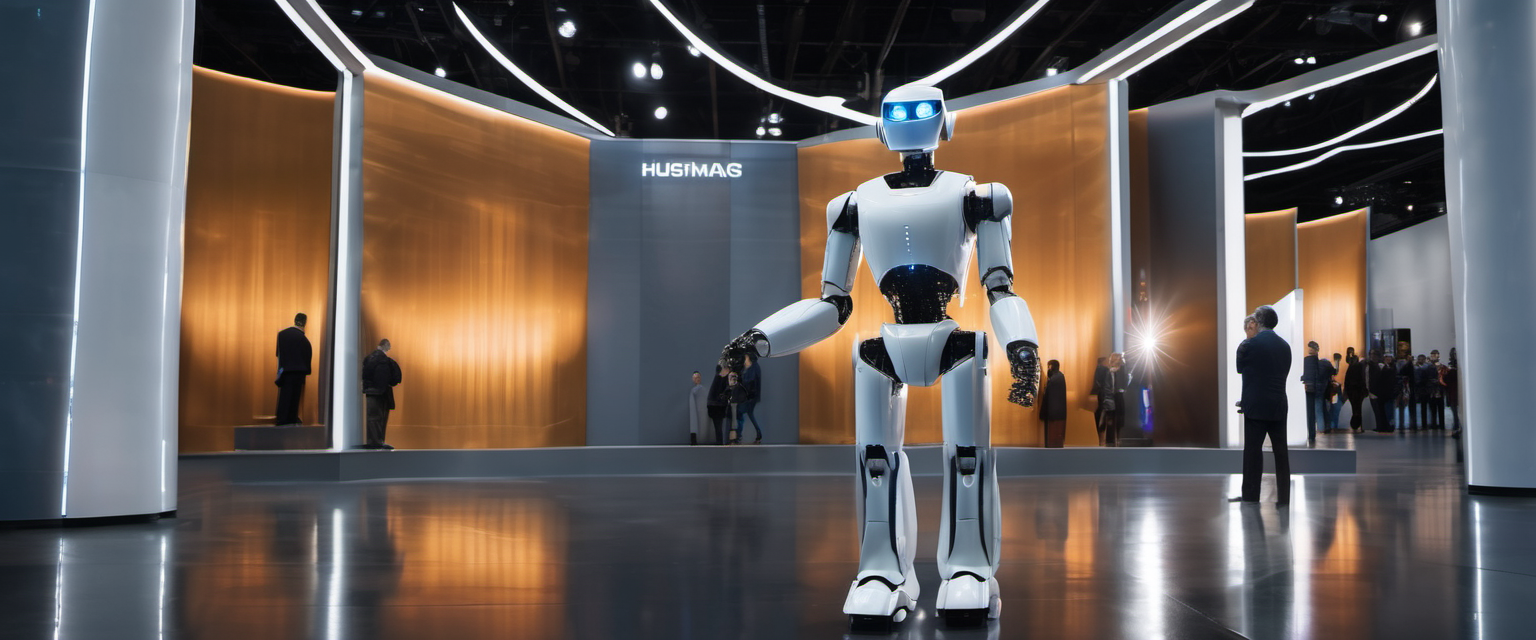
At Automate — North America’s largest robotics and automation show — Faraday Future (NASDAQ: FFAI) rolled out what it calls the second-half launch of its “FF EAI Robot World,” a sprawling line spanning six product series. The headline unit is the All-New Futurist, a full-size humanoid priced at $89,900, a figure that includes a $10,000 “Skills” software package. There is also a $1,990 education robot called FX Navi and a wheel-legged unit called Faber, because if you are going to pivot, you may as well pivot the whole catalogue.
The Futurist’s numbers are the part that should make you sit up. It stands about 5 feet 8 inches and weighs roughly 121 pounds — about 14% lighter than the previous generation — with a new T-shaped structure for a more stable, human-like gait. It carries 31 degrees of freedom across the body, not counting the hands, a peak knee-joint torque of 320 newton-metres, a top speed near 11 mph, and up to six hours of runtime on a 1,152 Wh dual-battery system. Faraday Future also says it is the first full-size humanoid in the U.S. to natively support Nvidia’s Sonic full-body motion-control stack.
Read that list without the company name attached and it is a perfectly competitive 2026 humanoid: faster than most on paper, lighter than its rivals, on the same Nvidia software layer everyone else is racing to adopt.
The point isn’t Faraday Future. It’s that Faraday Future could.
Here is why a serial disappointment shipping a humanoid spec sheet matters more than another tidy demo from Figure or Tesla. For most of the last three years, the implicit comfort for workers was that building a credible humanoid was brutally hard — the kind of thing only a handful of vertically integrated giants with custom silicon and years of robotics research could pull off. The moat was competence.
Faraday Future just walked across that moat. A company whose core competency is not manufacturing — whose entire reputation is built on the gap between announcement and delivery — can now assemble a 31-degree-of-freedom humanoid with an 11-mph top speed and put a price tag on it, because the hard parts are increasingly things you buy. The motion control comes from Nvidia. The actuators, batteries, and reference designs come from a maturing Chinese supply chain. The “Skills” are a software upsell. What used to be a research program is becoming a bill of materials.
That commoditisation is the displacement story, not the robot itself. When even the industry’s punchline can field a respectable humanoid, it means the components — the brain, the body, the training stack — have decoupled from any single company’s genius. The supply is broadening from “a few frontier labs” toward “anyone with a checkbook and an integrator.”
The honest discount
None of this means $89,900 humanoids are about to flood factory floors, and with Faraday Future specifically, skepticism is not optional — it is earned. A price is not a product. The company has a long, documented history of announcing things on stages that arrive late, in trickles, or not at all, and a glossy Automate unveiling is exactly the kind of event it has always been good at. “Priced at $89,900” and “shipping at volume to paying customers” are separated by the same chasm that swallowed most of the FF91’s promised production. Treat the unit count, not the spec card, as the real scoreboard.
But notice what the discount no longer covers. You can doubt that Faraday Future will manufacture this well, or at all. What you can’t doubt anymore is that the recipe exists and is being passed around — that a humanoid with a serious spec sheet is now something a struggling carmaker can shop together from off-the-shelf parts and a Nvidia license. The hard version of this question used to be “can anyone build it?” Automate quietly retired that one. The new question is just who ships, and at what price the labour it replaces stops being cheaper.