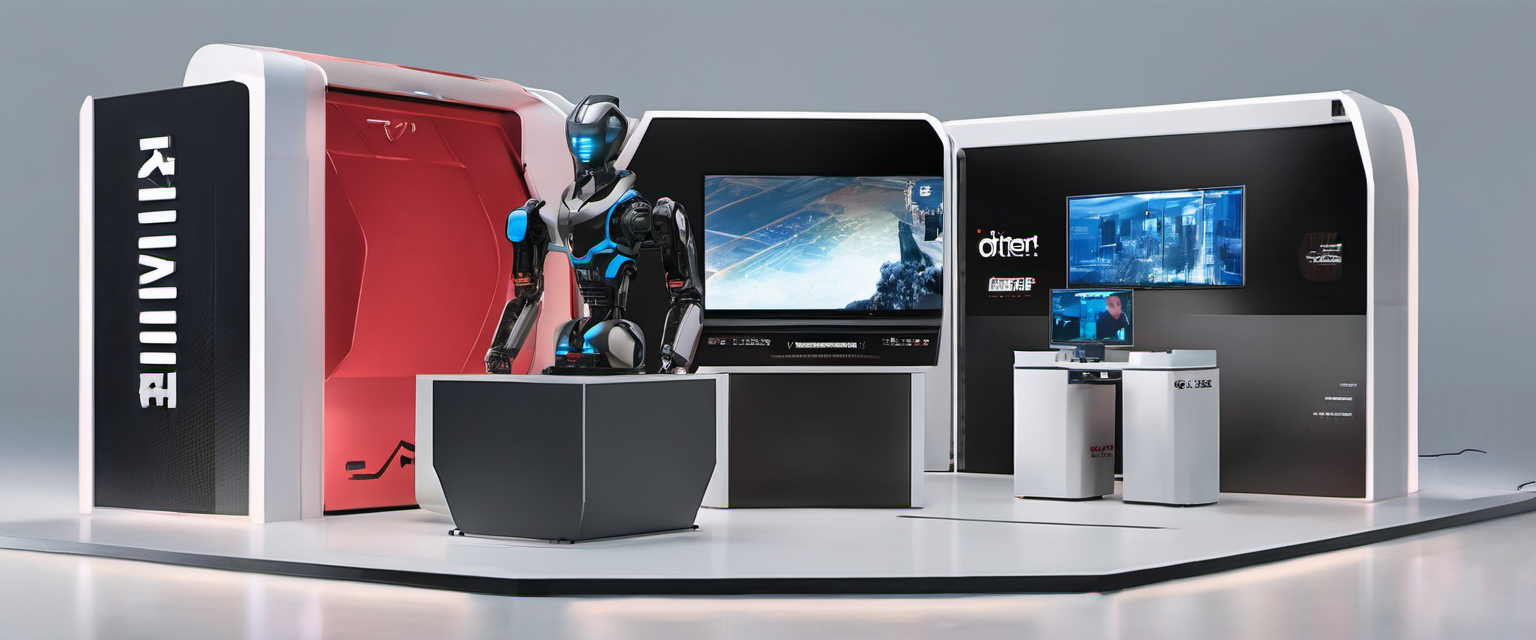
Computex Taipei 2026 opened Monday with something it has never had before: a dedicated AI Robotics Zone at Nangang Hall 2, added this year at the request of Taiwan’s industrial supply chain. The booth that stopped foreign trade journalists the longest was not Nvidia’s, not ASUS’s, and not Foxconn’s. It was Hiwin. The machine-tool company has been one of the world’s largest suppliers of precision ball screws, linear guideways, and motion-control components since 1989, with a market cap and a chairman’s net worth that have ridden Taiwan’s semiconductor-equipment cycle for two decades. It has never set foot at Computex before. This year, it bought a booth, brought a humanoid hand, and put a planetary roller screw on a stand under a spotlight.
The thesis on the wall was unmissable. Taiwan built the chip. It is now bidding to build the body.
The hand and the screw
The Hiwin booth’s centrepiece was a 17-degrees-of-freedom dexterous hand that operates with “zero-shot” control — meaning it grasps objects whose shapes it has never trained on by reconfiguring fingers per-object rather than calling a learned policy. The demo cycle the booth ran on loop: a three-finger pinch for a round object, a folded-finger gripper mode for a flat box, an opposed-thumb wrap for an irregular plastic part. No object-specific fine-tuning, no manipulation policy retraining, no demonstrations replayed from a tele-op log. It is the same problem Nvidia’s GR00T-on-Unitree-H2-Plus reference design unveiled the day before is solving with Sharpa’s 22-joint hand. Hiwin is offering the alternative supplier.
The second exhibit was the one the financial press should have led with. Hiwin’s new planetary roller screw, engineered specifically for the heavy-load joints of humanoid robots and high-payload industrial arms, is exactly the bill-of-materials line that humanoid OEMs have been struggling to source at automotive scale. Roller screws translate motor rotation into linear force at the precision and load capacity humanoid hips, knees, and shoulders require. Until last year, the global supply of high-load roller screws ran through three German vendors and one Japanese — none of them set up for million-unit consumer-grade volume. Hiwin manufactures at machine-tool-industry scale and prices at machine-tool-industry margins. A humanoid joint that used to cost €1,800 in a Bosch Rexroth bill becomes a different number on a Hiwin bill.
The third exhibit was the partnership Hiwin is shipping to the United States. The Taiwanese firm now produces an 8-degree-of-freedom arm for Dexterity’s “Mech” platform, a mobile two-armed warehouse robot built for real-world physical-AI deployments. Dexterity does the vision and the autonomy stack. Hiwin does the arm, lightweight enough to be mobile, strong enough to lift loads past the OSHA single-person limit. The product line shows the Hiwin pitch in commercial form: the brain is somebody else’s, the body is Hiwin’s.
The hall is the news
What makes Hiwin’s debut more than a vendor story is the room it walked into. Computex 2026 added an AI Robotics Zone for the first time — a deliberate organizational signal that the show, which made its reputation on x86 motherboards and gaming GPUs, now thinks the next compute cycle is physical. Inside that zone, the lineup reads like a Taiwan supply-chain roll call. Solomon brought a 6-DOF robot arm fitted with a stand-lamp-shaped vision camera in place of an end-effector. AAEON, MSI IPC, and Compal demonstrated edge-inference boxes with explicit humanoid SKUs. ASUS unveiled Kairo, an autonomous service robot orchestrated by ASUS’s Maestro AI platform, alongside a companion robot pitched at home use.
Jensen Huang’s keynote the same morning was the framing. “The era of physical AI is approaching, where AI agents like humanoid robots operate in physical spaces. It will be a tremendous growth opportunity for all of us.” The “us” in that sentence is Nvidia’s compute and Taiwan’s everything-else. Foxconn’s keynote slot the same week made the same argument from the contract-manufacturing side: physical AI is a manufacturing problem, and the Taipei supply chain knows manufacturing.
The Qualcomm announcement landing the same window — Snapdragon C compute and Dragonwing IQ10 humanoid-grade SoCs — completes the picture. Three of the planet’s largest compute vendors are now actively bidding to be the chip inside a humanoid robot. None of them owns the actuators or the precision transmission. Hiwin does.
The semiconductor analogue everyone in the hall was thinking
The unspoken comparison every Taiwanese vendor in the Robotics Zone was making is the one to TSMC’s 1990s climb. Taiwan did not invent the modern integrated circuit. It became indispensable to it by being the place where the bill of materials could be produced at the right cost, the right yield, and the right scale, and by accreting two decades of supplier ecosystem around that capacity. The pitch this week is that humanoid robotics is at the same architectural moment. The reference designs are emerging (Atlas, Figure 03, Unitree H2 Plus, Optimus Gen 3, Apptronik Apollo). The compute is converging on a small number of platforms (Jetson Thor, Snapdragon C, the AMD line). What does not yet exist at scale is the bill of materials — the joints, the actuators, the precision transmissions, the dexterous end-effectors — at automotive cost and consumer volume. Whoever supplies that bill at scale is positioned roughly the way TSMC was positioned in 1995.
Hiwin is not the only candidate. Nidec in Japan, Harmonic Drive in Germany, and a number of mainland Chinese suppliers — Lianzhuang, Inovance, Estun — are all chasing the same line. What the Computex debut signals is that Taiwan’s machine-tool industry is now organized around the bid. Hiwin showing up at Computex is the institutional version of a sector-wide pivot. Solomon at the booth across the aisle is the same pivot in vision systems. The semiconductor-packaging partnership Hiwin signed with Qualcomm on June 1, a day before its Computex debut, is the institutional handshake that makes the pivot a supply-chain story rather than a single-vendor one.
The hall the news isn’t
What was conspicuously absent from the Robotics Zone, and from any of the major Computex keynotes, was a humanoid OEM with a Taiwan address. There is no Tesla Optimus equivalent on the island. There is no Figure equivalent, no Unitree equivalent, no Apptronik equivalent. The Taiwanese pitch this week was explicitly not “we will sell you a humanoid.” It was “we will sell you the parts whoever builds the humanoid needs.” That is the same pitch TSMC made in 1996 when it declined to compete with its own foundry customers in chip design.
The strategic question, and the one no Hiwin executive answered on the booth floor, is whether the parts-not-products thesis works the second time. The semiconductor industry’s modular split between fabless designers and pure-play foundries took two decades to settle and produced one TSMC-shaped winner. The humanoid industry could converge on the same split, or it could end up looking more like the auto industry, where the OEMs vertically integrate the high-margin components and the parts suppliers fight for margin on the rest. Hiwin is betting on the first. Tesla is betting on the second — Optimus joints, actuators, and end-effectors are reportedly almost entirely vertical inside Fremont. Which model wins depends on whether humanoid bills of materials end up looking more like Apple’s iPhone or more like the Camry.
What to watch by Q4
Three signals to watch through the back half of 2026. First, whether Hiwin’s planetary roller screw lands a named humanoid-OEM customer beyond Dexterity. A Figure, an Apptronik, or a Unitree spec-in would convert the debut into a supply-chain story rather than a booth story. Second, whether the AI Robotics Zone at Computex returns next year larger — the show’s exhibitor mix is the most honest indicator of where Taiwan’s industrial planners think the next decade lands. Third, whether the Beijing supply chain, which is already producing humanoid assemblies at faster cycle times than the western competition, responds with its own pivot — Lianzhuang and Inovance debuting their own Computex booths next June would tell us the global parts race has officially started.
The TSMC pattern took twenty years to settle. The humanoid version, if it works, is unlikely to take that long — the compute partners are already chosen, the reference designs are already shipping, and the bill of materials is the gating constraint. Hiwin’s first-ever Computex booth is the date the Taiwan supply chain put on the calendar.