The mobile industry has spent forty years selling you a phone plan. On Wednesday morning in Shanghai, it stood on stage and announced that you are no longer the main customer. The robot is.
”Not theories — operational across China”
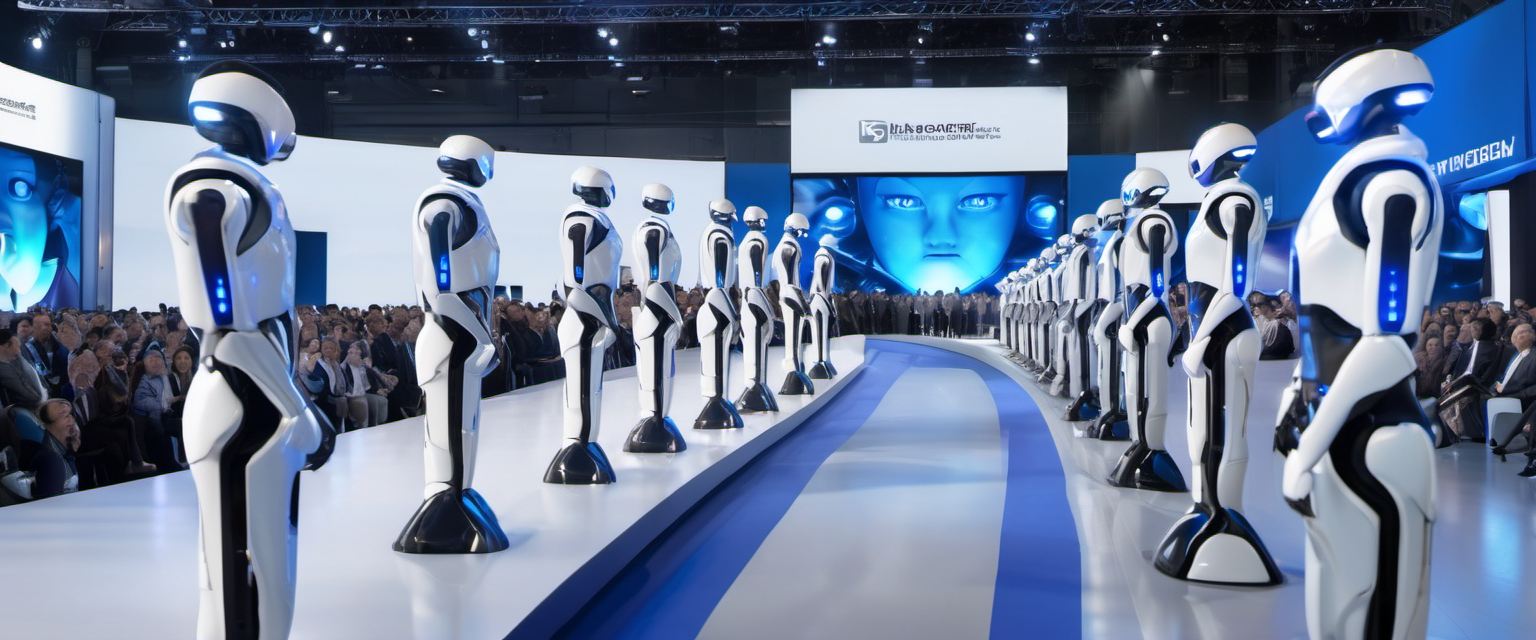
MWC Shanghai 2026 opened on June 24 with humanoid robots walking the keynote stage before a single human spoke. GSMA director general Vivek Badrinath used the slot to formalize what the industry has been circling since Barcelona: the “IQ era,” in which the network’s job shifts from connecting people to connecting “systems that sense, that decide, and that act in the real world” per Developing Telecoms. His evidence wasn’t a roadmap. It was a customer list — China Mobile, China Telecom, and China Unicom — each already pushing AI through next-gen infrastructure. “These technologies,” he said, “are not theories… they’re operational across China.”
The detail worth holding onto is which jobs the robots got. Per coverage of the opening, China Mobile is building robots for hospitality order management, China Telecom is running a Robotics-as-a-Service model with AgiBot in aviation and logistics, and China Unicom is putting robots into hazard inspection inside chemical plants according to TechTimes. Those are three specific human job categories — taking orders, moving cargo, walking the dangerous corners of a refinery — quietly reassigned, each with a 5G-Advanced connection as the leash.
The leash is the product
Here is the part that makes this a labor story and not a gadget story. In the same session, Huawei rotating chairman Wang Tao laid out the commercial logic without quite meaning to: between 2030 and 2040, “massive robotics,” autonomous vehicles, and full-domain IoT will place unprecedented demand on networks to connect billions of devices at once per Developing Telecoms. Translated out of keynote-speak: every robot that swallows a task also becomes a billable connection. The carriers aren’t selling robots. They’re selling the nervous system the robots rent.
A worker is a one-time cost to remove. A connected robot is a recurring line item, forever. That asymmetry is the entire pitch, and it explains why the loudest player on the floor was AgiBot, which says it was the first company to mass-produce humanoid robots, hitting its 10,000th unit in March and topping Omdia’s 2025 humanoid shipment ranking with a 39% share as reported. Its Robotics-as-a-Service leasing model — rent a humanoid the way you rent a phone line — is the thing China Telecom is actually deploying. The robot itself is sliding toward commodity; the subscription is the moat.
What a penalty kick is supposed to prove
Lest anyone think this is all spreadsheets, the GSMA also staged a Humanoid Robot Football Penalties Challenge, billed as a test of real-time autonomous decision-making with “no pre-programming, no hidden controllers, and no resets” per The Fast Mode. HONOR rolled out two robots, Flash and Vita Boy, for the cameras per TechTimes. The spectacle has a point: a robot that can read a moving ball and adjust mid-kick over a live network is, in principle, a robot that can read a warehouse aisle or a hotel lobby the same way. The football is the demo. The warehouse is the business.
None of this means the jobs vanished overnight. A handful of pilots in hospitality, logistics, and chemical inspection is not a labor apocalypse, and “operational across China” is carrying a lot of weight for one keynote. But the framing is the tell. When the industry whose entire existence was “connecting people” stands up and says its mission is now connecting machines, it is telling you, in its own corporate dialect, where it thinks the growth is. The phone in your pocket was the product for forty years. The robot on the night shift is the product now. You’re the legacy account.
Sources
- Developing Telecoms — Chinese telcos are kickstarting GSMA’s “IQ era” of mobile AI
- TechTimes — MWC Shanghai 2026: Humanoid Robots Open Day One as Telcos Declare Embodied AI Era
- The Fast Mode — Humanoid Robots to Compete in Football Penalty Challenge at MWC26 Shanghai
- Gizmochina — AGIBOT Unveils Full Humanoid Robot Lineup and Rental Service at MWC 2026