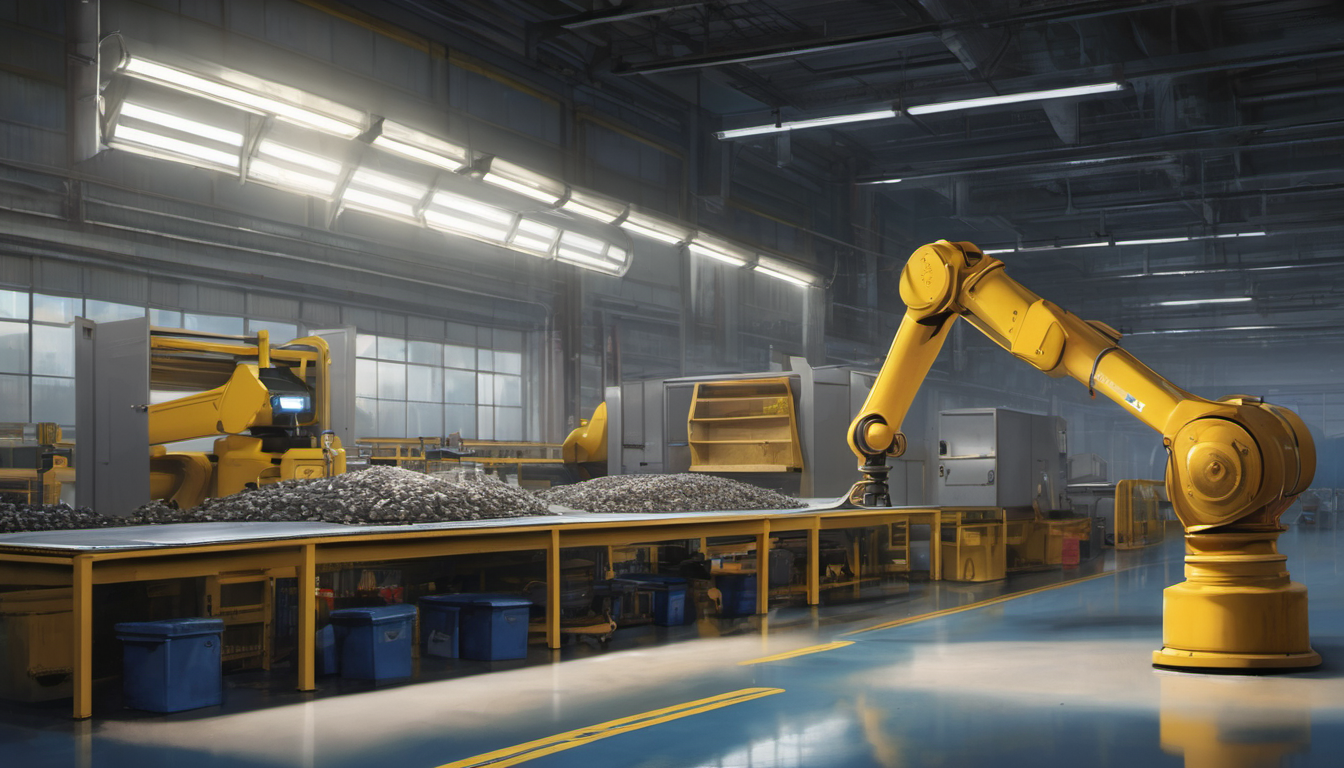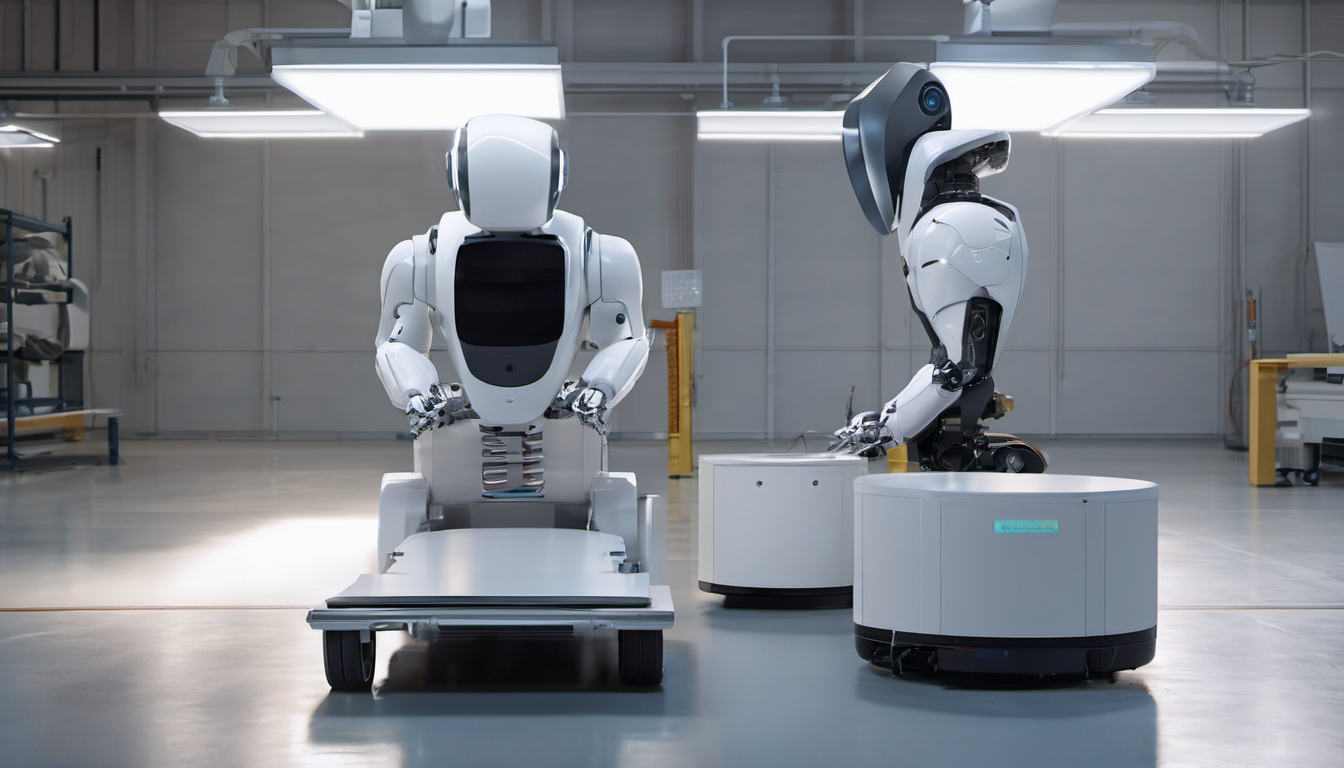
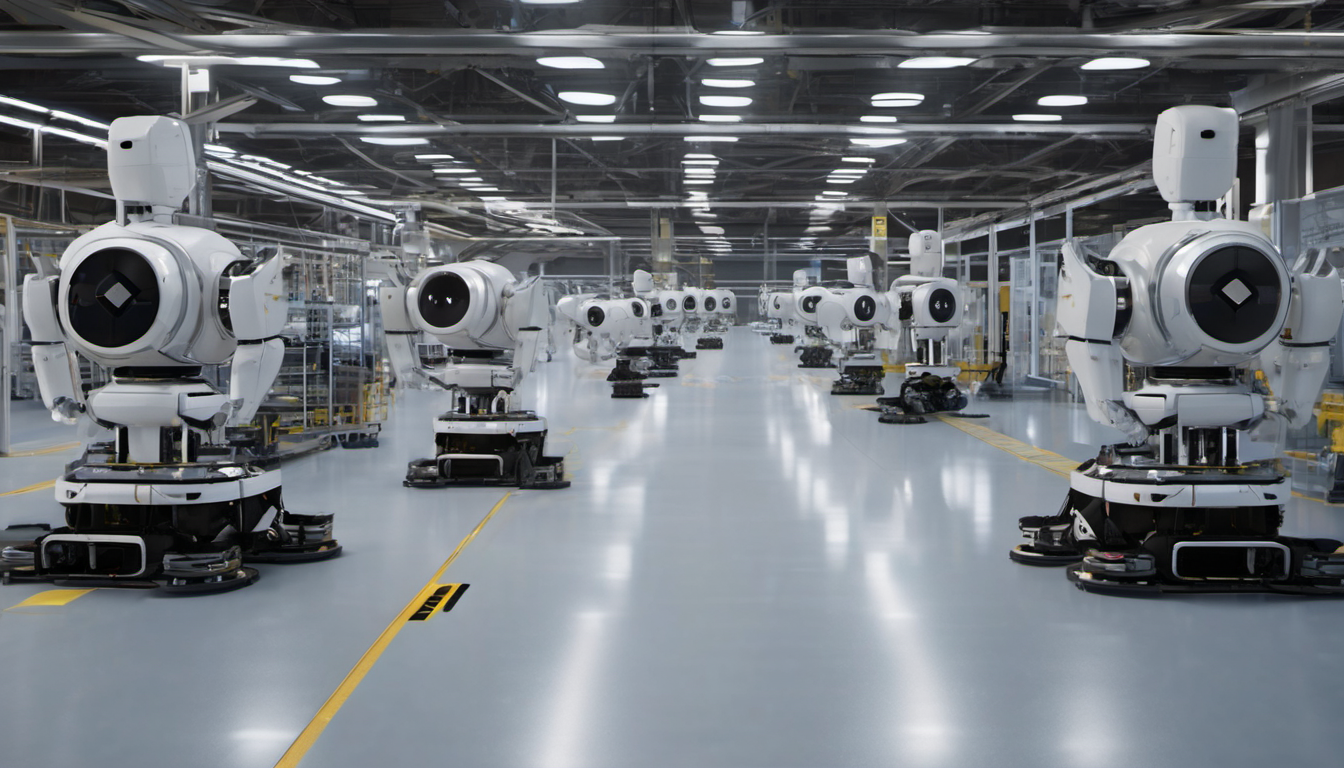
UBTech Robotics said on Sunday, September 13, that its industrial humanoid super smart factory in Liuzhou, Guangxi, has begun production. The company calls it the world’s first humanoid manufacturing facility designed for 10,000-unit annual capacity, and says one complete robot rolls off the line every 10 minutes.
The plant covers 14,000 square meters, stands 13.8 meters high, and builds the Walker S series and the Cruzr series.
The number worth taking apart is not 10,000. It is who works the line.
Cruzr units do the depalletizing, palletizing, loading and handling
Per the company’s statement, the robots handling depalletizing, palletizing, loading and material movement on the production front line are Cruzr Y1 and Cruzr S2 embodied-intelligence industrial humanoids. The line builds that class of machine and staffs itself with it.
Those four tasks are the first half of the list Agility published this week selling Digit 5 into American warehouses. We covered that machine on September 15: 50 lb repeated lifts, no safety barrier, and an expansion from tote handling into depalletizing, machine tending, kitting, quality inspection and palletizing. One company is selling those tasks. The other is already using them to build robots.
Final assembly stays mixed. It runs on collaborative robots, power-assist manipulators, unmanned logistics vehicles and 360-degree rotating worktables supporting flexible mixed-model production. “Power-assist manipulator” is the load-bearing phrase there. Human hands are still on the final-assembly station, just carrying less of the weight.
Quality control is the harshest section. Every complete robot goes through more than four hours of whole-machine testing, then an automotive-grade lighting inspection tunnel for 360-degree appearance screening. The visual inspector’s job in this plant is now a tunnel.
Warehousing is what UBTech calls an industry first: a fully automated stereoscopic warehouse built for humanoids. It occupies 65 square meters, stores 112 robots, and improves space utilization by more than 50%. AGVs, unmanned forklifts and logistics vehicles connect sub-assembly, final assembly, testing and storage.
Ten thousand is the floor of this line, not the ceiling
Multiply the two published numbers and the real shape of the plant appears.
One unit every 10 minutes means 10,000 units costs 100,000 minutes of takt time, roughly 1,667 hours. A single shift running 250 days at eight hours is 2,000 hours. The entire advertised annual capacity fits inside one day shift.
So “10,000-unit-class” is not this line’s limit. It is what one shift produces. Two more shifts are sitting unused. What sets next year’s output is order book and supply chain, not takt.
Against the cohort, the position is clearer. Figure quoted BotQ at one unit per hour in May, with 350 units built and 80% yield; Liuzhou’s takt is six times that. EngineAI quoted 15 minutes per unit and 10,000 a year at Honghualing in Shenzhen on May 29; Liuzhou takes another third off that.
One detail worth filing: the plant was built jointly with Siemens Digital Industries Software, and the manufacturing operations management system acting as the factory’s “smart brain” was co-developed. It runs a full digital closed loop across work-order scheduling, material distribution and quality monitoring, with one-item-one-code traceability through each robot’s unique serial number. A Chinese plant built on the premise of robots building robots runs its scheduling core on German software.
UBTech’s own explanation is the supply chain
Pang Jianxin, vice president of UBTech, told the Global Times in an earlier interview that mass production is inseparable from China’s supply chain. Without it, he said, mass-producing complex components would be extremely difficult unless cost advantages were completely sacrificed.
His reason was people, not lines: engineers, scientists and application scenarios accumulated over the past 10 to 20 years, which produced the supply-chain base, the manufacturing capability and the R&D strength.
The macro data supports the claim. China’s industrial robot output reached 98,677 units in July, up 30.2% year on year, and 635,056 units from January to July, up 28.5%, per the National Bureau of Statistics. Humanoid capacity is growing on that curve, not beside it.
We covered the other half of Liuzhou on August 31: a training center in the same city where more than 100 humanoids stand in rows while a dozen trainers in headsets drive them through sorting crates, packaging noodles and making coffee. Now the other end of the city has an assembly line. Trainers produce the software, the line produces the hardware, and both sit in Liuzhou.
The first industry automated
The plant is a closed sample of the thing it sells. The first stations humanoids take are the stations inside the factory that builds humanoids.
Four job categories are exposed by name. Material handlers and pallet builders, replaced by Cruzr. Forklift drivers, replaced by unmanned forklifts. Warehouse stock handlers, replaced by a 65-square-meter rack holding 112 units. Visual inspectors, replaced by a lighting tunnel. None are high-skill trades. All four are among the largest headcounts in an assembly plant.
What stays on the line is final assembly. Multi-angle precision assembly of a machine with dozens of joints still resolves to a person plus a power-assist manipulator. The line is the most honest map of the current capability boundary anyone has published: what could be replaced already was, and the part that was not is what the industry attacks next.
For readers outside China, the significance sits at the cost end. If 10,000 units takes one day shift, the labor content per robot collapses. Per-unit cost sets the quoted price, and the quoted price is what gets held up against a wage. That comparison is not abstract anymore: Agility’s S-4 already put a US warehouse humanoid at about $8,500 a month. The Liuzhou line pushes on the other end of that number.