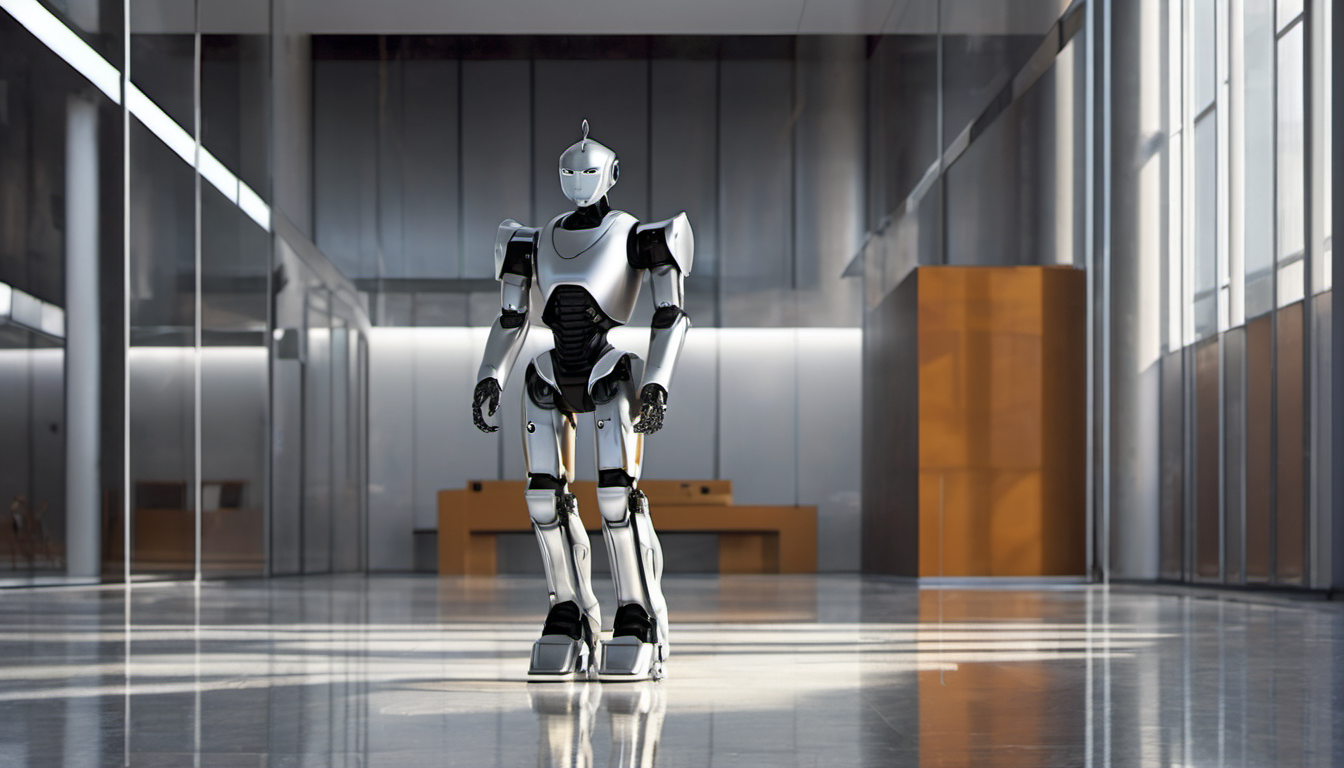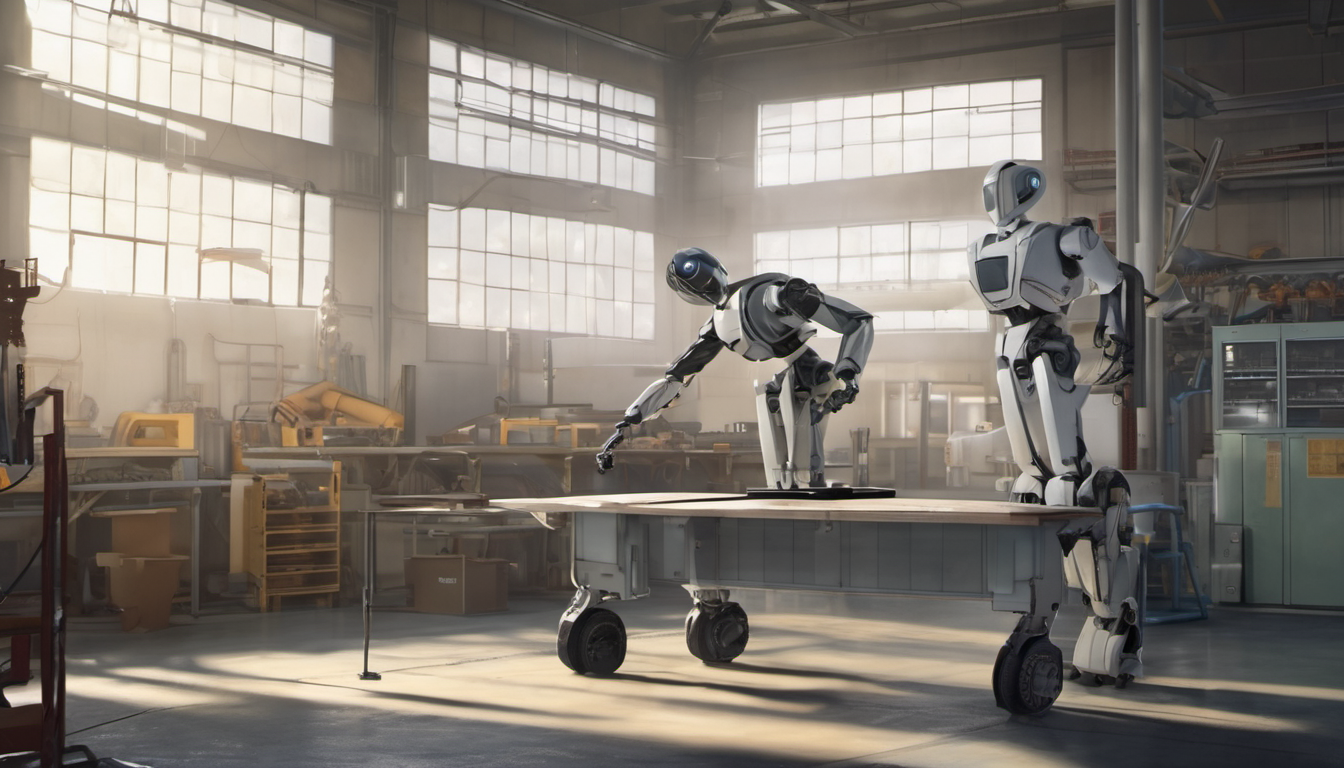
The week of May 7–11 produced two humanoid-robot news items that, side by side, tell you almost everything you need to know about where Chinese and US humanoid programs sit in May 2026.
May 7: Unitree fully opened UniStore, what its official tweet calls 「the world’s first humanoid robot task and action app store.」 At launch, the store has 24 apps. They are: Bruce Lee’s Jeet Kune Do, Wing Chun, Mantis Boxing, Mechanical Dance, Michael Jackson dance, Disco, Charleston, big-step walking, cheering, and — per Digitimes’ May 11 analysis — a “Kamehameha” move borrowed straight from Dragon Ball Z.
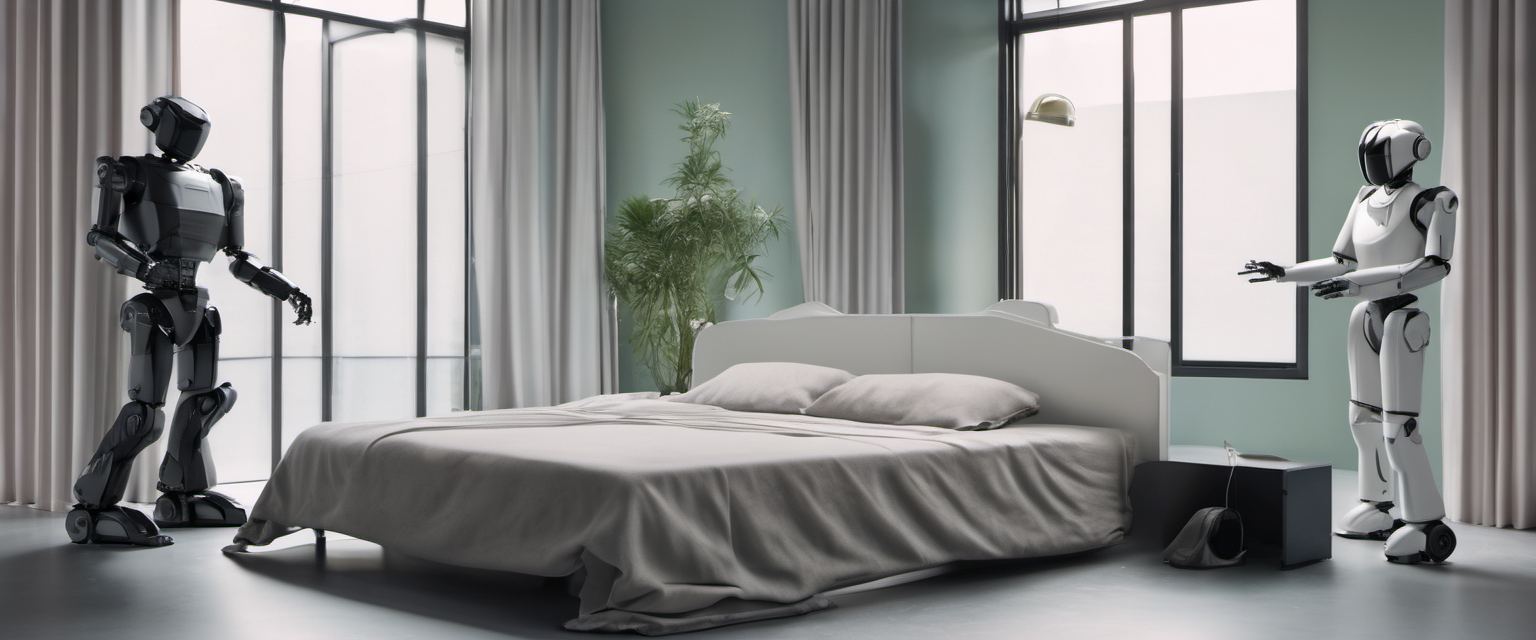
May 8: Figure published a video and blog post of two F.03 humanoid robots autonomously tidying a real bedroom in under two minutes. The robots opened doors, hung clothes, placed headphones on a stand, closed a book on a nightstand, moved furniture, and jointly made a bed — coordinated only by visual observation, with no shared planner and no message passing between them.
May 11: Digitimes ran a paywalled analysis under the headline “Forget the hardware race — Unitree wants to own the robot platform”. The same day, 36Kr published a 4,000-word teardown of UniStore and its main Chinese competitor — Zhiyuan’s Lingchuang Platform — under a headline that translates as “Have domestic manufacturers gone astray?”
That’s the week. The visual asymmetry is the story.
What’s actually inside the world’s first humanoid robot app store
Per 36Kr’s count, UniStore launched with 24 official action sets, all produced internally by Unitree, almost all in the genre of staged performance — martial arts, music dance, or stylized walking. Every action is marked 「free for a limited time」, which is the language of an app store that has not yet decided what to charge for. UniStore is currently restricted to the G1 Edu and G1 Edu+ humanoid robots, although the platform already pre-lists slots for the H1, A2, GO2 and the As2 robot dog — placeholder real estate for an ecosystem that does not yet exist.
The competitor in the same category is Zhiyuan’s Lingchuang Platform, which launched at the end of 2025. 36Kr’s audit found 662 published action works for the flagship Lingxi X2, 467 for the Lingxi X2 youth edition, and just 2 for the Yuanzheng A2. Unlike UniStore, Lingchuang is mostly third-party-uploaded: anyone can train an action from a video clip and share it back. The quality is lower; the quantity is higher. The content categories are the same: dance, martial arts, music routines, “funny interactions.”
The honest single-sentence summary of both Chinese platforms, per 36Kr, is that they look less like Apple’s App Store and more like a 「motion-sharing community」 — closer in shape to the model-sharing community MakeWorld that DJI built around the RoboMaster 3D-printer kits than to anything that would make a humanoid robot useful in a home.
What Hugging Face quietly shipped in the same window
In the same article, 36Kr makes the inconvenient comparison: Hugging Face’s app store for the Reachy Mini — a desktop open-source robot that is barely humanoid — has 219 applications, of which only 8 are official Pollen Robotics builds and the remaining 211 are third-party.
The Reachy Mini apps are not dance routines. Per 36Kr’s reading, they include:
reachy_mini_conversation_app— continuous-conversation companionreachy_mini_home_assistant— integration with the Home Assistant smart-home stack- Language-learning apps, gesture-tracking apps, music-interaction apps
- A children’s companionship app, a phone-anti-addiction reminder app
- Web 3D visualization, F1 race commentary, a community port of OpenClaw
Almost none of these are about making the robot perform. Almost all of them are about making the robot useful for some specific, daily, often-residential task.
Reachy Mini is open-source hardware that runs on a Raspberry Pi. UniStore runs on a humanoid robot that costs north of $16,000 at consumer pricing (G1 retail per RoboHorizon). The app-store gap goes the wrong way.
And then Figure made the bed
The reason May 8 is the inflection date on this story is not that Figure shipped a new robot. It’s that Figure shipped the first credible demonstration that the cooperative-multi-robot home-task primitive is here.
Per Figure’s own blog post — which 36Kr quoted before publishing — two F.03 humanoid robots execute a bedroom reset entirely from pixels to motor actions using the Helix-02 onboard Vision-Language-Action policy. The bed-making sequence is the headline:
- The comforter is deformable — no fixed shape, thousands of consecutive grip and tension decisions required as the fabric moves.
- The two robots coordinate without a shared planner, without message passing, without a central coordinator.
- The visible coordination signal is head nods — one robot waits, the other gets into position, both pull simultaneously, the duvet smooths.
- Total run time: under two minutes, per Interesting Engineering’s coverage.
There is a long list of things bed-making is not. It is not parts sequencing at a Hyundai metaplant in 2028. It is not a $140K Atlas doing a handstand. It is not 30,000 units per year of nameplate factory capacity. It’s a single, low-status, household task that nobody has previously been able to demonstrate in an unstaged home setting with a deformable object and two cooperating agents.
That happens to also be the genre of task that the Chinese app stores currently have zero entries for.
The structural mismatch
| Platform | Live apps | Genre |
|---|---|---|
| Unitree UniStore (May 7) | 24, all official | Dance, martial arts, performance |
| Zhiyuan Lingchuang (late 2025) | 662 + 467 + 2 for three robots | Dance, martial arts, music routines |
| Hugging Face Reachy Mini store | 219, 211 third-party | Conversation, home automation, daily-life utility |
| Figure Helix-02 in-house | 1 demo (multi-robot bedroom reset) | Actual home labor |
The Chinese humanoid programs are leading on hardware — Unitree expects to ship 20,000 G1 units in 2026 per its own published target, AgiBot has shipped past the 10,000-unit milestone, and the Beijing robot half-marathon demonstrated commercial-grade locomotion at population scale. What the Chinese programs do not yet have, per the May 11 36Kr framing, is a software story that is about anything other than performance.
That’s the gap. 36Kr’s word for it is 「technological spectacle」 — robots whose primary product-market fit, in May 2026, is short-video views.
What’s actually going on with the app-store framing
The Chinese app-store moment is a real attempt to solve a real problem. Per the 36Kr piece, a humanoid robot today is a device whose usage threshold is “extremely high”: outside the manufacturer-shipped action library, almost no non-professional user can program a useful behavior. UniStore’s clearest claim to legitimacy is not the 24 dance routines — it is the 「one-click import」 flow that lets a non-developer pull a finished motion onto their G1 and run it.
What’s missing is the iPhone moment’s actual ingredient: a developer ecosystem that ships anything other than entertainment. Both Chinese platforms have technically opened the door to third-party submissions — Zhiyuan actively encourages user uploads via its “spiritual stones” community currency — but the third-party content that has accumulated is structurally indistinguishable from the official content. Everyone is choreographing dances. Almost no one is shipping the equivalent of reachy_mini_home_assistant.
The reason is structural. The Chinese humanoid market in 2026 is downstream of livestream commerce and short-video. Performance content goes viral. A robot vacuuming a real living room does not. The platforms get the content the audience rewards.
What to watch
- Whether UniStore opens up to G1 / G1 Edu users to submit actions. Right now everything in UniStore is Unitree-made. The “app store” framing only earns the comparison to the iPhone App Store once the third-party ratio crosses some threshold.
- Whether AgiBot launches a comparable platform. AgiBot’s LinkCraft tool, per 36Kr, is a “zero-code” motion editor — closer to a creation tool than a marketplace. The shape of AgiBot’s eventual platform announcement is the diagnostic.
- Whether Helix-02 or any equivalent model ships as a developer SDK. Figure has, as of May 8, the best home-task primitive on the market. The leverage point is whether Helix-02 becomes the iOS of humanoid software or stays Figure’s private moat.
- Pricing on the UniStore “free for a limited time” tag. A paid layer would be the first humanoid-app monetization data point on record.
The dryly funny part
Per 36Kr’s count, the only third-party action in UniStore as of last week is described as “a fun-making hip-wiggling robot.” Out of 24 apps in the world’s first humanoid robot app store, the lone community contribution is a hip-wiggling routine.
Meanwhile, two robots in a Sunnyvale lab just made a bed in under two minutes, in a real bedroom, without anyone telling either of them what the other was about to do.
Both things shipped in the same week. Both are technically humanoid-robot software demonstrations. The history of computing suggests that one of these app stores is going to look very different in three years. The history of livestream entertainment suggests the other might look exactly the same.