Separating two pieces of fabric is the kind of task a human toddler masters without instruction. For a humanoid robot it is, in the words of China’s state news agency, a “demanding test of dexterity”: press too hard and the cloth deforms, too soft and it slips the grip. This is the frontier of Chinese factory automation in July 2026 — and it is worth taking seriously precisely because the people selling it are the ones admitting how narrow it still is.
On July 24, Xinhua ran an unusually candid survey of humanoid robots on Chinese factory floors. The framing was triumphant — 2026 as the year robots move into mass production — but the details underneath were a study in modesty.
97% of the time, on one fabric
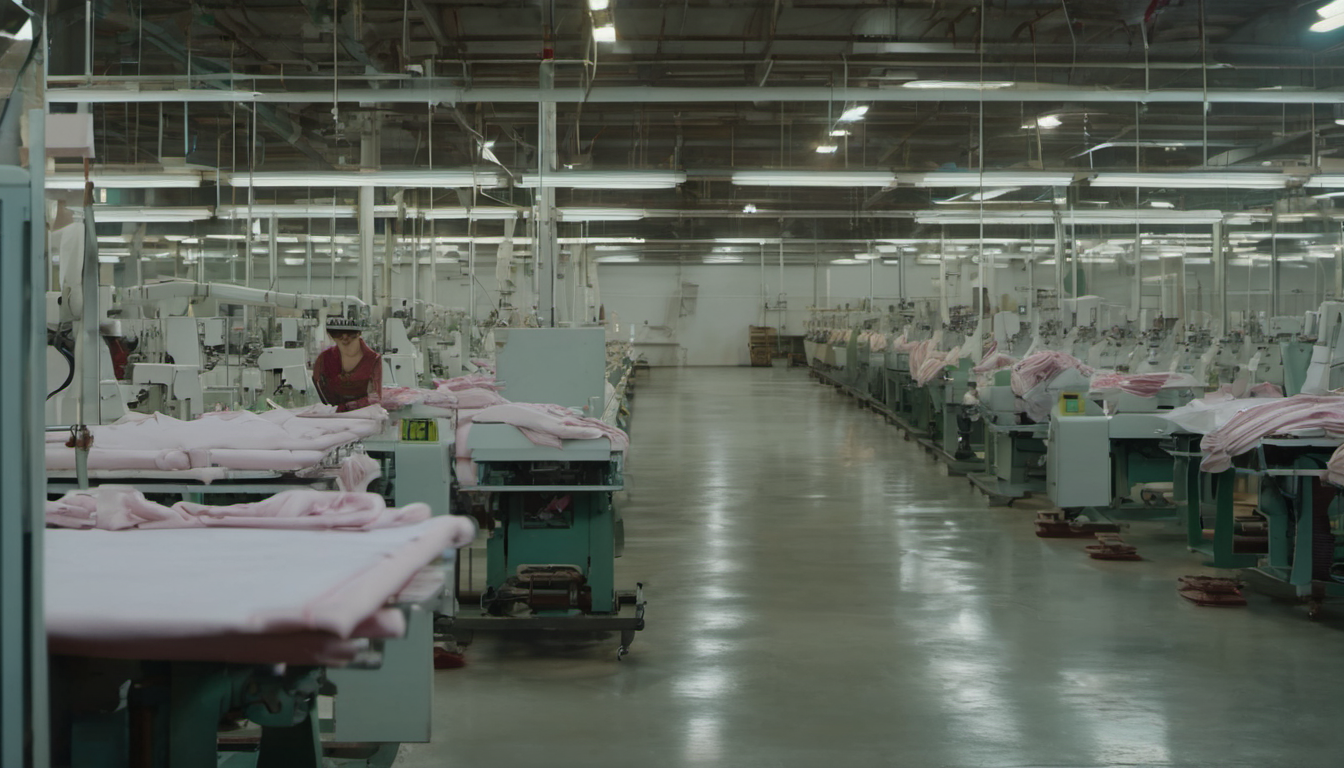
Aitu, a Zhejiang sewing-tech company, has robots in trials at garment makers including Sunrise Group, Eifini and Chenfeng Group. Their jobs are tightly bounded: load and unload fabric at template sewing machines, position material for pocket setters, place cut pieces at fusing presses. On a single product category and a single fabric type, Aitu says its robots separate fabric pieces correctly 97% of the time, with more than 98% of the resulting stitching meeting quality standards. At that rate, the company estimates the robot pays for itself in about 18 months.
Read those numbers twice. 97% success is genuinely good — for one product, one fabric. The unstated corollary is that a different material, a different cut, resets the robot toward zero, because the hard problem in this whole field isn’t walking or seeing; it’s manipulation that generalizes. “Handling fabric is like picking up tofu,” Aitu general manager Lou Lingtong told Xinhua. The quote is funnier than he intended, and more honest than most robotics marketing manages all year.
”Unable to run an entire production flow”
The single most important sentence in the piece is Lou’s own: humanoid robots “can perform individual processes well, but are still unable to run an entire production flow without human involvement.” A robot that separates fabric cannot then sew the garment, inspect it, and pack it. It does one station. A human still owns the shirt.
That is the reality behind the headline number everyone will quote. China’s Ministry of Industry and Information Technology, with the state-asset regulator, has launched a program to push humanoids and embodied AI into real-world operation and build deployment capacity “at the 10,000-unit scale” by the end of 2026. Ten thousand robots is a big, round, motivating figure. What those robots will actually do, on the evidence of this article, is a lot of single stations — one repetitive task at a time.
Where it’s further along
Manipulation of rigid parts is easier, and there the numbers are sturdier. PIABOT Robotics’ G2, deployed in electronics assembly and logistics sorting, reportedly completed 2,283 tasks over an eight-hour shift at one electronics manufacturer without an error. On an automotive line tapping holes in aluminum seat-belt components, a G2 cut cycle time from a worker’s roughly 18 seconds to as little as 12.9 — about a third faster. Hard, predictable, bolted-down tasks are where the economics already close. Soft, variable, human-judgment tasks are where the tofu problem lives.
The labor twist
Here is the part that complicates the tidy “robots are coming for the jobs” story. Lou says the number of garment workers retiring or quitting each year already dwarfs the number of jobs robots are taking. “Factories can’t recruit enough people or persuade them to stay.” In Chinese light manufacturing, the robot is arriving into a labor shortage, not a labor surplus — filling seats nobody wants rather than emptying seats people are fighting to keep. And Xiong Rong of the Zhejiang Humanoid Robot Innovation Center notes wider deployment spins up its own new work: maintenance, debugging, secondary development. The displacement is real, but it is not the clean one-in-one-out substitution the word “automation” implies.
The LostJobs read
The useful timeline is Lou’s, not the ministry’s. He expects 2026 to 2028 to be spent validating robots in individual processes, with coordinated, multi-task deployment scaling only from 2028 to 2030. In other words: the next two years are single stations; the shift where a robot runs your whole line is four-plus years out, if the manipulation and generalization problems yield on schedule — and “picking up tofu” suggests they’re in no hurry.
If your work is rigid, repetitive and measurable — the seat-belt-tapping end of the spectrum — the economics are already turning against you, robot by robot. If your work involves soft materials, judgment, exceptions, or coordinating across stations, you have more runway than the 10,000-unit headline implies. Plan around the station that’s being automated next, not the fully robotic factory that keeps living four years in the future.