Nvidia posted a blog entry on October 2 called 「The Machines that Make the Machines」, and Taiwan’s press worked through it over the weekend. Focus Taiwan and TechNews carried the numbers on October 4 and 5. It is the first time anyone has published measured results for robots building parts of Nvidia’s own GB300 NVL72 rack at Foxconn, known in Taiwan as Hon Hai.
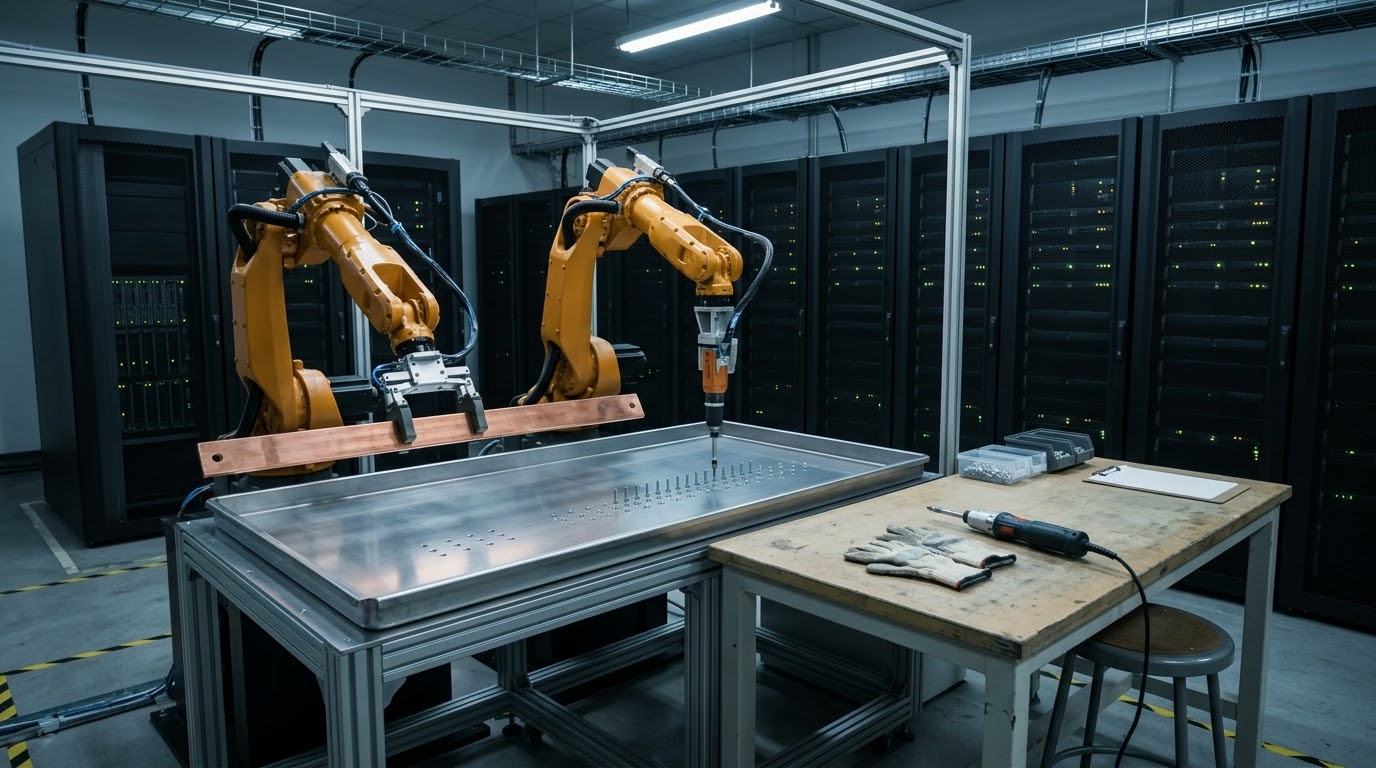
The robots work on the tester tray, the sub-assembly that checks computing modules before a rack ships. Two tasks have numbers.
The two tasks
The first is the busbar. A robot has to pick up a long, heavy metal busbar, seat it in the tray and fasten it with 16 screws. Reported success is above 95%. The time limit is 124 seconds. TechNews puts the current cycle at about 160 seconds, with screw fastening as the bottleneck. That is 36 seconds over, or 29% slower than the target.
The second is multi-connector insertion: four connectors, two large and two small, pushed into slots with little tolerance. Success runs 90% to 95% against a 72-second limit. No current time was reported.
TechNews also gives the target the teams are chasing: 99.5% on both tasks. The distance from 95% to 99.5% sounds small. It is a tenfold drop in failures, from one in 20 to one in 200. On a line shipping racks that cost millions each, someone has to catch a failed seat and redo it.
The same day, the same company
On October 5 Foxconn reported September revenue of NT$1.15 trillion, its first month above NT$1 trillion. Third-quarter revenue was NT$3.03 trillion, up 47.12% from a year earlier. Focus Taiwan adds that Hon Hai holds more than 40% of the global AI server market and expects its 2026 AI rack shipments to more than double. It also says Hon Hai plans to spread Nvidia-developed robots to plants in Texas, Wisconsin and California. No dates and no robot counts came with that.
That is what makes the numbers worth reading. The robots are being tested on the product that is driving Foxconn’s growth, so every second of cycle time matters.
Where this sits in our corpus
In June we covered the other half of this story. At VivaTech, Foxconn showed a humanoid doing assembly tasks trained in simulation, and the pitch was how fast it learned. This week’s data is the first look at how well a trained system does on a real server line. The answer is nearly there, not there yet.
For one loose comparison, in May Figure reported 80%-plus first-pass yield on the robots it builds at BotQ. That measures a different thing, the quality of robot manufacturing rather than task success, so do not set the two numbers side by side as a ranking. They do share a point: at 80% to 95%, a human is still part of the loop.
What it means for the jobs
TechNews notes the tasks are not hard for skilled line workers. Seating a heavy bar and driving 16 screws is repetitive work with a skill floor, the kind of job a rack factory fills in volume. Our read is that the first roles to change are test-tray assembly and rework on AI server lines, and that the change will look like fewer people per line before it looks like an empty line.
The numbers give a rough order. At more than 95% success the robot still needs a person nearby for the failures, and at 160 seconds it runs slower than the limit a line is built around. Both gaps are fixable, and 99.5% is the stated goal. Nothing in this week’s reports gives a date for it, a robot count, or a headcount for any Foxconn plant. The signal to watch is not another demo but the first number for robots per line in Texas, Wisconsin or California.