Most robot demos are edited. This one came with a bar chart, which is a much braver thing to publish.
On July 30, Google DeepMind introduced Gemini Robotics 2, the first version of its robotics stack that controls an entire humanoid rather than just the top half. Feet to fingertips, one model. The headline demo is Apptronik’s Apollo 2 being told to put a watering can in a green bin on a bottom shelf, then walking over, crouching, picking it up, walking again, and putting it there. Three models ship together: a vision-language-action model that moves the body, an embodied reasoning model called ER 2 that acts as the planner, and an on-device version for robots with no network.
That is the press release. Now read the chart.
The numbers DeepMind chose to print
On Apollo 2 with Inspire hands, general whole-body manipulation scores: pick up from a shelf, 76.3%. Pick up from a table, 68.4%. Pick up from the floor, 45.7%.
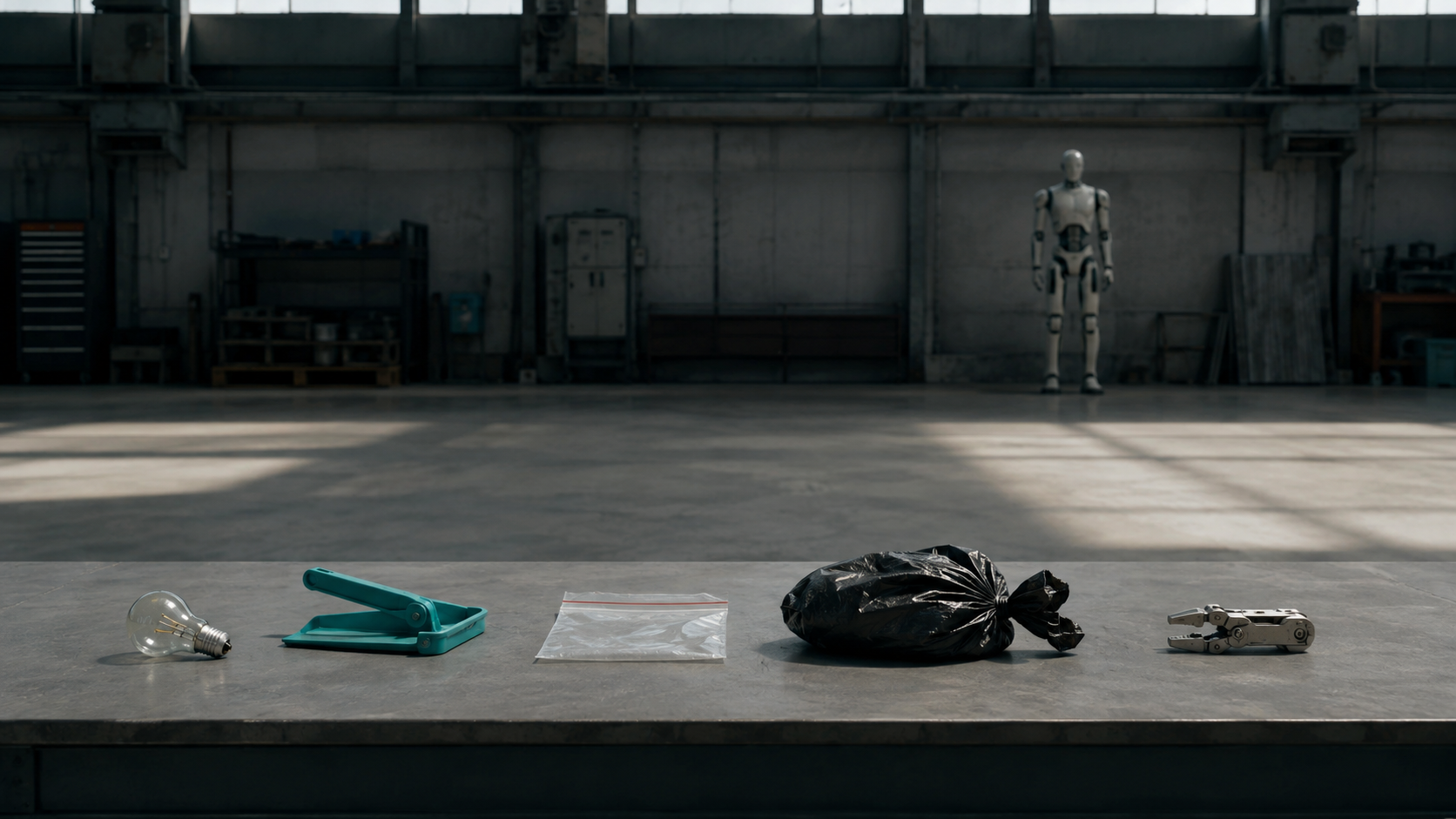
On Apollo 2 with the five-fingered, 22-degree-of-freedom SharpaWave hand, the multi-finger dexterity tasks: unscrew a bulb, 92%. Screw a bulb in, 36%. Tie a trash bag, 44%. Ziplock, 40%. Dustpan, 32%.
And on a Franka Duo — a bi-arm platform with a boring two-fingered parallel gripper, no fingers at all: precise insertion, 89.6%. Diverse tool kitting, 78.9%. General pick and place, 74.2%.
DeepMind’s own caption says the quiet part: “multi-finger dexterous manipulation remains challenging.” It also notes the robots “have more to advance in movement speed,” which is research-blog for it is slow.
Sit with the bulb pair for a second. Taking a bulb out succeeds 92% of the time; putting one in succeeds 36% of the time. Same hand, same object, same model, reversed. Removal is a grab and a rotation. Insertion requires you to find a thread you cannot see, align it within a fraction of a degree, and detect by feel whether you have cross-threaded it. That gap — 92 versus 36 — is a fairly precise measurement of how much of human manual competence is not vision, and not planning, but touch.
The gripper is beating the hand
Here is the part nobody put in a headline. The cheapest, dumbest end effector on the test — a two-fingered pincer that looks like something off a 1990s pick-and-place line — scored 89.6% on precise insertion. The anthropomorphic, 22-DoF, five-fingered hand scored 36% on screwing in a bulb, which is the same category of problem.
The instinct in this industry has been that the hand is the unlock: build fingers good enough and the robot inherits every tool humans ever designed. What this chart suggests is that the hand is the hard part and the gripper is already good enough for the tasks that pay. Warehouses do not need to tie trash bags. They need to insert, kit, pick and place, and the gripper is doing that at 74–90% today, on a model that generalises.
So if you are trying to work out which jobs move first, stop looking at whether the work needs hands. Look at whether it needs fingers. Kitting a tool tray is exposed now. Rewiring a fixture in an awkward corner is not — not because it is skilled in the way we flatter ourselves about, but because it needs a thread found by feel at 36% and rising.
The retraining number
Buried under the dexterity charts is the line with the longest shadow. Gemini Robotics On-Device 2 adapts to an entirely new robot body — different shape, different sensors, different degrees of freedom — in a few hours, typically with fewer than 200 examples.
Two hundred demonstrations. A few hours. That is the cost of teaching a machine a new body.
Compare it to the cost of teaching a person a new job, which is measured in months and is paid for by the person. The models are not yet better than a human at screwing in a bulb. But the transfer is already better by three orders of magnitude, and transfer is what turns one good demo into a fleet. DeepMind also shipped ASIMOV-Agentic, a benchmark for whether the planner refuses unsafe instructions from its own action model and knows when to ask a human for help — which tells you they expect these things standing next to people, soon, and are budgeting for it.
The honest read of July 30 is not “robots can do everything now.” It is: the brain generalises, the gripper works, the hand does not yet, and the retraining bill is measured in hours. Three of those four are on the machine’s side of the ledger.
Sources
- Gemini Robotics 2 brings whole body intelligence to robots (Google DeepMind, July 30, 2026)
- Gemini Robotics ER 2: video understanding, task orchestration and multi-robot collaboration (Google, July 2026)
- Google DeepMind ships three physical AI models for whole-body control, dexterity and multi-robot collaboration (MarkTechPost, July 30, 2026)
- Gemini Robotics 2: Safety Technical Report (Google DeepMind, PDF)