On July 28 we wrote that SoftBank had sold its last 9.65% of Boston Dynamics to Hyundai and immediately opened talks to buy Gravis Robotics, a Zurich startup building excavators that dig without a driver. The reported price was north of $500 million. The direction was clear; nothing was signed.
On August 17 the deal landed, and it is not the deal that was reported. SoftBank did not buy Gravis. It put $200 million into a Series A as the sole investor, valuing the company at $1 billion. In three weeks, “acquire the whole thing at $500M” became “take a minority stake at twice that.” Gravis calls it the largest Series A in the history of construction robotics. Europe has a new robotics unicorn out of it.
A box that bolts onto somebody else’s machine
The open question in July was what Gravis actually sells. This round answered it, and the answer is more interesting than “a driverless excavator.” Gravis does not build machines.
The Gravis Rack is a flat rectangular computing appliance that mounts on the roof of an existing excavator cab. Inside are the chip running the AI, cameras and a lidar unit. Two masts on the rear counterweight carry additional cameras, lidar modules and a GPS antenna. Positioning runs through GNSS RTS, which corrects satellite signal error down to under an inch in some conditions. A Wi-Fi transmitter syncs data to a companion tablet called Slate, where an operator watches a live sensor feed with overlays flagging buried water pipes and other things to dig around, plus elevation data.
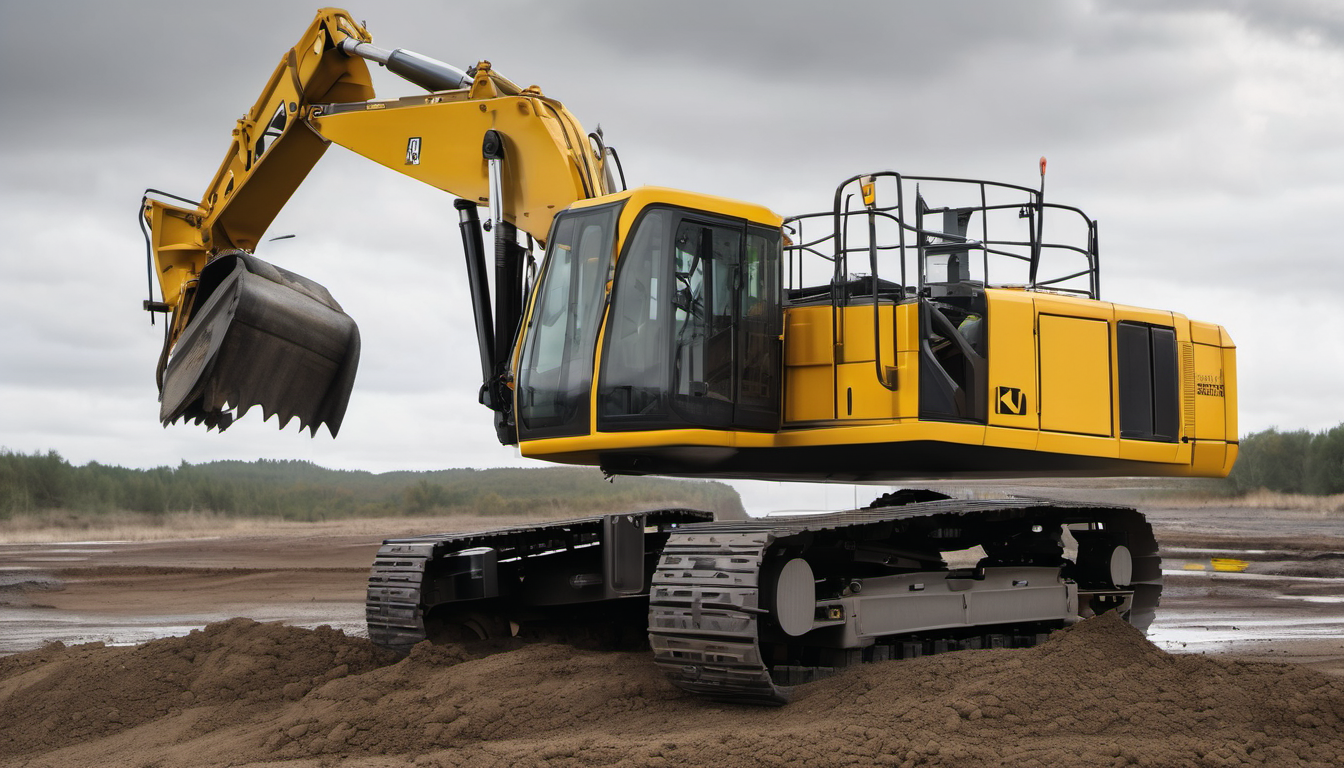
The load-bearing word is “existing.” The Rack retrofits onto machines from Caterpillar, John Deere, JCB and Hitachi. Once fitted, the machine drives, digs trenches, excavates large areas, loads trucks and manages stockpiles on its own. It also runs in copilot mode alongside a human operator. Gravis claims a 30% productivity gain over manual operation.
What they say is hard, and how they say they solved it
Co-founder and CTO Dominic Jud drew a technical line. Self-driving cars and robot arms work in what the company calls static environments, where the goal is to move without disturbing the surroundings. An excavator does the opposite. Its entire job is to disturb the terrain, cutting through soil and rock.
Jud says a human operator reads the ground by listening to the engine, feeling the machine vibrate and pushing against hydraulic resistance. Gravis trains its models in simulation built to reproduce that feedback. “We didn’t try to simplify the world for our software,” he said. “We gave it the physical intuition to handle real job sites.”
How much to discount that is not knowable yet. The round size gives one reference point: the company raised $23 million last November. Nine months later it raised $200 million.
How many are running now
Gravis says the Rack is deployed across dozens of job sites globally. The U.K. is the next push, where it recently booked an $8 million contract to retrofit existing excavator fleets.
Dozens of sites and $8 million are not big numbers. The retrofit form factor changes what they mean. Buying new machines puts a contractor on a 10-to-20-year equipment replacement cycle. Bolting a box onto machines already sitting on the site compresses that to the length of a purchase approval.
Set this against SoftBank’s other two robotics moves and the shape is clear. It paid $5.4 billion for ABB’s industrial robotics division, which is buying capacity. It sold Boston Dynamics for $325 million, which is clearing out the display case. This one is neither. It is buying a way around the equipment replacement cycle.
There is a second reason the retrofit shape matters, and it is about who signs the check. Gravis does not sell to robot buyers. It sells to contractors, and contractors evaluate equipment on two things: cost per cubic meter moved, and whether the schedule holds. Robot specifications have no column on that sheet. A box that clamps onto machines already in the yard fits the purchasing behavior contractors already have. It does not touch the equipment line on the balance sheet; it comes out of a services or rental budget. Persuading a contractor to fit ten machines is an order of magnitude easier than persuading it to replace a fleet. Part of why the valuation doubled sits right there.
What this round buys is a claim, not a fleet in the field. The evidence Gravis has today is “dozens of job sites” and one $8 million U.K. contract, and the 30% figure is the company’s own, with no third-party audit behind it. We wrote in July that outdoor autonomy has humbled better-funded teams, and construction sits at the bottom of global robot-penetration tables for reasons that are not accidental. SoftBank marked Gravis at $1 billion. What got marked up is the probability that the retrofit path works, not evidence that it already does.
Copilot mode is the number to watch
The company’s stated rationale is a shortage: aging workforce, operators it cannot hire, schedules it cannot hit. That is true of construction and it is also the standard opening line of every heavy-equipment automation pitch.
Read “30% productivity gain” and “also works as a copilot” together, though, and the output is not a filled shortage. It is a smaller headcount. Long before full autonomy ships at scale, copilot and remote operation arrive: one operator watching several machines from a Slate tablet instead of sitting in one cab. Back the 30% figure out and roughly seven seats cover what ten used to. The shortage absorbs that first. The remaining seats come after.
The excavator operator is exactly the category we flagged in July: no degree required, pay well above the floor, long assumed safe because an outdoor job site is too messy to script. This round does not prove that wall has come down. It shows someone will bet $1 billion that it will, and that the bet doubled in three weeks.
The next number worth tracking is narrow. Once that $8 million U.K. retrofit is finished, check whether the operator headcount on those same sites moved.
Sources