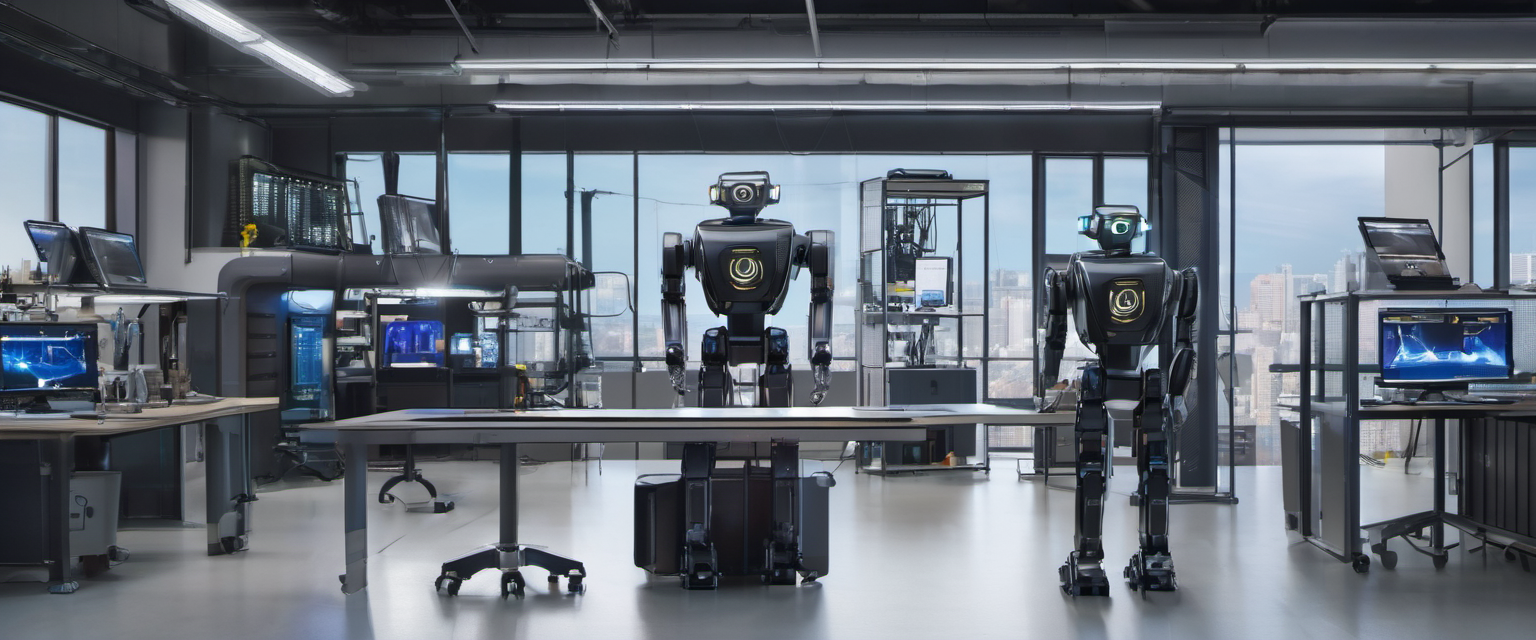
At GTC Taipei on Monday, NVIDIA announced the Isaac GR00T Reference Humanoid Robot — the first open humanoid robot reference design, and the first complete robot NVIDIA will sell to researchers rather than just the chips inside one. The “brain” is NVIDIA’s Jetson AGX Thor and the open Isaac GR00T software stack. The “body” is a Unitree H2 Plus, built in Hangzhou, with Sharpa Wave five-fingered hands. First in line: Stanford Robotics Center, ETH Zurich, Ai2 and UC San Diego, with availability from Unitree in late 2026.
The spec sheet is a serious machine, not a conference prop: nearly six feet tall, 150 pounds, 31 degrees of freedom in the chassis and 75 with the hands, 120 Nm arm torque, 360 Nm leg torque, a 7 kg rated payload (15 kg peak), and an onboard Blackwell GPU pushing 2,070 FP4 teraflops with 128 GB of unified memory. Battery life is about three hours, which by current humanoid standards is honest rather than embarrassing.
American brain, Chinese body
Sit with the geopolitics for a second. Washington spent three years building export controls to keep NVIDIA’s best silicon out of China. NVIDIA’s answer, announced in Taipei of all places, is to put Chinese hardware into American universities — CNBC notes this is the first robotics system the chipmaker has sold to researchers, and the body it chose belongs to Unitree, which filed in March for a 4.2-billion-yuan (~$620 million) IPO on Shanghai’s STAR board.
Nobody at NVIDIA is confused about why. Unitree ships human-scale hardware at prices no Western competitor matches, and Computex week has been one long admission that the humanoid supply chain runs through Asia — Taiwan’s HiWin debuted as the joint supplier to that supply chain a day later, and Qualcomm pitched its own robot chip the same morning NVIDIA presented GR00T. The bodies are commoditizing. The fight is over who owns the brain.
A reference design is a platform play
“Reference design” is the tell. IBM published one in 1981 and accidentally handed the PC industry to Microsoft and Intel, who owned the layers everyone had to license. NVIDIA is running the play on purpose: the GR00T foundation models are open on GitHub, the workflow is coming to the cheaper Unitree G1, and the hardware partner is welcome to the assembly margins. Jensen Huang’s framing — humanoids open “a multitrillion-dollar economic opportunity” — is the standard Huang sentence, but the structure underneath it is specific: commoditize the body, open the software, and collect rent on the compute every robot needs.
“Robotics moves fastest when researchers can build on open platforms, share code and test ideas on real machines,” said Stanford’s Steve Cousins in the press release. He’s right, and that’s exactly the part worth reading twice.
Why a research robot is jobs news
Until now, every humanoid lab burned its first year on bring-up: integrating hardware, wiring sensors, rebuilding the same data-collection plumbing as the lab next door. That fragmentation was an accidental moat — it kept humanoid skills locked in demos. A standard 75-degree-of-freedom platform with shared code, shared sims and shared training pipelines means a grasping policy validated at ETH Zurich runs at UC San Diego the same week. Skill development stops being artisanal and starts compounding.
The distance between “lab demo” and “warehouse shift” has mostly been an engineering-friction problem, and friction was quietly doing more to protect human jobs than any policy. NVIDIA just sold the friction-removal kit to the four labs best positioned to use it. Late 2026 is when the universities take delivery; the rest of us are on the same timeline whether we ordered or not.
Sources: NVIDIA Newsroom, GlobeNewswire, CNBC