On June 11, Chinese embodied-AI company X Square Robot open-sourced XRZero-G0, a hardware-and-software kit that lets a human in a VR headset generate robot training data just by doing tasks with their own hands. The company says the system cuts real-robot training data requirements by up to 20x under experimental conditions, and it shipped the announcement with receipts: a 2,000-hour multimodal dataset, the research paper, the hardware designs and code on GitHub, and the dataset on Hugging Face. Free, for everyone, effective immediately.
The expensive part of robot school
The reason your plumber still has a job and your customer-support rep doesn’t comes down to data. Text was lying around the internet in exabytes; demonstrations of skilled hands doing physical work were not. Teaching a robot to manipulate objects has meant either teleoperating an actual robot — slow, expensive, one robot-hour per robot-hour — or hiring rooms full of people to puppet hardware all day. Data scarcity has been the manual worker’s moat.
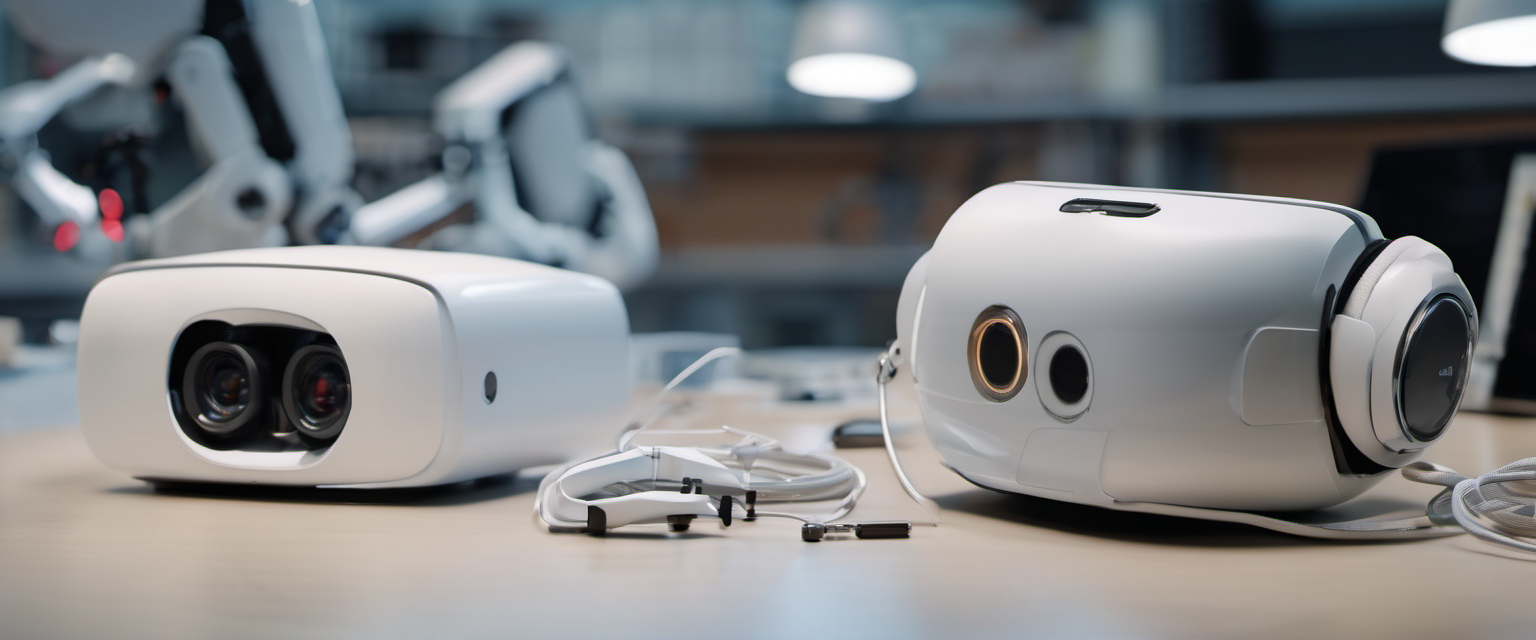
XRZero-G0 is a direct attack on that moat. The rig pairs a PICO 4 VR headset (head-mounted camera for global context, inside-out spatial tracking) with two handheld physical grippers — one press-actuated, one finger-driven — carrying wrist cameras and millimeter-accurate 6-DoF pose tracking. A person wears it and simply does the task: folding, sorting, picking, placing. No robot present. The system records what the hands saw and did, runs it through a closed-loop quality pipeline — collection, inspection, training, evaluation — and filters out trajectories a real robot couldn’t physically execute.
Ten cheap episodes plus one real one
The headline claim from the company’s controlled experiments: roughly ten of these robot-free human episodes, combined with a single real-robot episode, matched the performance of training on purely real-robot data in the tasks they evaluated. If that ratio holds beyond the lab, the cost structure of teaching robots manual work just changed by an order of magnitude — the scarce, expensive ingredient (robot time) gets swapped for the cheap, abundant one (a person wearing a headset).
And because the output transfers across robot bodies — the framework is explicitly built for cross-embodiment policy transfer — a demonstration recorded once doesn’t train one robot. It trains any robot that downloads the policy, the same logic we flagged in Neura’s skill-sharing Neuraverse last week, except this version is open-source and the demonstrations come from human bodies.
The apprenticeship, exported
There’s a tidy irony in the mechanics here. The data collectors X Square Robot envisions are humans doing skilled manual tasks — exactly the work the resulting models are meant to automate. The job of demonstrating work for the machine is, for now, a job. Data-collection-as-employment already exists in China’s robot training centers; this rig makes the role portable enough to happen anywhere a headset ships.
Worth being precise about what this is not: it’s not a product on a factory floor, and “up to 20x under experimental conditions” is the kind of phrase that has a habit of shrinking outside the lab. X Square Robot is the company behind the WALL-OSS foundation model, and open-sourcing is also a recruiting and ecosystem play against better-funded rivals.
But the direction is unambiguous. Every barrier between human demonstration and robot capability that falls makes the physical-skills moat narrower. The pitch used to be that robots couldn’t learn your hands. Now the hardware to teach them costs a VR headset and two grippers, and the dataset is a download link.