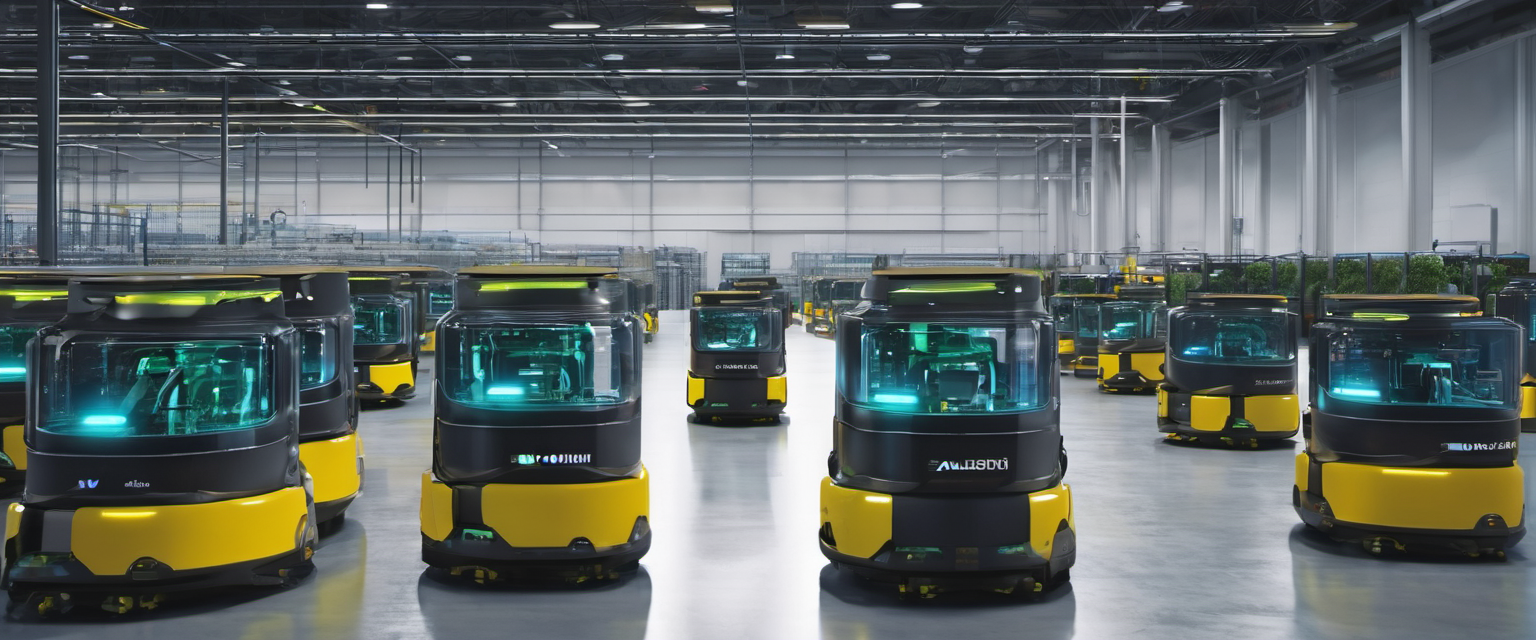
At its Delivering the Future event in London on Thursday, Amazon unveiled a new generation of its Proteus warehouse robot that takes plain-language instructions from workers. Type what needs doing — no programming interface, no technical command syntax — and Proteus decides the priority, picks the route, and chooses when to do it. The robot arrived gift-wrapped in a bigger number: more than €10 billion (about $12 billion) to expand and modernize Amazon’s European fulfillment network with robotics and automation.
The robot got a promotion
The interesting part isn’t the hardware. Earlier Proteus units were confined to dock operations, shuttling carts along predefined routes. The new version roams the whole fulfillment site and — this is the shift — interprets a request and works out how to complete it on its own, rather than executing a narrowly defined command.
For a decade, the standard warehouse story was algorithms directing humans: pick rates, scan timers, optimized walking paths. The new Proteus quietly inverts the org chart. Now the human sends a casual text — and the machine, not a supervisor, decides what gets done first. Amazon frames this as reducing the need for specialized training. True. It’s also a job description for warehouse middle management, running on a battery.
Proteus is still in pilot at Amazon’s research facilities, with European deployment planned for the first half of 2027. It joins a roster that’s filling out fast: Vulcan, the touch-sensitive picker, keeps expanding, and STARK — a tote-handling system that lifts full storage bins from conveyors onto carts — goes from its Barcelona pilot to 15 European sites by 2027.
€10 billion, 25,000 jobs, and the order they appear in
Alongside the automation spend, Amazon pledged to create 25,000 additional jobs in Europe “over the coming years.” Read the two numbers together. €10 billion buys robots that take verbal orders, handle totes, and feel what they’re gripping. The 25,000 jobs arrive on an unspecified timeline, in unspecified roles, across a continent where Amazon already employs hundreds of thousands.
This is the now-standard structure of an automation announcement: the capital expenditure is precise, dated, and binding; the job creation is round, vague, and aspirational. It’s the same arithmetic running through this spring’s earnings season — companies cited AI as the top reason for U.S. job cuts for a third straight month in May — except here the press release leads with the robots and lets the jobs trail behind as ballast.
To be fair to Amazon, it isn’t claiming the robots won’t change work — it’s claiming they’ll remove the “repetitive” and “physically demanding” parts. Every warehouse operator says this, from DHL with its 8,000 robots on down. The tell is never the adjective. It’s the retraining budget.
The retraining tell
And there it is: a $1 billion commitment to Career Choice, Amazon’s education program, by 2030 — training employees in cybersecurity, software development, logistics, renewable energy, and mechatronics. More than 300,000 employees have already been through it.
Companies don’t spend a billion dollars retraining people whose jobs are safe. Career Choice is a well-run program and genuinely better than nothing, which is what most displaced warehouse workers get. But its existence at this scale is Amazon’s own forecast of how many current roles won’t survive contact with Proteus, STARK, and Vulcan. The curriculum — mechatronics, software, cybersecurity — is a list of the jobs that remain when the moving and lifting belong to machines that answer texts.
The robots ship to Europe in 2027. The plain-language interface means the last specialized skill — knowing how to talk to the machines — just got automated too.
Sources: Amazon, Reuters via Investing.com, Interesting Engineering