For two years, every corporate robotics deployment has been press-released as a story about augmentation — fewer back-strains, better safety, more time for “higher-value tasks.” On Tuesday, DHL Supply Chain’s global CIO Sally Miller went on the record in Fortune’s CIO Intelligence column and broke the script.
“Does it reduce our dependency on labor? Yes, it does,” Miller told reporter John Kell. [“If anyone says otherwise, I don’t think they are being truthful.”]
That sentence, from the CIO of one of the world’s largest logistics employers, has not been said publicly by a peer in two years. It is the inverse of the Coca-Cola robotics announcement, the Walmart restructuring memo, and the Tesla Optimus tweet. Miller’s job description includes saying it.
8,000 robots, 2,800 sites, three vendors
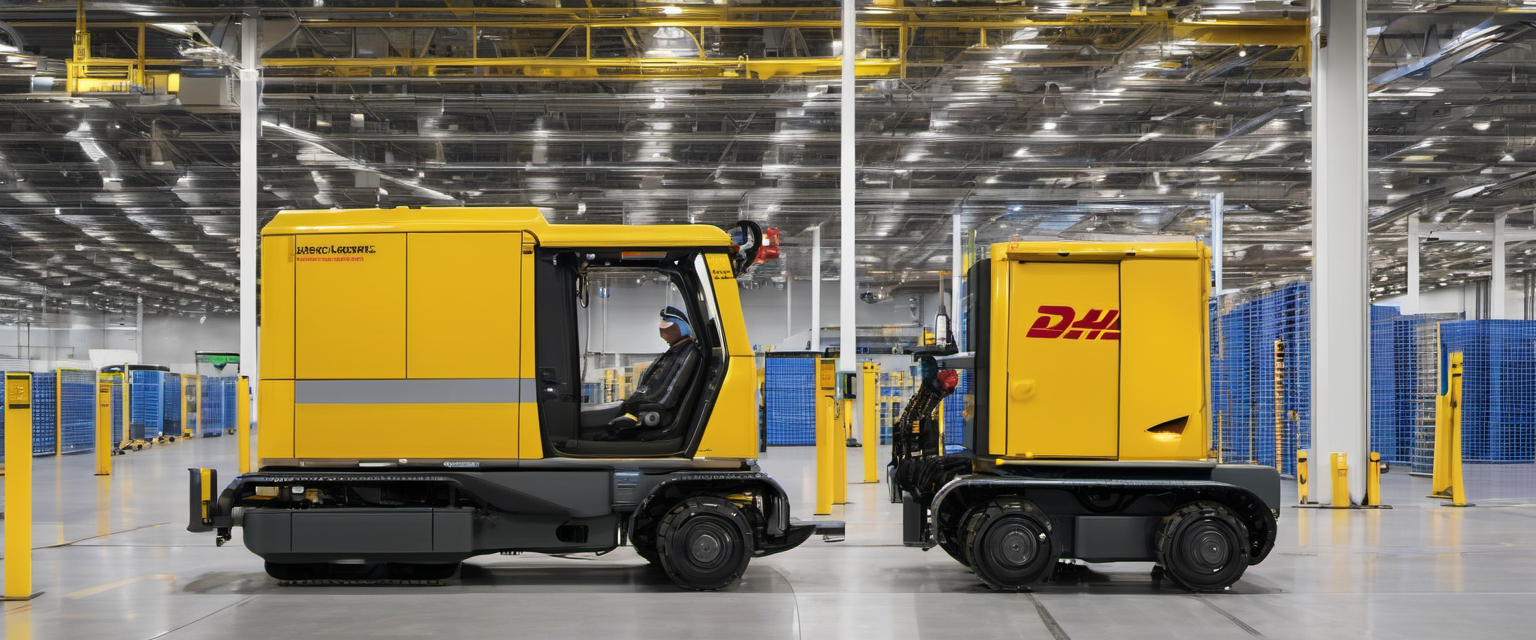
DHL Supply Chain — the contract-logistics arm of the German parent DHL Group — runs roughly 2,800 facilities globally. As of this week, those sites collectively run more than 8,000 deployed robotic systems. The first bet was placed in 2017. Miller, a two-decade DHL veteran promoted to global CIO in 2024, names her three “honed in on” vendors with unusual specificity:
- Locus Robotics — the autonomous mobile robot that follows pickers around the warehouse, which just rolled out Locus Array, an end-to-end “physical AI” fulfillment system replacing the picker entirely.
- Boston Dynamics — controlled by Hyundai Motor Group, the parent that also just announced 25,000 Atlas humanoids across U.S. plants by 2028. The Stretch case-handler and Spot are the workhorses at DHL.
- Robust AI — Carter, the camera-mapped mobile cart that Miller singled out by name: “computer vision to harness that data,” avoiding both objects and workers.
Tying them together is SVT Robotics, the connective tissue middleware. Multiple vendors per use case is Miller’s deliberate hedge: “It decreases our risk, because these are startup companies, and funding comes and goes. Not all of them are going to make it.” That last line is the line every other Fortune 500 robotics buyer is afraid to say in print.
The labor numbers, the macro backdrop
For scale: U.S. manufacturing payrolls were 17.2 million in 2000. By September 2025, per McKinsey via Deloitte, that figure was 12.7 million. The Trump tariff regime that was billed as a manufacturing-reshoring play has not, per Politico’s April reporting, produced a meaningful upturn.
Logistics ate part of the difference. The U.S. warehousing and storage workforce grew from ~500K in 2000 to ~1.9M today. Miller’s quiet point is that the warehouse-jobs growth curve is the next one bending. The job is shifting from “walk the floor, pick the box” to “supervise the robot that picks the box.”
That shift maps to specific bullet points in the article:
- The hardware-cost ROI varies by site, with markets where labor is hardest to fill being the most desirable for robotization.
- Workers in the new model are spending more time working with vendors on data and AI integration — i.e., a fraction of the floor headcount becomes a smaller pool of higher-skill robot supervisors. Most of the floor headcount doesn’t get retrained into it; the headcount line goes down.
- McKinsey says VC into robotics rose threefold from 2023 to 2025, with $40.7B invested annually globally.
The retention spin — and why it might be true
The most interesting twist in Miller’s Fortune interview is the worker-experience claim: “In sites where robots have been deployed, turnover is lower and onboarding is faster. People prefer to work in sites where there’s technology deployed.”
Reading the cynical version: in a workforce where the median picker walks 15 km/day and the back-injury rate is one of the highest in the BLS dataset, a robot that hauls the heavy bin to your picking station is, in fact, less painful than the pre-robot job. The remaining humans are happier per remaining job. The labor-pool number, separately, goes down. Both are true. The story DHL is now ready to tell publicly is the first one. The CIO of DHL Supply Chain is also ready to tell the second one, in the same paragraph, which is the news.
Read against the same week’s earnings cycle, this is the operations counterpart to Cloudflare CEO Matthew Prince’s WSJ op-ed on the 「measurer」 layer of white-collar work. Prince said: middle management, finance, legal, audit. Miller said: pickers, packers, putaway. Different floors of the same building, same week, same admission.
What to watch
- The next DHL-style on-the-record admission from a US logistics CIO. Once one Fortune 500 CIO says “yes, fewer jobs” in print, the next one says it on an earnings call. The leading indicator is the Q2 transcripts from UPS, FedEx, XPO, and Maersk.
- Locus Array deployment numbers. Locus Robotics’ new “fully autonomous fulfillment” system is the first product where the picker isn’t even in the loop. If DHL adopts Locus Array at scale across its existing Locus footprint, the per-site picker headcount step-down is the data point to track.
- Boston Dynamics’ bandwidth. Hyundai is pushing 25,000 Atlas units into its own plants by 2028 and selling Stretch into DHL. Whether the same supply chain can serve both internal Hyundai demand and external DHL demand is the Boston Dynamics 2026 H2 question.
- The Robust AI funding round. Miller specifically named Robust AI and the Carter platform’s computer-vision floor mapping. Anyone shopping the Robust AI cap table just got a Fortune endorsement. The Series D timing will be the test.
- SVT Robotics M&A. A middleware layer that quietly ties 8,000 robots at a Fortune 500 customer together is, by definition, an acquisition target. SAP, Manhattan Associates, or Blue Yonder buying SVT is the next plausible move.
- The “happier with fewer” framing. If the DHL talking point — “people prefer to work in sites where there’s technology deployed” — gets adopted by Amazon, Target, and Walmart in earnings calls, the public-facing narrative of warehouse automation has flipped. That’s the language watch.
For two years the CEO playbook on robotics has been “augment, not replace.” The DHL CIO’s line in Fortune is the first time a Fortune 500 operator has put the other version of the sentence on the record. Miller didn’t invent the math. She just said it.
Sources
- Fortune — How 8,000 robots are changing work inside logistics giant DHL Supply Chain (May 20, 2026)
- Politico — Manufacturers still waiting for Trump tariff promises (April 2, 2026)
- Deloitte — U.S. manufacturing labor impact spotlight
- McKinsey — Turning humanoid supply-chain constraints into billion-dollar wins
- Locus Robotics — Locus Array launch
- Interesting Engineering — Hyundai to deploy 25,000 Atlas robots across US plants
- Robotics Tomorrow — SAP and Cyberwave deploy fully autonomous AI-powered robots in live SAP logistics warehouse (May 12, 2026)
- Phil Stock World — How I Choose Which Cloudflare Employees to Replace With AI (May 20, 2026)