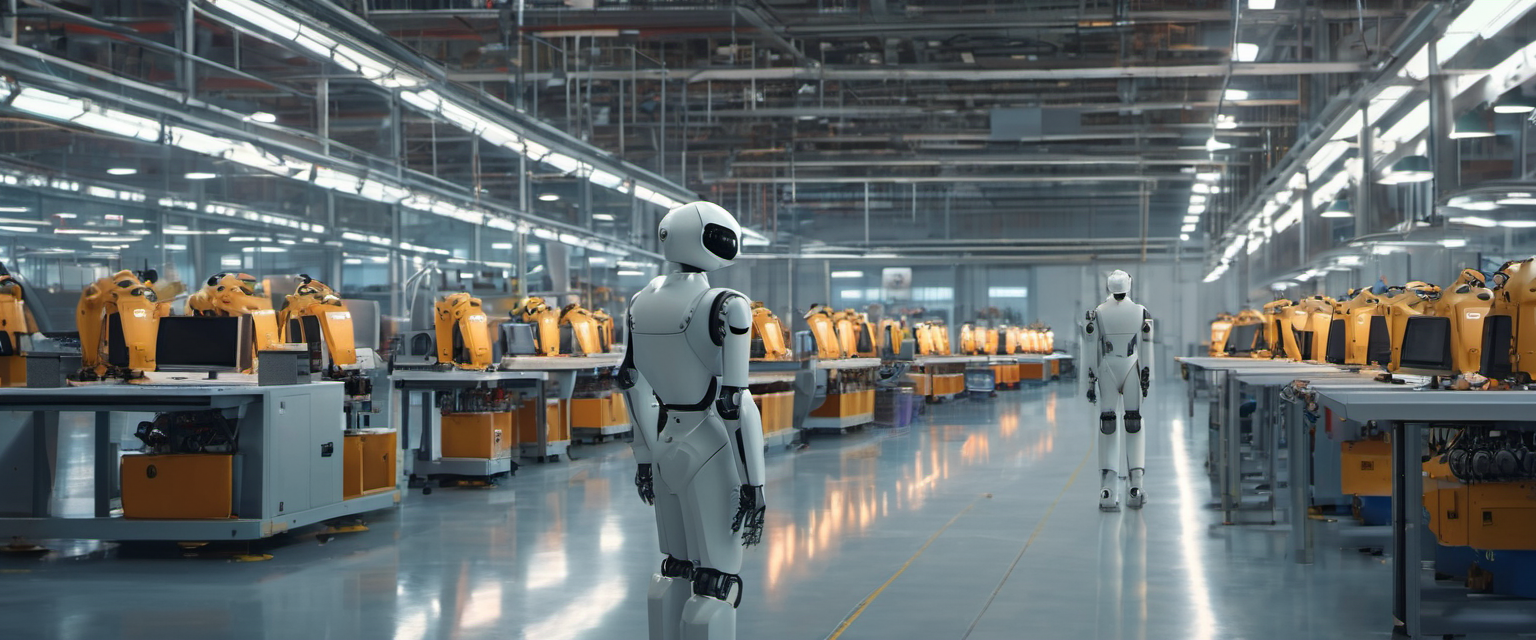
China’s Ministry of Industry and Information Technology and its state-asset regulator SASAC have jointly issued a 2026 special action plan that tells the country’s humanoid robots, in effect, to stop performing and start working. The official document, quoted by the South China Morning Post, is unusually blunt about the finish line: by the end of 2026, key humanoid robot products will “complete application verification and regular deployment in a number of representative scenarios, entering ‘work mode’.”
The targets come with numbers and dates, which is what separates industrial policy from a press release. More than 100 high-value application scenarios. Deployment capability at the 10,000-unit scale. Provincial implementation plans due by the end of June — about two weeks from now — and progress reports due by the end of November.
The plan, minus the slogans
Per Gasgoo’s readout of the document, the campaign spans ten provincial-level hubs — Beijing, Tianjin, Shanghai, Jiangsu, Zhejiang, Shandong, Hubei, Hunan, Guangdong, Sichuan — plus the central state-owned enterprises, and sorts the work into three domains: industrial manufacturing (production, inspection, maintenance, logistics), public services (catering, retail, healthcare), and specialized operations (workplace safety, emergency rescue, disaster relief).
Six tasks follow, and one of them contains the most honest phrase in the entire document: companies are to develop practical operational skills by shifting from “stunt mode” to “work mode.” A government ministry has now officially said what every viewer of a humanoid backflip video has been thinking. The rest of the list is the standard machinery — shared real-world training environments to stop every city building its own robot gym, innovation consortia, scaling rules (“validate one solution, deploy a batch”), and financial backing that includes equity investment, debt financing, and insurance products.
The mechanism that matters most is the quietest one: SOEs and provincial authorities are instructed to “open up scenarios” using special funds and government incentives, with a list-based tracking system to make sure they do. Translation: the customers have been ordered to buy, the venues have been ordered to host, and everyone’s compliance will be graded. ROI can be worked out later.
The same week, in Washington
For contrast: three days before this campaign hit the international press, four U.S. senators introduced a bill to create a commission to study American robotics competitiveness. One government is assessing whether it should have a strategy; the other has assigned deployment quotas with submission deadlines to ten provinces and its entire state-owned sector. You can argue about which approach produces better engineering. There is no argument about which produces more deployed robots by December.
Who actually clocks in
This isn’t starting from zero. Beijing-based Robotera already has humanoids working in more than ten logistics centers run by China Post and SF Holding, per China Daily — packing boxes and, in this week’s demo, correcting its own mistake when an item was pulled out. Co-founder Xi Yue says orders are in the thousands this year. AGIBOT crossed 10,000 humanoids built back in March. The campaign’s 10,000-unit target is less moonshot than mandate to industrialize what the leaders are already doing.
Vivo’s robotics lab director Shao Hao told SCMP the policy pushes the industry “from a demonstration-driven logic to a task-oriented logic,” and that the six-month sprint “could determine whether embodied AI can achieve large-scale commercial deployment.”
Now read the scenario list one more time, slowly: production, inspection, logistics, catering, retail, healthcare. Those are not technology categories. Those are job descriptions — tens of millions of them in China alone. When deployment becomes a state KPI with a November reporting deadline, the question of whether robots will take over routine physical work stops being a forecast debate. Somewhere in a provincial industrial office right now, someone is writing the implementation plan that answers it, and it’s due in two weeks.
Sources
- South China Morning Post — China fast-tracks humanoid robots and embodied AI industry under nationwide programme
- Gasgoo — Two departments jointly launch special campaign for humanoid robots and embodied intelligence
- China Daily — Robotera humanoids in China Post and SF Holding logistics centers
- eWeek — China’s 2026 plan: move 10,000 humanoid robots from demos to real jobs