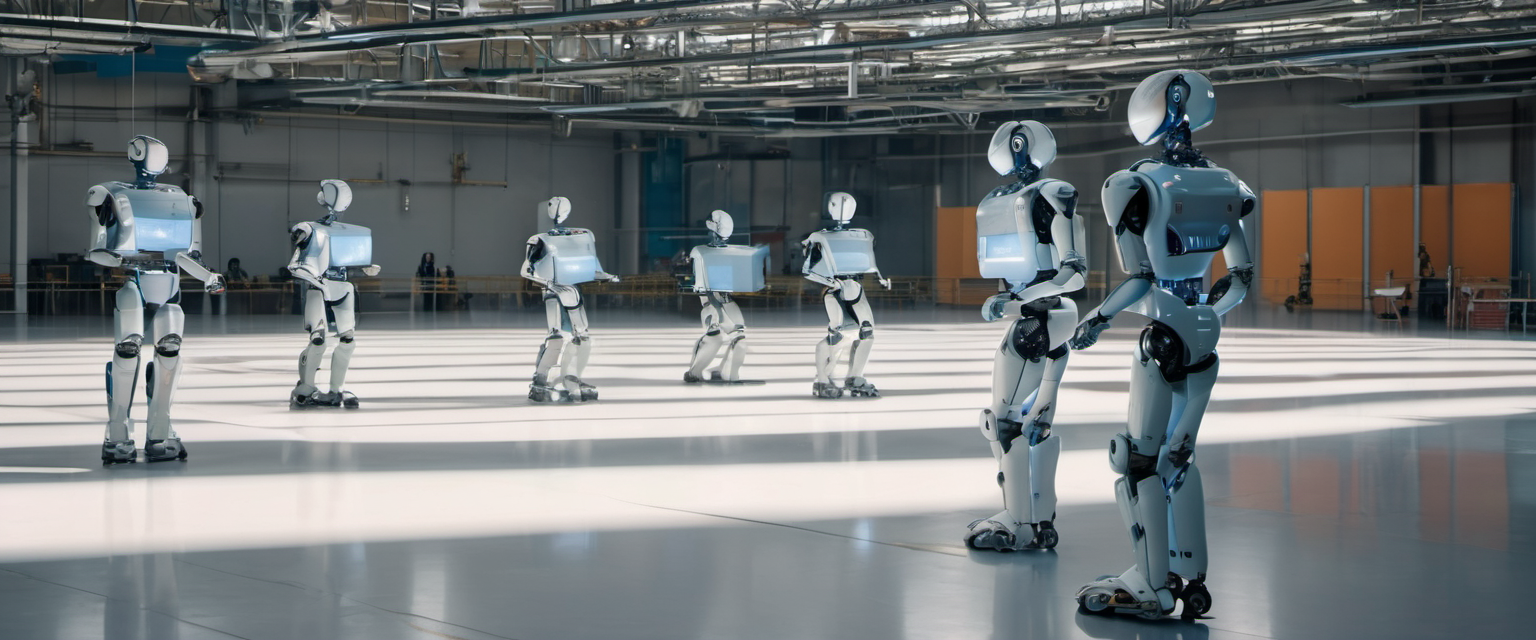
Chinese-made humanoid robots can do backflips, direct traffic, box, and pour you a coffee. According to a Fortune/Associated Press report published June 6, they cannot, for the most part, do a job. That gap — between what the robots perform and what they produce — is the whole story of China’s humanoid boom, and it is finally getting said out loud by the people funding it.
The headline numbers are genuinely large. Chinese humanoids accounted for roughly 85% of the global market last year, per a Barclays report cited by the AP. Of the more than 13,000 humanoid robots shipped worldwide in 2025, AGIBOT and Unitree each shipped over 5,000 — while U.S. rivals like Figure AI and Tesla each managed a few hundred or fewer. Morgan Stanley pegs the eventual humanoid market at $5 trillion and expects China’s sales to more than double this year, to around 28,000 units. By any shipment metric, the race is over and China won it.
The orders are real. The work isn’t.
Then you read what the robots are actually for. Shanghai’s Matrix Robotics sells the MATRIX-3, a 5.6-foot humanoid at about $99,000 a unit, and says it has roughly 1,000 orders — from coffee chains and hotels. Shenzhen’s EngineAI offers a basic humanoid at 180,000 yuan (about $26,600), pitched as a security guard or museum guide that also dances and boxes. Founder-CEO Allan Zhang, a Tesla alum, says Matrix has built only a few hundred so far but could deliver 5,000 this year “depending on the number of orders.” That last clause is doing a lot of load-bearing.
The skeptics in the piece are not short-sellers; they’re insiders. “Most humanoid robots are still performative rather than functional,” Samm Sacks of the New America think tank told the AP, falling short in messy, unpredictable environments. “The use cases of these robots are still so limited,” said Chibo Tang of Gobi Partners, which invests in robotics startups. “Without the demand and without that scale from the market, these companies are not able to really go into mass production.” When your own VC is explaining that there isn’t enough demand to justify the factory you just built, the bubble is no longer a theory.
It isn’t one. China had more than 140 humanoid manufacturers and over 330 models in 2025, by the Ministry of Industry and Information Technology’s own count — and last year the government itself publicly warned of an industry bubble given how far commercialization lags the hype. Of the more than 2 billion yuan ($295 million) in orders booked in 2025, many came from state-owned enterprises buying units for power plants, data centers, and entertainment. Translation: a meaningful share of “demand” is the state buying from itself.
What the shipment chart leaves out
This is the part worth filing away, because it cuts against the narrative this site usually reinforces. We’ve covered Unitree’s manufacturing scale and Computex’s wall of humanoid hardware as evidence the robots are coming for the jobs. The AP report is a useful corrective: building 13,000 robots and employing 13,000 robots are different sentences. Most of those units are doing demos, research, or lobby-greeting — not displacing a warehouse shift.
The economics explain why. “Humanoid robots remain expensive to produce, fragile in operation, and dependent on highly structured environments to function,” Sacks said. The viable near-term path runs through factories and logistics — except many factories already run cheap, reliable single-purpose robotic arms that don’t need a $99,000 anthropomorphic generalist to replace them. A Mercator Institute report flagged that even China’s robots, cheaper than anyone else’s, are “far too expensive for widespread deployment.” Japanese and U.S. humanoid startups are struggling to find buyers too; this is not a China problem, it’s a product-market-fit problem with a Chinese accent.
None of this means the threat is fake — only that it’s on a slower clock than the shipment chart implies. Unitree booked 1.7 billion yuan ($250 million) in revenue last year and a 278-million-yuan ($41 million) profit, so somebody is making money. Morgan Stanley thinks average unit prices fall from $46,000 last year toward $21,000 by 2050, and some models already sell below $6,000. When the price curve and the capability curve finally cross the line where a humanoid is cheaper and more reliable than the person, the displacement starts in earnest. For now, the robots are very good at the part of the job that looks like a job. The rest is still hiring.
Sources: Fortune / Associated Press, Associated Press (humanoid robots summit)