On August 28, at Reservoir’s first Ruggedize event in Salinas, California, Deere signed off on $10 million over three years into Reservoir’s on-farm R&D infrastructure.
The figure is small. Deere booked $1.379B in net income last quarter, so $10M is less than a day of profit. What the money buys is the interesting part. It does not buy a machine, and it does not buy a company. It buys ground where prototypes are allowed to break.
What $10M actually purchases
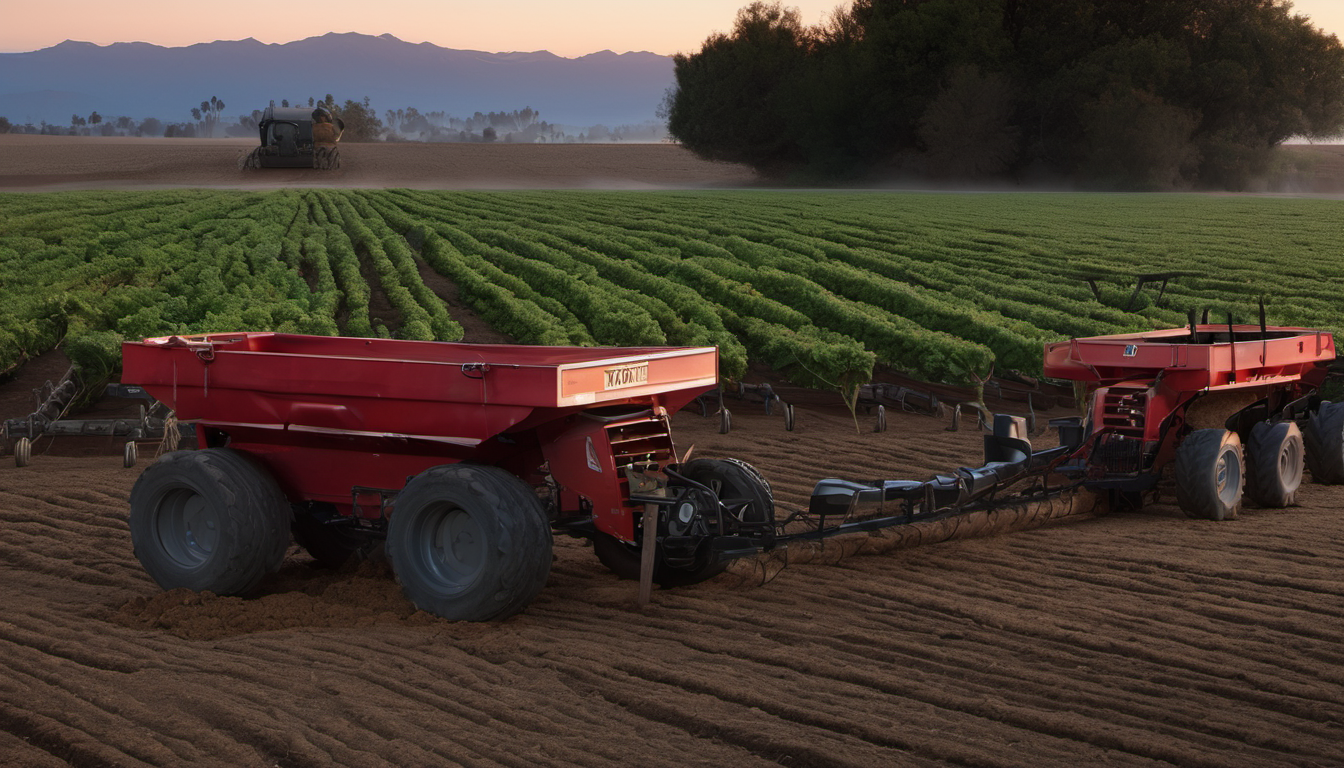
Reservoir was founded in 2024. Deere has been in it since the founding and is now a key investor. The flagship site sits in Salinas: 40 acres total, 24 of them commercial test fields leased from grower Tanimura & Antle, plus a historic barn serving as shop and storage. Twelve startups moved in at opening. More than 20 are there now.
Deere’s money is not earmarked for a technology. Per Reservoir, it subsidizes startup participation, covers farm operations and equipment, and lowers the barrier for deep-tech founders to reach growers and real fields. The footprint is expanding past California into Yuma, Arizona, built with the University of Arizona, and Merced County in the Central Valley. Western Growers has separately committed $1.5M over the same three years.
Jason Brantley, Deere’s vice president of production systems for small ag and turf, put the rationale in an order worth reading closely. Automation on the farm, he said, is addressing the immediate labor and efficiency needs of the industry.
Labor first. Efficiency second. That is not a reporter’s paraphrase. That is the executive who owns the business unit naming his own sequence.
The same week, the automation division was shrinking
A week earlier Deere posted fiscal Q3 2026: $1.379B net income, $5.10 per share, ahead of expectations, with full-year guidance raised to $4.75B–$5B.
Split it by segment and the two halves point opposite directions. Production and Precision Agriculture, the unit that carries revenue from autonomous machinery, smart spraying and precision systems, posted net sales down 6% and profit down 9%. Small Agriculture and Turf posted net sales up 12% and profit up 28%.
Brantley runs production systems for Small Ag and Turf. The division writing the $10M check is the one that grew this quarter. The division everyone reads as the scoreboard for “is farm automation selling” is the one that shrank.
That mismatch is the story. Row-crop automation rides the equipment replacement cycle, and when corn and soybean prices soften, orders slide right. Specialty crops run on a different clock. Demand for automation in lettuce, strawberries and wine grapes is not set by commodity prices. It is set by whether the crew shows up. By routing money into field validation for specialty crops while its precision division contracts, Deere is conceding that these are two separate curves.
The number is 40%
Incubator stories write themselves into “innovation ecosystem” and leave the reader holding nothing. So go back to something countable.
A 2024 Western Growers study found that robotic weeding in Salinas Valley leafy greens cut labor costs by as much as 40%.
That is a landed number, not a forecast. And it landed on one specific task. Weeding went first because it is repetitive, non-selective, and requires no judgment about ripeness. The machine only has to recognize what is not the crop.
Harvest is a different animal. When to pick, which one to pick, how to close a hand without bruising: that is still human. The shape here is identical to the warehouse. This morning we covered the ratio Locus’ head of grasping named out loud: suction covers 60% to 70% of picks, the remaining 30% to 40% needs pinch and touch, and touch is something simulated data does not help much with. For comparison, Amazon’s Vulcan reported 75% coverage of unique SKUs once it added force and torque sensing. Nobody has published the equivalent ratio for a lettuce field. The structure is the same one: the easy share is gone, and the hard share is being turned into training data by real machines on real ground.
Reservoir’s 40 acres are where that data gets collected.
This layer of displacement is invisible to every tracker we cite
Here is where specialty crops diverge hardest from the white-collar layoffs we cover most weeks.
Tech cuts produce WARN filings, 8-Ks and leaked memos. Challenger publishes a monthly count, and we can follow the story announcement by announcement. Agriculture has none of that. Salinas harvest crews are largely seasonal, hired through farm labor contractors, many on H-2A visas. They do not get laid off. The contract simply is not offered next season, or the hours per acre come down a notch.
So this displacement never appears on a layoff list. It appears in a grower’s per-acre labor budget, in a contractor’s scheduling sheet, and in a town where fewer buses arrive the following year. By the time it shows up in a statistic, it is several seasons old.
The calendar is worth marking. Yuma targets full operation on October 1, and Merced County is expected to open this fall. With Salinas, three of the most labor-intensive specialty-crop basins in the United States each get a field validation site inside one year. A validation site does not manufacture machines. It manufactures the answer to “does this thing actually work in dirt” — and that answer is exactly what a grower waits for before signing next season’s labor contract.
Three things to watch if you work this line
Watch tasks, not machines. Weeding has already cleared the 40% line. The next tasks to loosen are thinning, de-leafing and in-field transport: repetitive, non-selective, no judgment call. Harvest and pruning loosen last.
Watch the first full production season at Yuma after October 1. Salinas and Yuma are the summer and winter halves of the same growers’ rotation. A system validated in one can follow the crop to the other. The first machine to clear a cross-season validation will scale faster than any industry forecast has it.
Watch what Deere buys. It has already acquired Blue River Technology, Sentera and GUSS Automation. Deere says Reservoir is not built as an acquisition pipeline, though it does not rule one out. Whichever tenant Deere buys is the tenant whose technology moves from “runs on a test plot” to “your dealer can order it next year.” That gap has historically been one to two production seasons.