On August 27, The Information reported that SoftBank is in talks to buy a majority stake in 1X Technologies, the Norwegian humanoid maker, at a valuation of roughly $6B. Talks are live and terms can move.
Start with how far the number fell. A year ago, 1X went out for $1B and was reportedly asking around $10B. SoftBank is talking at $6B, 40% below the ask, and it is not buying a slice. It is buying control.
What the product actually is today
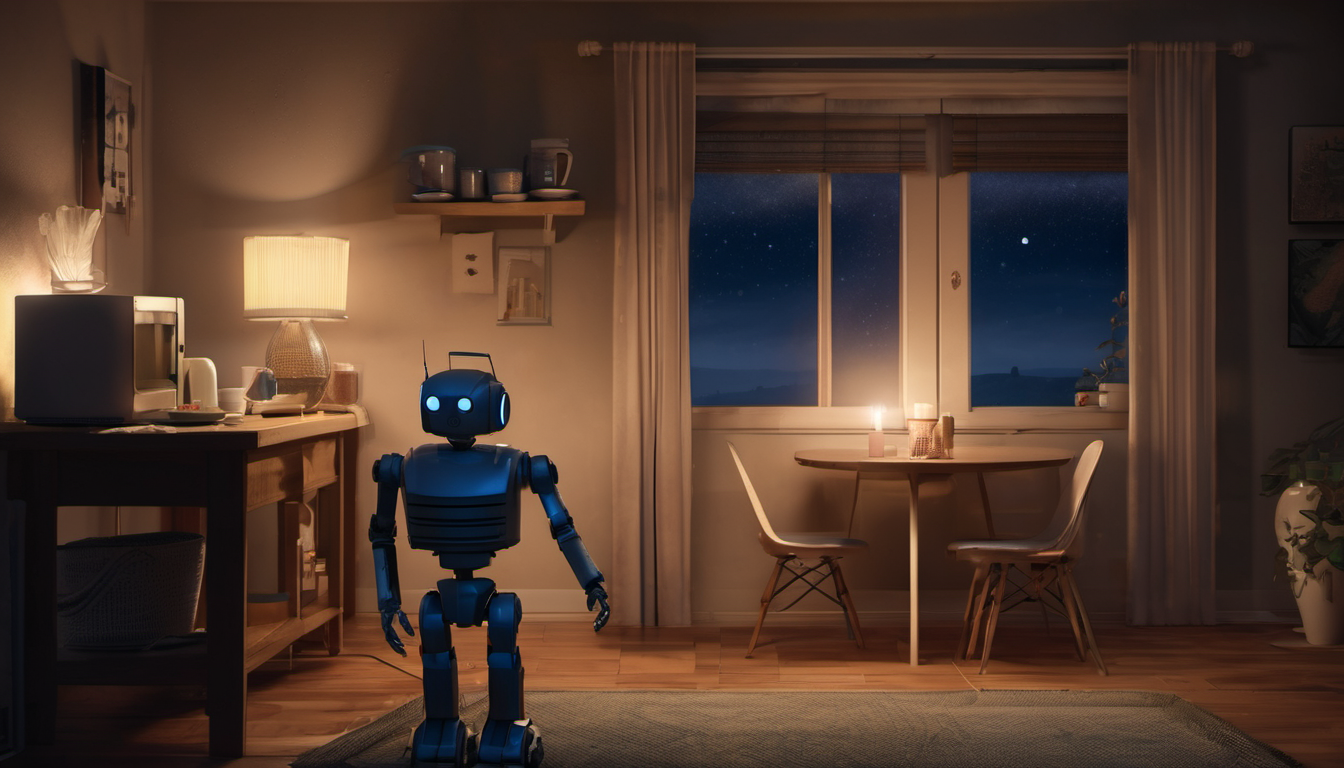
NEO is the home humanoid 1X announced in October 2025. Two ways to buy: $20,000 outright, or $499 a month on a six-month minimum, both against a $200 refundable deposit. First deliveries were set for 2026 in the U.S.
The part that matters is how the machine gets work done. Engadget was direct about it at launch: NEO learns chores through teleoperation. The owner books a window in an app and names the task, a 1X operator puts on a VR headset and takes the robot over, the task gets done, and the session trains the network. Autonomous today means walking, opening a door, hitting a light switch, fetching something in plain sight. Folding, clearing a kitchen, anything with steps that depend on the last step — a person takes the controls.
So $20,000 buys half a machine and half a staffed service.
We covered the household scoring rubric at Beijing’s World Humanoid Robot Games on August 23: one human intervention and the whole run settles as remote control, weighted 0.5 against 1. The competition discounts teleop by half. The market bills it at full price, $499 a month.
Where SoftBank’s robot money went this summer
In early July SoftBank sold its last Boston Dynamics stake to Hyundai. By the end of the month it was in talks for a maker of autonomous excavators, and we put those two moves side by side: the company everyone has watched dance and backflip got cashed out, and the money went into a machine nobody will livestream.
This is the third move. Majority control of a home robot whose current product is a crew of remote workers wearing headsets, plus a body.
Read the three together and they point one direction. SoftBank is not buying robot fame. It is buying labor that is already being performed and already being billed. The excavator bills by the cubic yard on a jobsite. NEO bills by the month in a living room. Atlas had a demo calendar.
What $6B is worth this quarter
On August 24, XPeng’s robotics unit raised over $900M at a post-money valuation above $6.3B, which XPeng called the largest single private round in China’s embodied AI industry. Three days later SoftBank is discussing majority control of 1X for less money at $6B.
Inside one week, a Chinese automaker’s robot subsidiary is worth $6.3B on a financing, and a Norwegian company is worth $6B whole. The difference is that the first sold shares and the second would be selling the wheel. Against Unitree’s 18,000 bipeds and 219x multiple, which we ran on August 18, $6B is not a premium in today’s humanoid market. It reads closer to a takeout price.
OpenAI is on the 1X cap table. It invested through the OpenAI Startup Fund in 2023, alongside Tiger Global and a group of Norwegian investors, and the two sides discussed an acquisition last year that did not proceed. SoftBank is now having the conversation OpenAI walked away from, for control, at 40% below what 1X wanted for itself.
The labor read
The first job this creates is remote operator. It is domestic work with a new delivery mechanism: you never enter the client’s home, you put on a headset, and from another city or another country you fold their laundry and clear their table. The billing changed. The labor did not. House cleaning has been unbundled into a shift-scheduled, piece-countable, cross-border remote role.
The second effect lands on conventional domestic service, and not soon. $499 a month is roughly twice-weekly cleaning in a large U.S. city. As long as a person is still taking the controls, the cost structure underneath has not moved; 1X earns the spread and the data. Real substitution waits on the autonomy rate, and there is no public, verifiable number for it yet.
The third line is the data. Every teleoperated session a customer buys is another labeled sequence of household manipulation. That is the same logic as NEO’s 25-degree-of-freedom hand with force sensing in every knuckle, which we covered in July: land the hardware, feed it sessions, walk the autonomy rate up. What SoftBank would be buying control of is that pipeline, not this year’s revenue.
So the thing to watch is not the $6B price tag. It is the first time 1X publishes an autonomy completion rate, and whether that rate is measured per task or per hour. Until then NEO is a machine that moved domestic work online. It is not yet a machine that removed it.