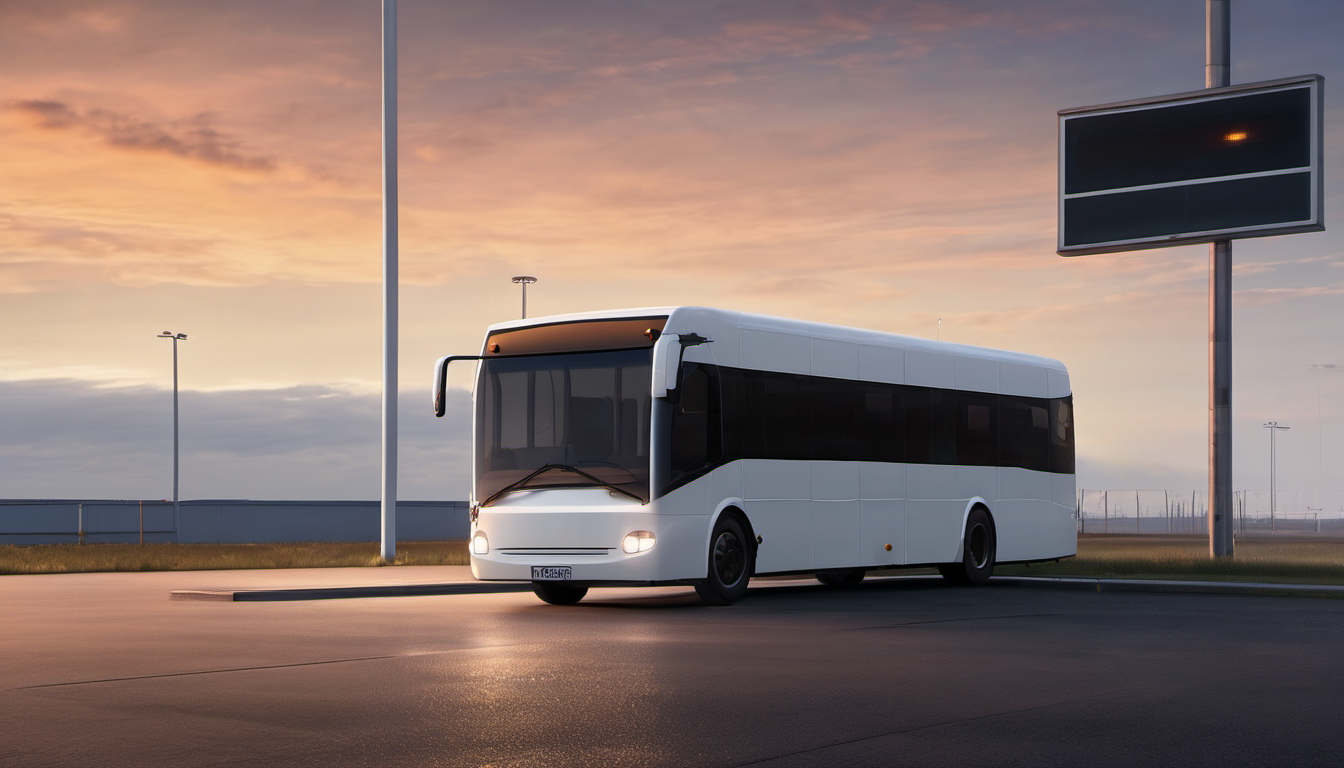
On September 9, Zurich Airport posted a release about two buses. Since the start of the month the buses have been driving themselves across airport grounds with nobody in the safety seat. Monitoring moved to a room the airport calls a remote cockpit. The airport calls the result Level 4, and by its own definition that means no safety person inside the vehicle. (Zurich Airport newsroom)
This was not a demo day. The programme started in March 2025 with Chinese autonomous driving firm WeRide as technology partner. Over eighteen months the two buses covered more than 15,000 km. The safety operator started in the driver’s seat, then moved to the back seat, then handed an increasing share of the watching to the remote room. The empty driver’s seat came last, not first.
What the eighteen months bought
The buses are named Nimbus and Stratus. They run one fixed route, from the Gate 101 staff entrance to a maintenance area, and they do not cross aircraft taxiways. They carry airport staff, not passengers. WeRide says this is its first European Robobus deployment operating without an onboard safety operator.
The first Level 4 trips are running empty. The airport expects staff back on board after roughly four weeks of testing. Every stage of this programme has opened with a passenger-free phase, and this one is no exception.
The pilot is funded through the end of 2026. Whether the two buses keep running past that is under review with the project partners. The airport attached a more consequential line to that: whatever happens to these two vehicles, what the programme learned will shape how it deploys automated vehicles next.
The load-bearing sentence is in the middle
The airport wrote that the former safety drivers have been trained for the new role and will accompany operations remotely going forward.
That sentence decides what kind of event this is. On September 3, Tesla launched Cybercab in Austin with no steering wheel and no pedals, removing any possibility of a human taking over from inside. Zurich ran the opposite play. It kept the person and changed the seat.
Raphaël Glaesener, senior innovation manager at Zurich Airport, finished the thought in the release: automated driving does not mean people disappear, but the tasks change, and operations get more efficient because one employee will be able to monitor several buses.
The number is hiding in that clause. Today it is two buses. The stated destination is one employee watching several. The ratio has not moved yet. What moved is that the ratio is now a variable. Driver and vehicle had been welded at 1:1, because one vehicle in service required one person in it, and that requirement was the job description. The remote cockpit unwelds them. Everything after this is arithmetic on the denominator.
Set that against the cohort. Bedrock Robotics said on August 26 that its excavators are digging on three live sites with nobody in the cab, pulling the operator out of a machine that takes five years to master. Waymo added 18 counties in a single week in August. Pony.ai and Uber named a 2,000-vehicle European commitment on August 13. All of those run on public roads and all of them compete on coverage. Zurich has two vehicles on a short fixed loop inside a fence, a scale too small to report on its own terms.
What makes it reportable is the completeness. Public-road fleets still lean on remote intervention as a backstop, and none of them has published the ratio of remote operators to vehicles. Zurich published it, in a corporate release, as the point of the exercise.
The exposure is not driving. It is one-to-one attendance.
At European airports this work sits with ground-handling contractors. The staff in the remote cockpit are employees of Swissport and Krummen Kerzers. Swissport is the largest ground handler in the world and does this same work at several hundred airports.
Which means the substitution will never appear in a layoff notice. Nobody was cut. People were reassigned, inside the same contractor. When the ratio does move from 1:1 to 1:N, the shrinkage lands on the hiring side: vacancies go unfilled rather than incumbents going out the door. That form of displacement is close to invisible in the statistics. Layoff trackers cannot see it, and the airport’s headcount does not fall in the reporting period.
So the exposed category is not “driver.” It is one-to-one attendance on a machine. Watching a bus, a furnace, a line, a press. The content of the work is a human standing next to equipment as the fallback. The moment the fallback can be performed through a screen, one person per machine becomes one person per row, and the difference comes quietly out of next year’s hiring plan.
The airport’s stated reason is a shortage of skilled workers. That is the same reason we heard in April when Japan Airlines put humanoids on the tarmac at Haneda. On the airside, “we cannot find people” has become the standard opening line for automation. The two cases share a target: aviation ground operations, one of the most stable and heavily unionised blue-collar job families in postwar Europe and Japan, historically priced on seniority and on knowing the apron. A remote cockpit marks down knowing the apron and marks up handling several feeds at once.
The calendar is legible. Staff back on board in about four weeks, pilot ends at the close of 2026, and the airport then decides whether to widen the use of automated vehicles. That decision is worth more attention than this one, because it does not settle the future of two buses. It settles how many other vehicle types at Zurich get walked through the same three stages.
Sources
- Zurich Airport: Automated shuttle buses now operate without a safety driver on board (Zurich Airport newsroom, September 9, 2026)
- Zürich Airport deploys L4 autonomous shuttle – WITHOUT a human monitor (Electrek, September 13, 2026)
- WeRide Expands European Presence with Autonomous Robobus Shuttle Deployment at Zurich Airport (WeRide)