Two months ago BYD confirmed it was building a humanoid robot and then said nothing else about it — no specifications, no timeline, no production target. We noted at the time that for a company whose entire identity is volume and cost curves, the absence of a single number was itself the number.
The numbers have now arrived. They answer a question most people hadn’t thought to ask: what job is this thing for?
Not the assembly line. The showroom.
Xiao Di, 31 degrees of freedom, one task
BYD told China Securities Journal on July 28 that it will unveil its first humanoid in August at Di Space, its network of offline experience venues. The Zhengzhou venue had teased it three days earlier with a poster promising, almost apologetically, that the machine “won’t show up with a pile of specs and jargon.” Maybe, the poster said, when you walk closer, it moves slightly.
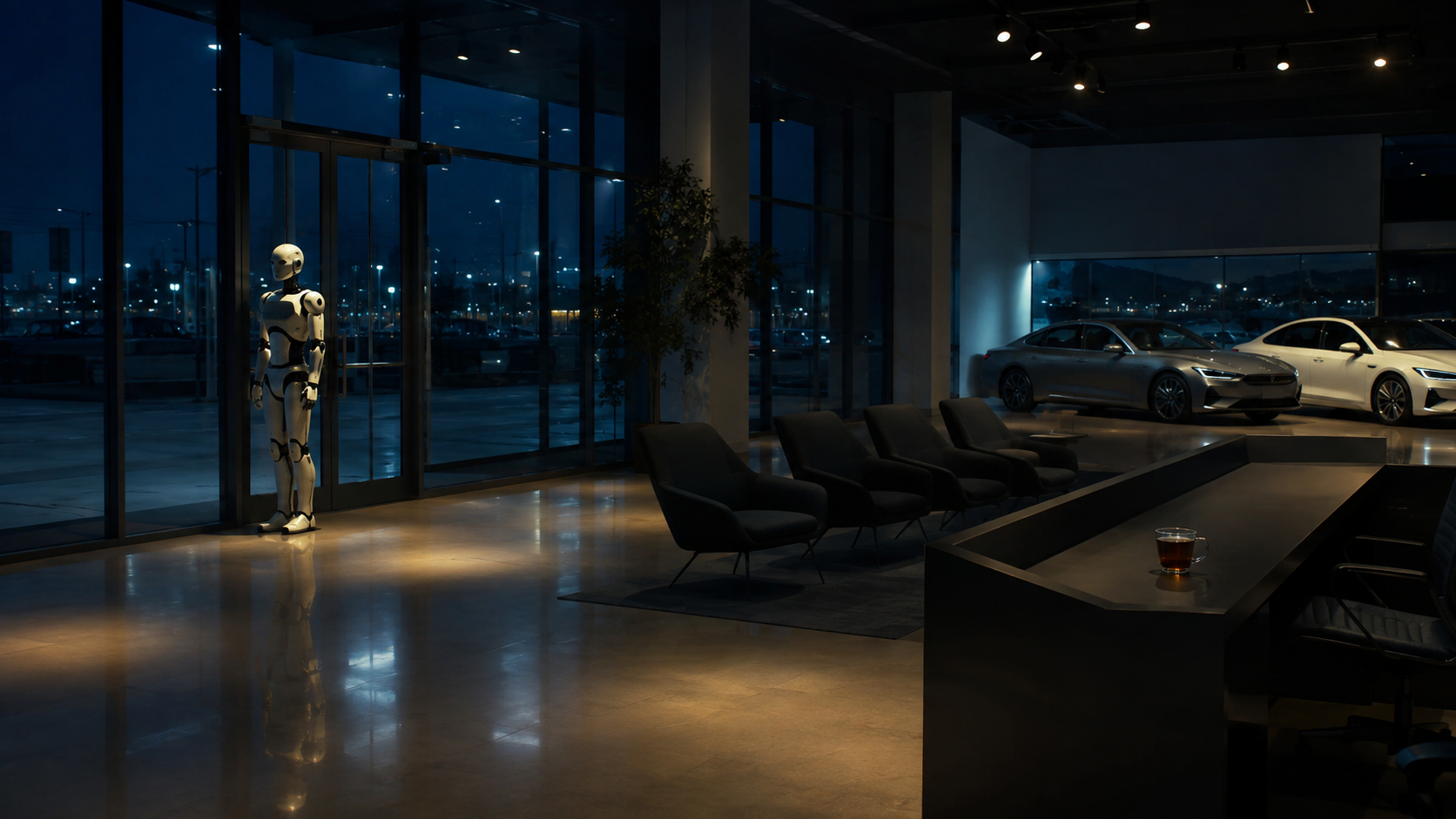
It showed up with specs anyway. Xiao Di — 小迪, roughly “Little Di” — stands 1.61 metres, weighs 58.5 kilograms, and carries 31 degrees of freedom. Seven of those are in each hand. The published capability list runs to multimodal interaction, facial and gesture recognition, 360-degree vision, and two-way translation across six Chinese dialects and six foreign languages.
Read that as a job description rather than a spec sheet and it snaps into focus. There is nothing in it about lifting, carrying, torque, payload, or surviving an eight-hour shift beside a stamping press. Every single line item is about talking to a stranger who has just walked through a door. BYD did not build a factory worker who can also chat. It built a receptionist who happens to have legs.
The reassurance is the tell
Executive vice-president Stella Li has been consistent about the deployment plan: two to three robots in every BYD store, greeting customers, explaining models, demonstrating in-car functions. She expects robot sales advisors to be ready for real-world use within the next year or two.
She also said, unprompted, that robots cannot replace the emotional connection between human salespeople and customers.
That sentence is the most informative thing anyone at BYD has said about this product. Nobody issues a public reassurance that a welding cell won’t replace the emotional connection between a welder and a chassis. You only pre-emptively deny a substitution when the substitution is the obvious reading. The denial is not a lie — a machine that has been on the floor for a week probably does sell fewer cars than a good salesperson. It is simply a statement about this year, delivered by a company that thinks in decade-long cost curves and has never once lost an argument about manufacturing scale.
The showroom is the easiest hard problem
There is a reason the first humanoid from the world’s largest EV maker is pointed at retail rather than production, and it isn’t sentiment.
A car plant is a brutal environment for a humanoid: heavy parts, tight cycle times, safety certification, and a failure mode that involves someone’s hand. A showroom is climate-controlled, flat-floored, and scripted. The tasks are the same forty questions in rotation. The customers are forgiving, and slightly delighted, and filming. When the robot fails, the failure is an awkward pause, not an incident report.
So the showroom is the beachhead — the place where a machine that isn’t good enough to work can still be good enough to be deployed, at scale, immediately, while the manufacturer collects a few million real-world interactions to train on. That is also, incidentally, the pattern by which retail and front-of-house staff keep meeting automation years before the people the automation was theoretically built for.
Meanwhile the core business is doing fine without any of this. BYD delivered 419,211 vehicles in July, up 21.76% year-on-year, with overseas sales of 179,841 units — a 124.3% surge — carrying a domestic market that slipped about 9%. Chery’s Aimoga brand is already selling humanoids to consumers; SAIC-GM has wheeled humanoids on battery assembly lines; Xpeng plans mass production of its Iron humanoid by year end. Every Chinese automaker is now also a robotics company.
Tesla has spent five years trying to build Optimus a job on the factory floor and has yet to ship one. BYD skipped that argument entirely and gave its robot the one job a humanoid can actually hold today: standing near the door, being pleasant, and learning.
Sources
- BYD confirms plan to unveil humanoid robot in August (CnEVPost, July 28, 2026)
- BYD may unveil humanoid robot in early August, teaser suggests (CnEVPost, July 26, 2026)
- BYD’s Humanoid Robot Steals the Show as Export Engine Powers a Third Consecutive Sales Gain (ad-hoc-news, August 2, 2026)
- BYD’s humanoid robot to begin work at D Space facility in August (KrASIA)
- BYD to debut first humanoid robots in August as rivalry with Tesla intensifies (South China Morning Post)