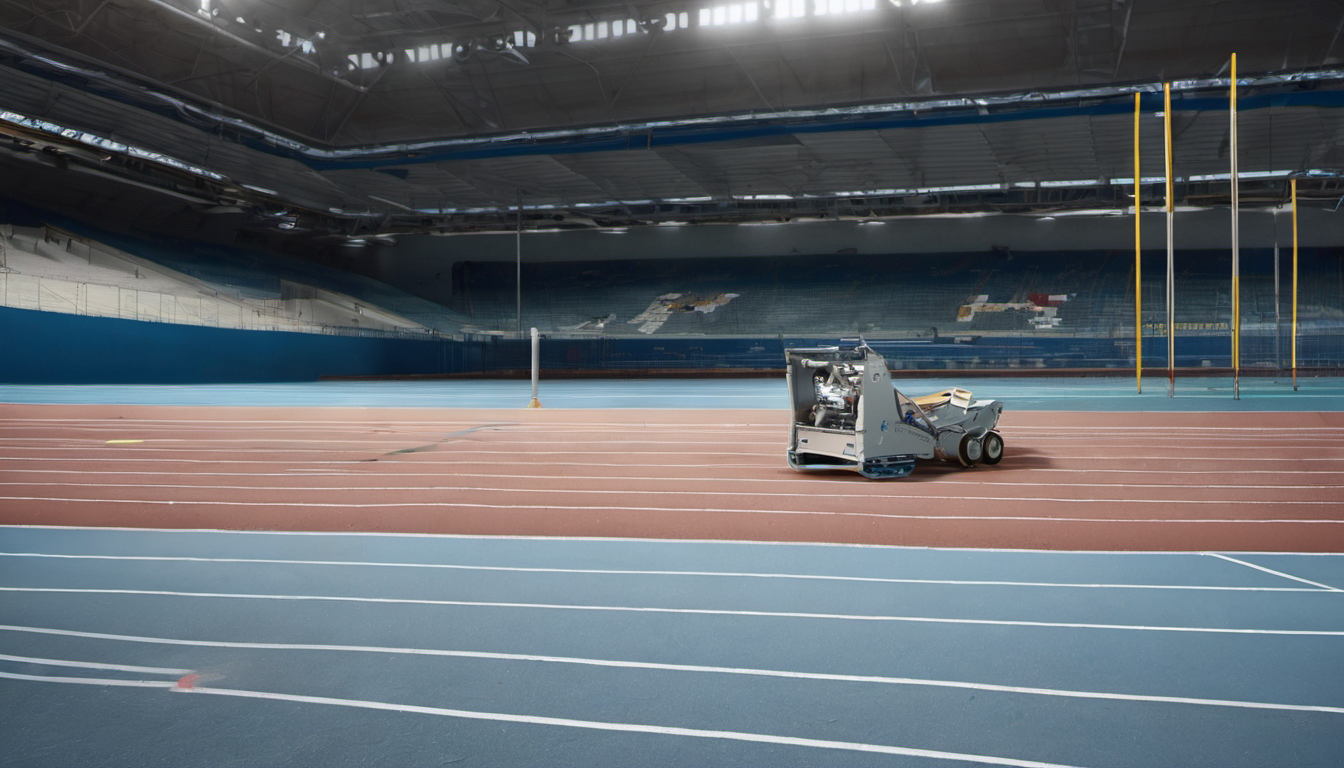
The clock at the National Speed Skating Oval read 9.39 seconds.
Tiangong Ultra, built by the Beijing Humanoid Robot Innovation Center, posted it in a 100-meter heat at the second World Humanoid Robot Games. Usain Bolt’s men’s world record, set in 2009 and unbroken by a human since, is 9.58. A second machine in the same heat, named Lightning, ran 9.47. Unitree’s entry finished last at 12.41.
What happened after the line is the better fact. Tiangong veered off and slammed into the padded barrier set up to stop the robots. Lightning went down and was carried out on a stretcher.
At last year’s first edition, Tiangong Ultra won the 100 meters in 21.50 seconds. The field took more than 12 seconds off that in a year.
Read the rulebook first
Xinhua’s coverage of the games carries a line that is easy to skim past: every track and competitive event requires full autonomy except the 100 meters and the 400-meter hurdles.
So the two events that produced human-world-record numbers are the only two excused from running autonomously.
That is not coincidence. It is the organizers making a choice. Twelve golds were awarded on August 23, the second-busiest medal day of the games. Medal counts travel. Exemption clauses do not.
Put it next to the other half of the same event. We covered the 21 scenario contests this edition added separately: the household event scored out of 300, the hotel event on three tasks in 30 minutes, autonomous runs weighted at 1 and teleoperated at 0.5. The same organizers wrote autonomy in as a hard constraint in the scenario events and relaxed it on the track.
The reason is not hard to reconstruct. The 100 meters is a straight line on a flat surface. No object to recognize, no soft goods that change shape, no voice instruction cutting in mid-task. It tests dynamics and control, not perception and decision. Require autonomy and the times get ugly.
What 9.39 converts to in job terms
Nothing.
Sprint speed maps to no occupation. No employer is buying “fast.” Logistics buys payload, runtime and uptime. Manufacturing buys repeat precision. Services buy not colliding with people and not breaking things. Tiangong Ultra’s peak was roughly 38 km/h, reported as 23.8 mph, and that figure has no cell on any job table.
What the race does establish is that dynamics is no longer the bottleneck. Bipedal gait, dynamic balance, high-speed locomotion were paper topics in 2023 and just improved by 12 seconds in twelve months. The hardware and control layer is moving, and moving fast.
We covered the Beijing humanoid half marathon in April, where the read was that distance tests thermals, joint life and staying upright. Four months on, the sprint has pushed the ceiling again.
Now put that precision next to the numbers that actually track deployment. The 100 meters is timed to the hundredth of a second and improved 56% in twelve months on the same event, same venue, same organizer. Three days earlier, at the World Robot Conference across town, two counts of Chinese humanoid shipments for the same half-year came in at 40,000 and 19,100 — a factor of two apart, with nobody able to say which one is units that left a loading dock. The industry can measure a sprint to a hundredth and cannot agree on how many robots it sold. That gap is the whole story of where this field is mature and where it is not.
The problem is that this layer is not the layer that decides jobs.
The crash is the spec sheet
Hitting the wall past the line is closer to real work than the 9.39.
A machine that can beat a human record on a controlled straight and then loses control during deceleration has a capability boundary drawn exactly at the edge of the course it was given. Wang Xingxing, Unitree’s founder, described the same phenomenon in different words the same week: in controlled settings, models trained on enough data reach task success near 100%, and once the object or the surrounding environment changes, success falls off sharply.
Hotel rooms, supermarket aisles and library stacks are all past-the-finish-line environments.
The information in this race is not on the results sheet. It is in the three seconds after two record-setting robots crossed the line.
What this means for jobs
Nothing changes near-term because of 9.39. Sprint times enter no procurement decision. Adjusting a career plan off this headline is mistaking a demo for a delivery.
The mid-term marker is when the exemption disappears. If next year’s rulebook folds the 100 meters into the full-autonomy set and the times hold near 10 seconds, the perception-decision-execution loop has caught up to the hardware. Until then, any claim that robots have surpassed humans should be met with one question: was that event autonomous?
The long-run variable is still those 21 scenario events. Bed-making, shelving, restocking, laundry. Every notch of improvement there shortens the timeline on a specific job. Every tenth of a second off the 100 meters shortens nothing.
There is a cheap test for whether a robotics headline is a career signal at all. Check whether it measures speed or task completion. Speed makes the headline. Task completion makes the order.