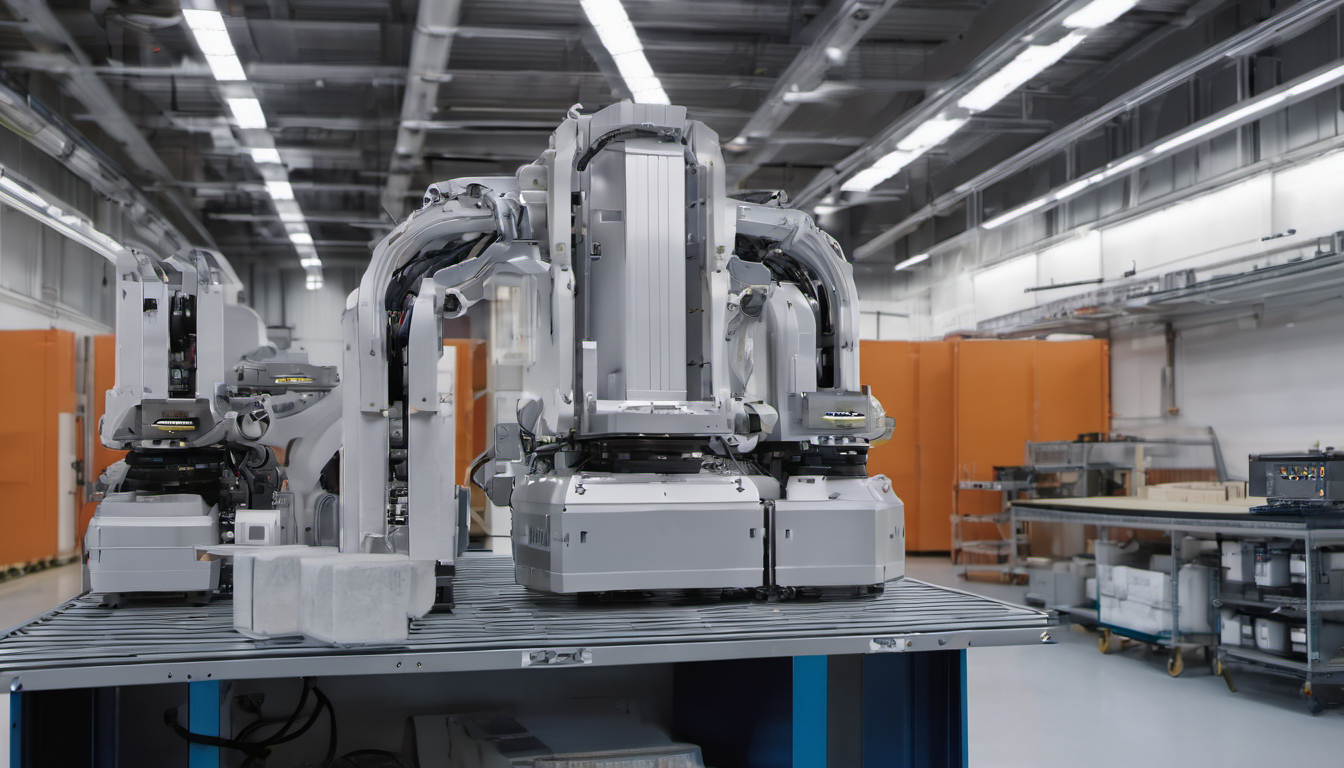
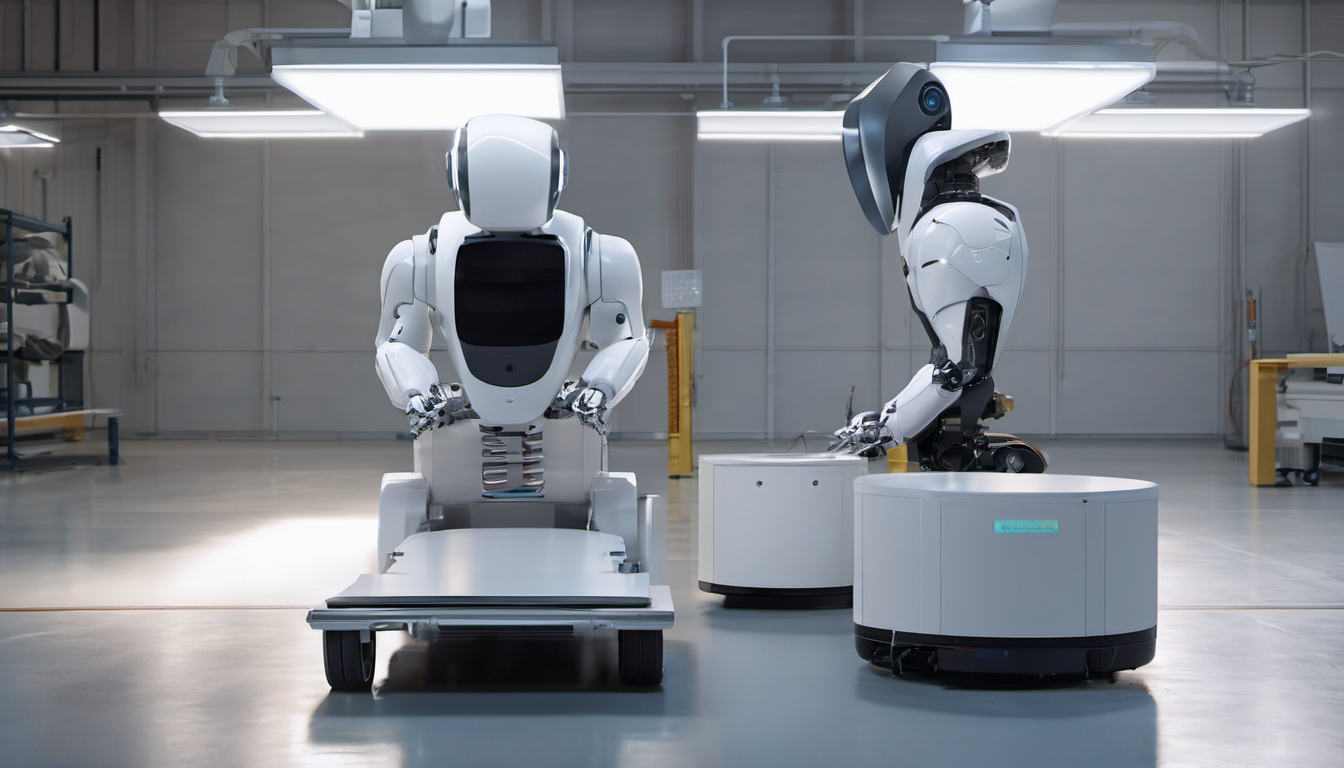
On September 18, Toyota named a number no automaker has approached: 400,000 in-house-developed robots across 60 plants worldwide, arriving progressively from 2028. The company put an estimated ¥1 trillion a year against it, roughly $6.4 billion annually, covering plant renovation and robot deployment across the full group. Toyota’s own operations take 150,000 units; group affiliates split the remaining 250,000.
The robot doing the work is ELEY, short for Embodied Learning Robot for Enhanced Yield. It weighs 50 kilograms, rolls on wheels instead of walking, and grips with two fingers instead of a full hand. Toyota skipped bipedal locomotion entirely. The reason traces back to a decade of scar tissue with ELEY’s predecessor.
Why wheels beat legs, according to Toyota’s own failures
That predecessor was the Human Support Robot, or HSR. Toyota researcher Toshihide Yamada wrote a technical account in March describing what kept going wrong: the HSR’s arm struggled the moment it met unexpected external force, and even a slight positional deviation could damage the joint or stall the machine outright. In a real factory full of humans and objects, contact is constant and unpredictable, and that failure mode shows up on the clock, not in a lab.
ELEY’s fix is an actuator design called quasi-direct drive, or QDD. A standard industrial joint pairs a fast motor with a high gear-reduction ratio: compact, strong, and rigid. Hit it with an unplanned force and it fights back, sometimes hard enough to break. QDD inverts the ratio, pairing a high-torque motor with a low 10:1 reduction, which buys what engineers call backdrivability: the joint yields to contact instead of resisting it. Toyota’s engineers also added a scapular axis the HSR never had, the shoulder-blade joint humans rely on to reach, push, or twist a lid. ELEY’s proportions are sized to an average adult Japanese male, on the logic that a robot learning by watching people needs a body close enough to theirs that the motion actually transfers.
The learning system behind ELEY comes from Toyota Research Institute, the company’s US-based arm in Los Altos and Cambridge, a separate operation from the Frontier Research Center in Japan. TRI calls its framework a Large Behavior Model, built on Diffusion Policy, a method it co-developed with Columbia University and MIT researchers including Russ Tedrake. The technique treats action generation as denoising: start from random noise, condition on what the camera sees, and iteratively refine toward a coherent movement. That structure naturally represents more than one valid way to do a task, weighted by probability. A person doesn’t fold a shirt identically twice either.
In practice, workers wear jigs shaped like ELEY’s hands while doing their normal jobs, and the robot’s cameras build a behavioral model from watching. At Toyota’s European headquarters in mid-September, ELEY folded T-shirts convincingly after 1,500 practice runs over two weeks. The scaling bet is a shared training network: a skill learned once in Japan would, in theory, propagate to a robot in Kentucky without repeating the two-week practice cycle. Every success and failure feeds back into one dataset across all 60 plants at once.
Toyota’s own engineers name three unresolved problems. First, reliability across a full shift: an hour of clean demo performance says nothing about eight, ten, or twelve continuous hours. Second, repeatability of end-effector positioning. Researchers at the University of Virginia have documented that diffusion-based policies compound errors and extrapolate poorly outside their training distribution, meaning a slight lighting change or a part sitting a few degrees off can throw off a learned motion. Third, the data infrastructure itself: collecting, validating, versioning, and distributing model updates across hundreds of thousands of machines at 60 sites is a system that doesn’t exist yet at that scale. That’s a data-readiness problem before it’s an AI-sophistication one.
A different number, a different bet than Hyundai’s
Set 400,000 against the field and the gap is not close. In May, Hyundai told JPMorgan investors it would deploy 25,000 Atlas humanoids across Hyundai and Kia plants, with 30,000-unit annual production capacity and 300,000 US-made actuators a year by 2028. At the time, that was the most aggressive single-OEM commitment in the industry. Toyota’s number is 16 times that.
The two companies are also making opposite bets on where value sits. Hyundai bought Atlas’s maker, Boston Dynamics, and is deploying a bipedal humanoid built by that subsidiary. Toyota designed ELEY itself, runs it on its own LBM framework, and owns the full stack from actuator to policy. BMW picked a third model entirely: it rented Figure AI’s hardware by the hour, running Figure 02 through 11 months and roughly 30,000 X3 builds at Spartanburg before rotating in Figure 03 for logistics sequencing. Buy the finished robot, rent the robot-hour, or build the entire stack in-house: those are the three postures the humanoid industry has now actually tried at scale, not just announced. Toyota’s is the riskiest one, and if the LBM approach transfers cleanly across 60 sites, it’s also the one with the most reusable upside: a training method that generalizes beyond car plants into logistics, healthcare, or any other domain built on physical skill.
What the 400,000 is actually for
Toyota has been explicit that the ¥1 trillion figure is an estimate, not a commitment, and that it covers group-wide plant renewal, including equipment replacements, not a clean net addition of robotic labor. The genuinely new headcount-displacing capacity inside that 400,000 will run considerably lower than the headline number.
What Toyota says it’s actually protecting is harder to quantify and, on its face, less about cost. The company employs roughly 18,000 takumi, master craftspeople who’ve spent careers on a single technique: fine-seam welding, tactile sheet-metal inspection, precision paint application. That knowledge doesn’t transfer through a manual. It’s the kind of tacit skill philosopher Michael Polanyi described in 1958 as “we know more than we can tell,” and most of Toyota’s takumi are aging out faster than Japan’s shrinking labor pool can train replacements. ELEY’s entire training method, learning by observing rather than by code, is Toyota’s attempt to capture that skill before it retires with the people who hold it.
Toyota executive vice president Hiroki Nakajima has framed the goal as “coexistence, not replacement.” That line has already been tested once this year, by a different company’s union. Starting July 20, roughly 40,000 workers at Hyundai’s Ulsan complex walked out over a robot that won’t arrive on the floor until 2028, Atlas, costing an estimated 5,000 vehicles in lost production. What the union settled for on August 25 wasn’t a veto. It was an information-sharing clause. The 2028 deployment date never moved.
Toyota’s language is softer than Hyundai’s was going in, and “coexistence” is the framing it’s leading with. Whether that framing holds won’t be decided by the September announcement. It will be decided plant by plant, in 2027 and 2028, by how many welding, inspection, and paint jobs quietly become supervising ELEY instead of doing the work by hand.
What’s certain now is narrower. Over the next two years, Toyota runs this system inside real production conditions across 60 factories and converts every failure into training data. Whether 18,000 takumi’s worth of tacit knowledge is actually transferable to a machine, or only approximable, is not a question a T-shirt-folding demo answers. It gets answered on the floor, over years, in the details that don’t make it into a September press cycle.
Sources
- Automotive World: Toyota plans to deploy 400,000 factory robots from 2028 (2026-09-18)
- Tech Times: Toyota Bets 400,000 Robots Can Capture Craftspeople Skills That Took Decades to Build (2026-09-19)
- Toyota Global Newsroom (Frontier Research Center): technical account of ELEY’s design (March 2026)
- Seoul Economic Daily: Toyota to Deploy 400,000 Humanoid Robots at Plants Worldwide (2026-09-19)