The last time we wrote about Agility Robotics was September 7, the day its S-4 hit EDGAR. That filing put the first public price on a warehouse humanoid: about $8,500 a month. The price was new. The machine was still Digit 4.
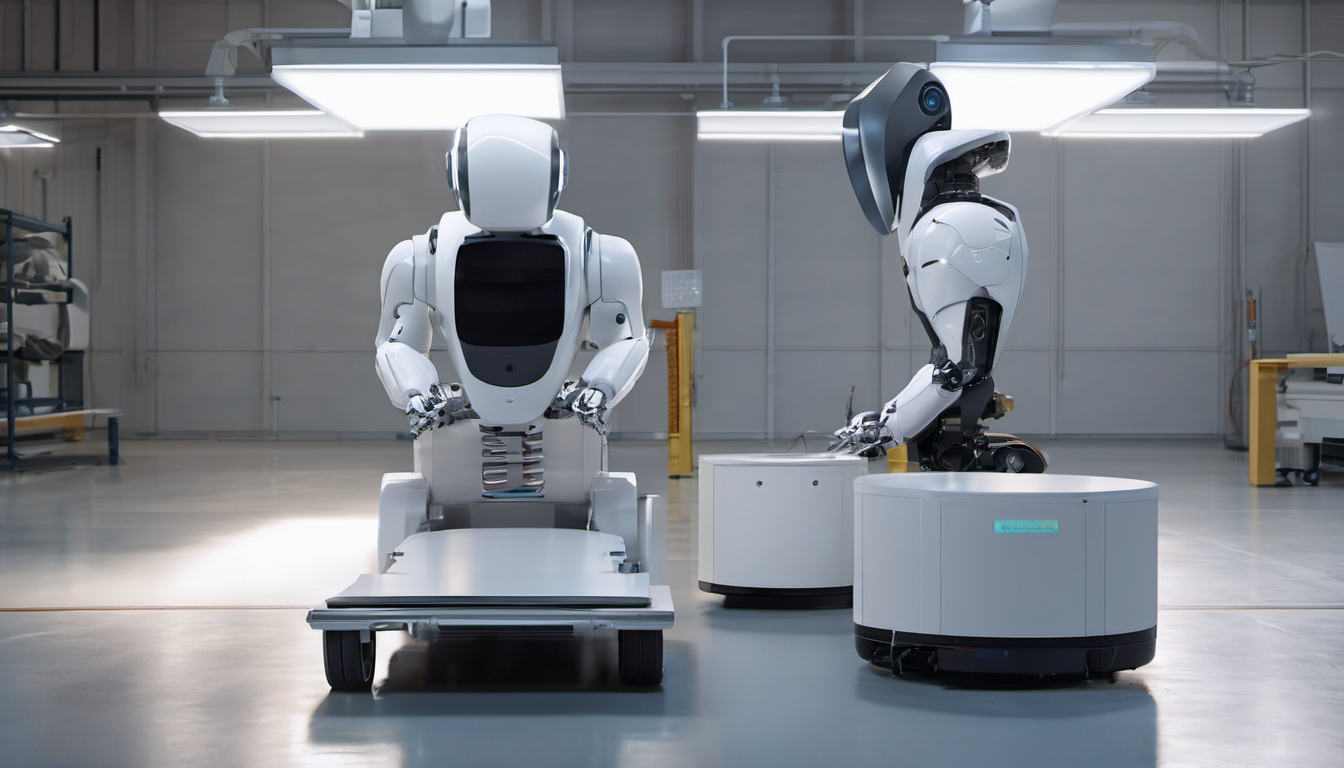
On September 15 the machine changed. Agility unveiled Digit 5 while the company walks toward a public listing through a SPAC merger with Churchill Capital Corp XI.
The company lists three changes: legs, batteries, safety architecture. The third one is the story. Agility told The Robot Report that Digit 5 can work in close proximity to people without physical safety barriers.
Fifty pounds is a regulatory number
The most visible change is the legs. Digit 4’s backward-bending ostrich knees are gone, replaced with forward-bending human-style legs.
Jonathan Hurst, co-founder and chief robot officer, explained the trade. The old configuration was tuned for walking and running well. The new one is tuned for lifting heavy things and getting up and down off the ground repeatedly. Proprietary cycloidal actuators drive the new legs, and they let Digit repeatedly lift up to 50 lb, or 22.7 kg.
That figure was not chosen for a spec sheet. Hurst said the band covers single-person lift tasks in OSHA-regulated facilities. American warehouses and plants sort material handling into two buckets: what one worker may lift alone, and what requires a second worker or a machine. Digit 5 aims at all of the first bucket.
The robot also grew. It weighs 284 lb (129 kg), stands 5 ft 11 in (1.81 m), and reaches 7.2 ft (2.2 m), up from Digit 4’s 5.5 ft. The knees carry padding so it can kneel, and the legs fold into a stable seated position.
Ninety minutes of work, nine minutes of charge
The second number is power.
Digit 5 gets a faster autonomous charger. It runs 90 minutes and charges fully in nine. Agility calls that a 10:1 run-to-charge ratio, against 2:1 for Digit 4. On that curve the robot clears more than 20 working hours in a 24-hour day.
That lands on top of the arithmetic we ran on September 7. The S-4 quoted a daily run-time spec, we discounted it hard for realistic utilization, and one robot still came out a bit over two human work-years. At the time that spec was a line in a filing and nothing else. It now has a charge curve underneath it.
The cage is what actually moved
The humanoids being trialed in industrial facilities right now almost all work inside roped-off areas, far from any person. Not because they cannot do the work. Because nobody will let them near a body.
Agility says Digit 5 does not need the rope. The robot carries proprietary AI and multiple sensor technologies that continuously monitor for people across a 360° radius. As someone approaches it evaluates the risk, slows, and stops. There are no defined zones; it decides behavior from the situation. If it has to, it sits down on the ground and cuts power to its motors. Hurst gave the underlying rule: the robot has to be in a statically stable posture with its motors off before a person can touch it.
On safety generally, he ruled out a single fix. “It is not possible to take an existing robot, add a safety hat on it, and then have it operate safely,” Hurst said. It touches electrical, mechanical, sensing and compute, all of it.
He also drew a line worth keeping. One kind of safety is a personal opinion about how safe a robot seems. The other is the industrial standard and the regulatory process that keeps third parties who know nothing about the technology from getting hurt. Digit 5 is being built for the second one.
The robot uses visual and auditory cues to signal intent. Behind all of it sits an independent safety controller that fires when a person crosses an unsafe distance.
The hand is still two fingers
On manipulation, Agility’s answer is unglamorous.
“One thing we learned is that general-purpose hands don’t exist. There are none on the market. There are none coming soon. There are hands that look like a human hand, but they’re not very good,” Hurst said.
The company runs a two-fingered gripper, and took its cue from Cybathlon. Hurst noted that the winner of the last two years, the most dexterous artificial manipulator on the planet by that measure, was a single-degree-of-freedom parallel-jaw gripper with one rotation at the wrist. It beat a field of five-fingered hands.
“No hand that exists on the market can pick up 25 kilogram bins and do complex manipulation with them, but our manipulator can,” Hurst said. Digit 5 takes swappable end-effectors on ISO-standard mounting flanges, and Hurst added that if somebody else builds a better one, they will buy it and bolt it on.
From totes to the whole workflow
Across more than two years of commercial deployment, Digit 4 did essentially one job: tote-based material handling.
Digit 5 is being sold against a whole facility. Agility’s list runs to six tasks: depalletizing goods on arrival, machine tending, kitting, sequencing, quality inspection as items move through, and palletizing for shipment.
Read that list next to a story from five days earlier. On September 10 we covered Maven, eight wheeled dual-arm robots running mixed palletizing in one large consumer-goods warehouse, 30 kg per arm pair, 16 hours a day. Maven’s founder was blunt about legs at the time, calling them pointless for the work, complex and unreliable. The two approaches now target the identical stations: depalletize, palletize, tend the machine.
Agility is also taking Digit outside North America for the first time, starting with the European Union and the United Kingdom, and expects Digit 5 to carry a CE mark plus additional regulatory marks. Early access opens in the first half of 2027, with general availability for manufacturing, warehouse and distribution operators by the end of 2027.
Which weight band is exposed
Digit 5 is not aimed at “warehouse work.” It is aimed at a legally bounded subset of it: the load one person may lift alone. Order selectors, case pickers, machine tenders and inbound/outbound visual inspectors spend most of their day under 50 lb.
Losing the barrier changes deployment density, which is the constraint that has actually capped these programs. A caged humanoid needs floor area, a rerouted traffic pattern, and its own safety assessment, which is why pilots stall between a handful of units and a few dozen. Sharing an aisle removes that ceiling.
The timing is specific. Early access in the first half of 2027, general availability by the end of 2027. The first fiscal year in which an operator could budget headcount against a Digit 5 shift schedule is 2028.
What stays safe for now is what two fingers cannot hold. In August we quoted Locus’ head of grasping on the split: suction and simple grasping cover 60-70%, and the remaining 30-40% needs tactile feedback and force judgment. The 50 lb ceiling is itself a line; above it the job still takes two people or a forklift.
One more thing to watch. In July, Agility hired a crew in Fremont specifically to teach Digit warehouse work. The skill list just went from one task to six. The number of people needed to teach it goes up, not down. That cohort’s job lasts exactly as long as it takes to fill the list.